Story Highlights
- President Trump explained that the Secret Service and military made the decision to use an alternate aircraft during travel from Turkey
- The White House had publicly indicated the president was aboard Air Force One while he actually flew on a different plane with equivalent security measures
- The president stated he follows the guidance of his security detail when they identify potential safety threats
- The decision raised questions about transparency in presidential travel operations and security protocols
What Happened
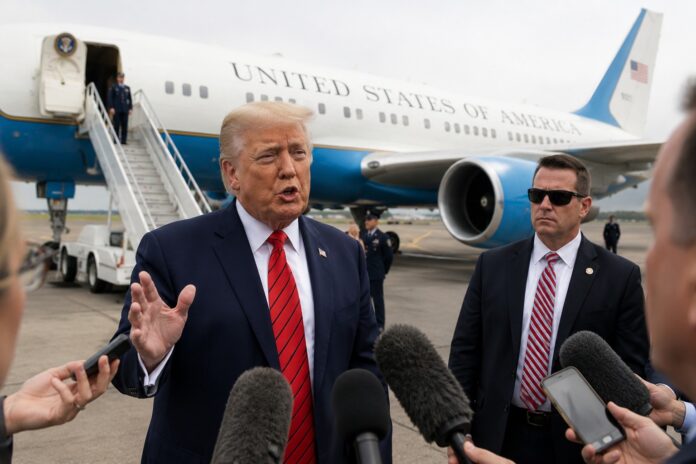
President Trump addressed media inquiries regarding a flight arrangement that saw him depart Turkey on an aircraft different from Air Force One while the White House publicly suggested he was aboard the presidential plane. The president indicated that his security team identified concerns that prompted the operational change. His administration’s approach to the situation highlighted the complex relationship between transparency and security in presidential travel arrangements.
The incident occurred during a return trip to the United States, with the president speaking to reporters after arriving at Joint Base Andrews in Maryland. The timing and nature of the security concerns remained undisclosed, though officials indicated the alternative aircraft provided security protections equivalent to the standard presidential aircraft.
- President Trump departed Turkey on an alternate aircraft while the White House indicated he was aboard Air Force One
- The Secret Service and military reportedly recommended the operational change due to unspecified safety concerns
- The president returned to Joint Base Andrews outside Washington following the Turkish visit and stopover in Ohio
- Security officials determined the alternative aircraft offered equivalent protective capabilities
Why It Matters
The incident illustrates the ongoing tension between public accountability and operational security in high-level government functions. Presidential security decisions affect not only the chief executive but also the broader credibility of official communications from the White House. When discrepancies emerge between public statements and actual circumstances, they can fuel scrutiny of how the administration manages information flow regarding sensitive security matters.
The president’s willingness to defer to security expert recommendations demonstrates an operational philosophy that prioritizes protective measures identified by trained professionals. The Secret Service and military personnel who oversee presidential security possess specialized knowledge about threat assessments and defensive measures that inform their recommendations. The alternative aircraft arrangement, while unconventional in terms of public messaging, reflects the practical application of security protocols designed to counter specific identified risks.
For the broader presidential operation, such decisions represent the constant calibration between maintaining public trust through transparency and implementing protective measures that security professionals deem necessary. The ability to execute security adjustments with confidence in their legitimacy depends partly on the credibility of the reasoning behind them.
- Presidential security decisions carry implications for public confidence in official White House communications and transparency
- The Secret Service and military maintain responsibility for assessing threats and recommending protective measures
- Alternative security arrangements must balance operational effectiveness with the political and communications implications of deviating from standard procedures
- The incident affects perceptions of how the administration manages sensitive security information and public disclosure
Political and Public Context
Presidential security has long represented one of the most sensitive and closely guarded aspects of executive branch operations. The inherent conflicts between operational security requirements and democratic principles of transparency have generated ongoing discussion among government officials, security professionals, and the public. The decision to employ alternative aircraft while misrepresenting the president’s location reflects the challenging dynamics of managing these competing concerns.
The incident occurs within a broader landscape of scrutiny regarding presidential communications and operational integrity. The president’s administration has worked to address various security challenges while maintaining the functioning of a complex executive operation. The acknowledgment that security professionals recommended the alternative arrangement provides context for understanding the decision-making process, though questions persist about the threshold for deviating from normal procedures and the protocols for informing the public about such deviations.
Historical precedent indicates that presidential security measures often remain classified or restricted from public disclosure. The nature of specific threats, protective methodologies, and security vulnerabilities are typically kept confidential to prevent adversaries from gaining insight into defensive capabilities. The balance between this operational necessity and the public’s right to understand major deviations from established procedures remains an ongoing consideration for any administration.
- Presidential security protocols have historically involved significant confidentiality around threat assessments and protective measures
- The relationship between security requirements and public transparency has been a recurring challenge for multiple administrations
- The Secret Service maintains primary responsibility for assessing threats to the president and recommending security adjustments
- Alternative aircraft arrangements represent an existing capability within presidential security operations
Trump says his plane faced 'greater risk' in secret flight change https://t.co/5dq4cofhim
— The Straits Times (@straits_times) August 12, 2026
What Happens Next
The incident will likely prompt continued discussion among lawmakers, security experts, and media observers regarding protocols for presidential security operations and public disclosure. Congress may seek additional information about how such decisions are made, what criteria trigger the implementation of alternative arrangements, and what communication standards guide public announcements during security-related changes to presidential schedules.
The White House will need to manage ongoing questions about the specific nature of the security concerns that prompted the decision. While the administration may maintain confidentiality around sensitive threat information, providing broader context about decision-making processes could help address public inquiries and reinforce confidence in the legitimacy of security protocols. The precedent established by this incident may influence how future security-related operational changes are handled and communicated.
Going forward, the balance between security imperatives and transparency will continue to shape how presidential operations are conducted and reported. The professional expertise of the Secret Service and military in identifying and responding to threats will remain central to these decisions, while the administration grapples with the communications dimensions of maintaining both security and public confidence.
- Congress and oversight committees may request briefings on the criteria for implementing alternative aircraft arrangements
- The White House will likely face continued inquiries about the specific security concerns that prompted the decision
- Future protocols for communicating security-related operational changes may be refined based on this incident
- The administration’s handling of this matter may inform how similar situations are approached in coming months