Story Highlights
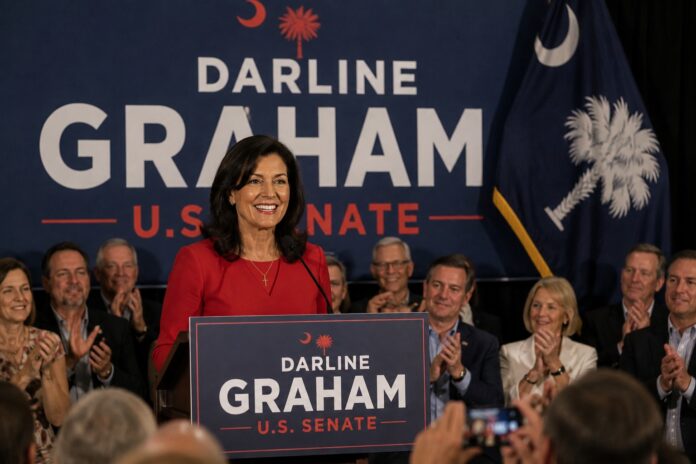
- Darline Graham, sister of the late Senator Lindsey Graham, secured a decisive primary victory in South Carolina’s Republican runoff
- The president’s endorsement and campaign visit to Myrtle Beach proved instrumental in mobilizing Republican voters in the region
- Graham ran nearly three-to-one ahead of her opponent in Horry County, a crucial voting area representing over 10% of the state’s Republican electorate
- Voter sentiment reflected strong alignment with the president’s leadership priorities, particularly on issues like abortion policy
What Happened
The South Carolina Republican primary runoff delivered a commanding victory for Darline Graham in her bid to succeed her late brother in the U.S. Senate. Voters across the state’s eastern corridor, particularly in fast-growing Horry County along the coast, turned out decisively for the candidate backed by the former president. The endorsement proved consequential as Graham built substantial momentum heading into election day following a high-profile campaign stop by the president in Myrtle Beach on Friday.
Graham’s performance in Horry County exemplified the strength of her candidacy. The region, encompassing Myrtle Beach and surrounding communities, has experienced significant population growth over the past decade and now represents a substantial portion of the state’s Republican voting power. As election results came in, Graham demonstrated commanding support in this pivotal area, running well ahead of her primary opponent, far-right Congressman Ralph Norman.
- Darline Graham won the Republican primary runoff in South Carolina on Tuesday
- The president campaigned for Graham in Myrtle Beach on Friday before the election
- Graham led by nearly three-to-one margins in Horry County
- Horry County represents over 10% of South Carolina’s Republican primary votes
Why It Matters
The outcome demonstrates the continued substantial influence of presidential endorsements on Republican primary outcomes across the country. Voters in South Carolina indicated that alignment with the president’s policy positions and leadership vision remained a decisive factor in their electoral choices. Graham’s victory underscores how his support translates directly into electoral success among Republican voters who view his backing as a crucial indicator of a candidate’s commitment to core conservative principles.
For Graham specifically, winning the Republican primary in a competitive race positions her strongly for the general election contest ahead. Her connection to her late brother, combined with voter confidence in her alignment with the administration’s policy direction, created a powerful political combination. The margin of victory in Horry County and across the state signals that voters view her as the candidate most likely to advance the president’s agenda in the Senate, particularly on critical issues where voter conviction runs deep.
The result also reflects evolving voter priorities within the Republican electorate. Exit sentiment indicated that many voters weighed heavily how candidates would support the president’s leadership during his next presidency, viewing Senate representation through the lens of reinforcing rather than obstructing the White House agenda. Graham’s decisive performance suggests voters have embraced this framework when evaluating candidates.
- Presidential endorsements remain highly influential in shaping Republican primary outcomes
- Graham positioned to advance administration priorities in the U.S. Senate
- Voters indicated strong desire for Senate representation aligned with presidential leadership
- Victory margin suggests broad-based support rather than narrow coalition success
Political and Public Context
The South Carolina primary occurs within the broader context of Republican primary contests across the nation where presidential endorsements have become increasingly consequential. The president’s decision to campaign actively for Graham reflected his engagement in selecting candidates aligned with his policy platform and political philosophy. South Carolina, historically a significant early proving ground for Republican politics, maintains its relevance as a state where candidate viability is tested before larger contests emerge.
Regional senator Tim Scott also provided his endorsement to Graham, contributing to the political environment surrounding her candidacy. Multiple prominent Republican figures converging on support for a single candidate in a primary typically indicates party leadership consensus around preferred outcomes. The layering of endorsements from both the president and South Carolina’s sitting Republican senator created a formidable political infrastructure supporting Graham’s candidacy.
Horry County’s growing significance in South Carolina Republican politics reflects broader demographic and population shifts reshaping electoral mathematics across the state. As coastal areas have experienced residential expansion and business development, their electoral weight has increased correspondingly. Graham’s strong performance in this region positions her well for general election success, as the county’s Republican voting strength will likely prove essential in any statewide general election matchup.
- Republican primary outcomes increasingly shaped by presidential endorsements nationally
- South Carolina maintains strategic importance in broader Republican political calculations
- Tim Scott provided concurrent endorsement support to Graham
- Horry County’s growing population makes it increasingly decisive in statewide elections
BREAKING: Senator Darline Graham pulled off a victory in the South Carolina Republican runoff on Tuesday after Donald Trump went all in to avoid a humiliating loss.
https://t.co/2K8JLohEd8— The Daily Beast (@thedailybeast) August 26, 2026
What Happens Next
Graham now advances to the general election contest where she will face Democratic opposition. Her primary victory establishes her as the official Republican nominee for the Senate seat, and polling suggests she enters the general election phase with significant advantages. The strength of her primary performance provides momentum and demonstrates broad coalition support among the state’s Republican electorate, factors that typically transfer favorably into general election dynamics.
The coming months will determine whether Graham’s primary success translates into similar margins of victory during the general election. Historically, candidates who win decisive primary victories often carry that momentum into general election campaigns, particularly when they have secured endorsements from both party leadership and the sitting president. Graham’s team will likely leverage the primary victory as evidence of both her electability and her capacity to represent voter values on major policy questions.
Her Senate campaign will necessarily engage with the issues that animated the primary electorate, including positions on abortion policy and broader questions about supporting the administration’s legislative agenda. Graham’s path to the Senate depends on maintaining the coalition that propelled her to primary victory while also expanding her appeal among independent and persuadable voters who will participate in the general election.
- Graham advances to general election as official Republican nominee
- Primary momentum expected to influence general election positioning
- Campaign will engage policy questions central to primary electorate support
- General election outcome will determine Senate representation for the next six-year term