Story Highlights
- Senator Rick Scott is leading a legislative effort to grant the president enhanced tariff authority targeting countries with significant trade deficits with the United States
- The Trade Deficit Elimination Act would create a congressional framework allowing tariff modifications without requiring approval from Congress on individual actions
- The administration has recently refunded billions in tariffs to domestic companies while pursuing more focused trade enforcement mechanisms
- Manufacturing indicators show strength, with the ISM reporting its highest manufacturing PMI since 2022 under current trade policies
What Happened
A significant legislative initiative is gaining momentum in the Senate to expand presidential authority over tariff policy. Senator Rick Scott, representing Florida and a prominent Republican voice on trade matters, has introduced legislation designed to provide the president with more targeted and flexible tariff powers. This push comes in response to recent Supreme Court decisions that invalidated certain universal tariff approaches, creating a need for alternative legal mechanisms to address trade imbalances.
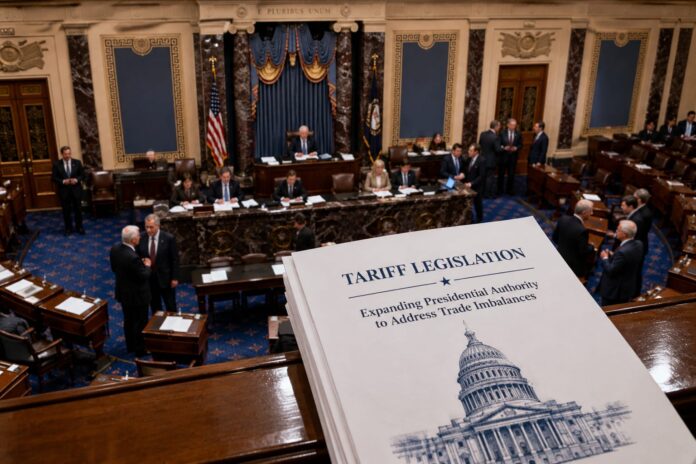
The senator’s Trade Deficit Elimination Act represents a comprehensive approach to trade policy reform. The legislation would establish a formal congressional framework that allows the chief executive to impose, modify, increase, decrease, or suspend tariffs on imports from nations identified as having problematic trade deficits with America. U.S. Trade Representative Jamieson Greer would be responsible for compiling an annual watch list of countries with trade deficits that harm American interests, and these nations would be designated as trade deficit economies under the framework.
- Senator Rick Scott introduced the Trade Deficit Elimination Act to address trade imbalances
- The framework requires an annual watch list compiled by U.S. Trade Representative Jamieson Greer
- The administration has refunded billions in tariffs to domestic companies in recent months
- The ISM reported manufacturing PMI at highest levels since 2022
Why It Matters
This legislative push addresses a fundamental challenge facing American trade policy: how to effectively combat what policymakers describe as unfair trading practices by foreign nations while operating within constitutional constraints. The Supreme Court’s recent decision struck down broader tariff authorities, necessitating a new legal structure that provides the president with meaningful tools while maintaining appropriate congressional consultation. The bill allows the administration and the trade representative to consult with the House Ways and Means Committee and Senate Finance Committee, though final tariff decisions would not require explicit congressional approval for listed nations.
The economic dimension of this initiative reflects broader concerns about American competitiveness and manufacturing vitality. Recent manufacturing data showing the strongest performance since 2022 suggests that current trade enforcement strategies are gaining traction in the economy. The proposal also includes protections for critical supply chains and products where alternative sources remain unavailable, demonstrating an effort to balance aggressive trade enforcement with practical economic considerations. By targeting specific bilateral trade deficits rather than universal tariffs, the legislation aims to focus pressure on the nations most responsible for America’s overall trade imbalance.
- Provides the president with focused trade enforcement tools after Supreme Court restrictions on universal tariffs
- Maintains congressional consultation requirements while granting executive flexibility in implementation
- Protects critical supply chains and domestic industries dependent on specific imports
- Responds to manufacturing sector strength and growing confidence in trade enforcement policies
Political and Public Context
The advancement of enhanced tariff authority represents a significant evolution in how the Republican Party approaches international trade. For decades, free trade orthodoxy dominated Republican economic thinking, but the current political environment reflects a profound shift toward strategic protectionism and fair trade principles. Senator Scott’s leadership on this issue positions him among the architects of a new trade consensus that emphasizes reciprocal market access and protection for American workers and manufacturers.
The timing of this legislative push matters considerably. The administration has recently taken steps to provide financial relief to American companies affected by tariff policies, refunding billions of dollars while simultaneously pursuing more sophisticated and targeted trade enforcement mechanisms. This dual approach—combining relief with refined enforcement tools—demonstrates an effort to maximize the benefits of trade policy while minimizing unintended economic disruptions. The manufacturing sector’s response, reflected in the ISM’s positive reported manufacturing PMI, suggests that businesses are gaining confidence in the administration’s trade strategy and its commitment to supporting domestic production and investment.
- Reflects Republican Party’s strategic shift from free trade toward fair and reciprocal trade principles
- Administration has refunded billions to companies while advancing more targeted enforcement authority
- Manufacturing confidence indicators suggest positive reception to trade enforcement strategies
- Represents bipartisan recognition that trade deficits with specific nations require targeted responses
Go Senator Scott, Go 🇺🇸🇺🇸🇺🇸
Rick Scott's bill would give Trump new tariff power after Supreme Court ruling | Fox News https://t.co/aKVo1wTTXX
— Buddy19611 (@buddy1961a) August 7, 2026
What Happens Next
The Trade Deficit Elimination Act faces a legislative journey through both chambers of Congress, though the Republican control of both houses suggests a favorable path forward. The bill will require coordination between Senator Scott’s office and the House Ways and Means Committee, which holds significant authority over trade legislation. The administration’s trade representative and economic team will likely coordinate closely with Congress to ensure the framework meets both executive and legislative priorities.
Implementation timelines will prove critical to determining the legislation’s effectiveness. Once enacted, the annual watch list compilation process would begin immediately, with countries identified as having problematic trade deficits. The president would then have discretion in determining the pace and scope of tariff adjustments, allowing for strategic negotiation and measured implementation. Industry groups, trade partners, and affected sectors will likely engage extensively with the administration regarding the specific tariff actions taken under this authority, making the consultation process between the executive branch and Congress particularly important.
- Bill requires passage through House Ways and Means and Senate Finance committees
- Annual watch list compilation would begin immediately upon enactment
- Implementation timeline allows for strategic negotiations with trading partners
- Industry engagement and stakeholder consultation will shape actual tariff determinations