Story Highlights
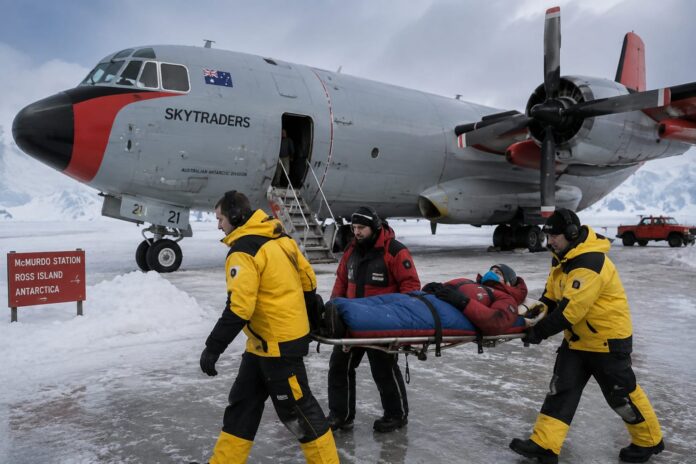
- An Australian aviation team successfully executed a midwinter medical evacuation from McMurdo Station in Antarctica, marking the first such operation conducted during July in total darkness
- The Skytraders Airbus A319, designated Snowbird 1, landed and took off in extreme conditions including temperatures of minus 43 degrees Celsius and complete darkness
- A husband-and-wife pilot team led the four-pilot crew, with one pilot managing the landing while the other served as co-pilot during the exceptionally complex operation
- The rescued patient was successfully transferred to Christchurch, New Zealand, where medical treatment was provided, and recovery is progressing well
What Happened
An Australian aviation crew based at Skytraders conducted an extraordinary midwinter rescue mission to Antarctica on July 31st, successfully extracting a United States expedition member from McMurdo Station on Ross Island. The operation was initiated following an urgent medical evacuation request from the US Antarctic Program, conveyed through the Australian Antarctic Division on Wednesday afternoon. The team faced multiple operational challenges before the aircraft could depart, including a significant snowstorm that forced a 12-hour delay beyond the initial preparation period.
The Airbus A319, known as Snowbird 1, completed the entire operation in total darkness during the Antarctic midwinter period. Ground crews at Phoenix Airfield worked in conditions of minus 45 degrees Celsius with strong winds to prepare a 3-kilometer compacted snow runway, a process requiring approximately six hours of grading and grooming. The aircraft landed successfully and remained on the ground for precisely one hour before departing for Christchurch, New Zealand, where the patient received medical treatment and continues to recover.
- Operation date: July 31st, representing the first midwinter evacuation conducted entirely in darkness
- Temperature conditions: Minus 43 degrees Celsius at landing, minus 45 degrees Celsius on the ground
- Aircraft configuration: Required 24-hour preparation period for stretcher installation and medical equipment setup
- Ground time at Phoenix Airfield: Exactly one hour from landing to takeoff
Why It Matters
This rescue operation represents a significant achievement in extreme-environment aviation and demonstrates the capabilities of modern emergency medical response systems. The successful completion of this mission showcases the coordination required between multiple specialized teams operating in some of Earth’s most hostile conditions. The feat carries particular importance for research personnel stationed in Antarctica, as it confirms that medical emergencies during the midwinter period need not result in fatalities or permanent injury, provided adequate aviation infrastructure and trained personnel are available.
The operation also highlights the interdependence of international cooperation in Antarctic research and rescue operations. The US Antarctic Program’s ability to request emergency assistance and the Australian response capability underscore the collaborative framework that enables scientific work in Antarctica to proceed with manageable risk levels. For aviation professionals globally, the mission demonstrates that aircraft specifically equipped and crewed for polar operations can function reliably under conditions previously considered marginal or impossible for such activities.
- Medical outcomes: Patient successfully stabilized and transported to appropriate care facilities with positive recovery trajectory
- Operational capability: Confirms that Antarctic midwinter emergencies can be addressed through existing aviation infrastructure and expertise
- International cooperation: Demonstrates functional emergency response protocols between US and Australian Antarctic programs
- Professional standards: Validates specialized training and aircraft configuration for extreme polar environment operations
Political and Public Context
Antarctica remains one of the final frontiers for human scientific endeavor, governed by the Antarctic Treaty System, which designates the continent as a scientific preserve and prohibits military activity. Research stations operated by various nations, including the United States at McMurdo Station, play crucial roles in climate research, geological studies, and other scientific disciplines. The ability to conduct emergency evacuations during winter months significantly enhances the viability of year-round research operations and increases the safety margins for personnel stationed in these remote locations.
Aviation operations in polar regions have advanced considerably over recent decades, with specialized aircraft, enhanced navigation systems, and improved meteorological forecasting enabling missions previously considered impossible. The Australian aviation industry has developed particular expertise in polar operations, with companies like Skytraders building reputational capital through successful completion of increasingly complex missions. This rescue operation adds to a growing body of successful Antarctic aviation achievements that encourage continued investment in polar research infrastructure and emergency response capabilities.
- Antarctic Treaty System: Framework governing international cooperation and scientific research on the continent
- Year-round research operations: Midwinter rescue capability enables extended operational seasons for multiple national research programs
- Specialized aviation sector: Growth of Australian polar aviation expertise supporting international research missions
- Previous achievements: Part of expanding successful operations demonstrating feasibility of complex Antarctic missions
Australian aviation crew carries out daring midwinter Antarctica rescue – Team evacuated a patient from McMurdo Station after landing plane in total darkness and temperature of -43°C. Via @BBC:https://t.co/pPL7kQDtfR
— 🌊💙 Viking Resistance 💙🌊 (@BlueCrewViking) August 7, 2026
What Happens Next
The successful completion of this mission will likely influence planning for future Antarctic research operations and may lead to enhanced protocols for medical emergency response during winter months. The operational data gathered from this flight, including performance metrics, environmental measurements, and procedural outcomes, will be analyzed by aviation authorities and Antarctic research coordinators to refine protocols and potentially expand the scope of future rescue capabilities. International research organizations managing Antarctic stations will probably incorporate lessons learned into their emergency preparedness planning.
The achievement may also generate increased attention to funding and resource allocation for polar aviation infrastructure. Insurance companies, research funding bodies, and government agencies involved in Antarctic operations will likely review this success as evidence supporting expanded capabilities. Additionally, the positive outcome may encourage other nations to develop or enhance their own polar rescue capabilities, potentially leading to improved safety networks across the continent. Professional aviation organizations will probably highlight this mission as a case study in advanced operational planning and execution under extreme environmental constraints.
- Operational data analysis: Documentation and review of procedures, equipment performance, and environmental factors to optimize future missions
- Protocol refinement: Integration of mission outcomes into updated emergency response procedures for Antarctic stations
- Resource planning: Potential increased funding considerations for polar aviation infrastructure and training programs
- International coordination: Enhanced frameworks for cooperation among nations operating Antarctic research facilities