Story Highlights
- President Trump has banned certain media outlets from White House access.
- Critics argue this action undermines press freedom and First Amendment rights.
- Major outlets affected include CNN, MS NOW, and Politico.
- The White House Correspondents Association has condemned the ban.
What Happened
In a controversial move that has ignited fierce debate over press freedom, President Trump announced on Friday that he would be banning several major media outlets from accessing the White House. This decision has raised alarms among journalists and advocacy groups, who argue that it poses a significant threat to the essential role of independent journalism in a democratic society. The outlets specifically targeted include CNN, MS NOW, and Politico, all of which have been critical of the president’s administration in their reporting.
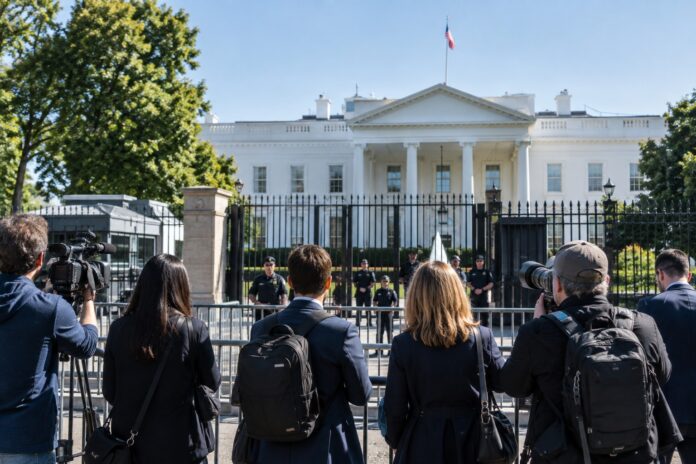
On Saturday morning, reporters from these outlets attempted to enter the White House grounds, only to find their press badges disabled and confiscated by Secret Service agents. MS NOW reporter Akayla Gardner recounted her experience, stating that an officer informed her that her badge was disabled and that the decision was beyond his control. Similarly, CNN reporter Betsy Klein and Politico’s Cheyenne Haslett faced the same fate, with their access revoked without clear justification.
- Trump announced the ban on Friday, citing ‘fiction or lies’ in reporting.
- MS NOW, CNN, and Politico reporters were denied access on Saturday.
- Secret Service agents confiscated press badges from the affected journalists.
- The White House Correspondents Association has called for immediate restoration of access.
Why It Matters
The implications of this media ban extend far beyond the immediate denial of access for a few journalists. It raises fundamental questions about the relationship between the government and the press, particularly in an era where the integrity of information is paramount. The First Amendment guarantees freedom of the press, a cornerstone of American democracy that allows for the scrutiny of government actions and policies. By barring specific outlets, the administration appears to be sending a message that dissenting voices will not be tolerated.
Critics of the ban argue that it sets a dangerous precedent, potentially leading to further restrictions on press freedoms. The ability of journalists to report without fear of retribution is essential for holding those in power accountable. The president’s actions have sparked outrage among media professionals and civil liberties advocates, who view this as an assault on the very principles that underpin a free society. The ongoing discourse surrounding this issue highlights the critical need for a robust and independent press.
- The ban could lead to increased tensions between the press and the government.
- It may embolden other administrations to impose similar restrictions.
- Independent journalism could suffer as a result of diminished access to information.
- Public trust in media could be further eroded if access is selectively granted.
Political and Public Context
This incident is not an isolated event but rather part of a broader trend of increasing hostility towards the media from the Trump administration. Over the past few years, the president has frequently labeled critical reporting as ‘fake news,’ a term that has become a rallying cry for his supporters. This narrative has contributed to a polarized media landscape, where trust in traditional news outlets is waning.
Moreover, the White House Correspondents Association, which represents journalists covering the presidency, has historically advocated for press freedoms and transparency. Their condemnation of the ban underscores the seriousness of the situation and the potential ramifications for journalistic integrity. The association’s call for the restoration of access highlights the need for accountability and the protection of First Amendment rights. As the public becomes increasingly aware of these developments, the implications for democracy and governance are profound.
- Trump has previously labeled various media outlets as ‘fake news.’
- The White House Correspondents Association has a history of defending press freedoms.
- Public trust in media has been declining amid accusations of bias.
- Similar actions have been taken by other leaders globally, raising concerns about press freedom worldwide.
NYT: First Amendment experts said Friday that Mr. Trump’s media ban was unlikely to survive a legal challenge, because the president explicitly connected his decision to bar CNN, Politico and MS NOW to the content of their reporting.
That’s “textbook viewpoint discrimination,”…
— Politics & Poll Tracker 📡 (@PollTracker2024) September 19, 2026
What Happens Next
The future of press access to the White House remains uncertain. As the administration faces backlash from journalists and advocacy groups, it will be crucial to monitor how they respond to the growing outcry. Will the president reconsider his stance and restore access to the affected outlets, or will he double down on his approach, further alienating the press?
Additionally, the potential for legal challenges looms large. Media organizations may pursue litigation to defend their rights and challenge the legality of the ban. Such actions could set important precedents for press freedoms in the United States. The outcome of this situation will likely influence how future administrations interact with the media and the extent to which they respect First Amendment rights. The ongoing developments will be closely watched by both supporters and critics of the administration.
- Media organizations may pursue legal action against the ban.
- The White House may face increased pressure to restore access.
- Future press briefings could be contentious as tensions rise.
- Public opinion may shift based on the administration’s handling of the situation.