Story Highlights
- President Trump announces plans for an ‘AI Force’ to oversee artificial intelligence development.
- The initiative aims to foster growth in the tech industry while ensuring oversight.
- Trump emphasizes the importance of U.S. leadership in AI, resisting restrictive regulations.
- This approach mirrors the establishment of the Space Force, showcasing a commitment to innovation.
What Happened
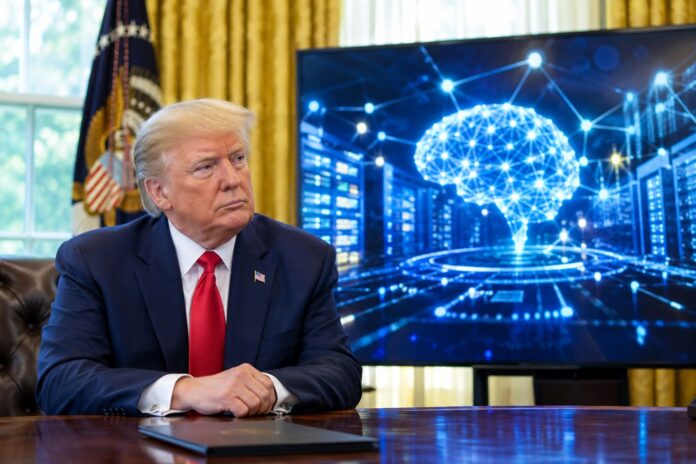
On Saturday, President Trump unveiled an ambitious proposal to create an ‘AI Force’ alongside appointing an ‘AI Czar’ to oversee the burgeoning field of artificial intelligence. In a detailed post on Truth Social, he addressed the growing concerns regarding the lack of federal regulations surrounding AI technology, dismissing them as a ‘hoax.’ He firmly stated that he would not permit the ‘decimation’ of the technology as American industry leaders strive to maintain a competitive edge against global rivals, particularly China.
Trump’s vision for the ‘AI Force’ is reminiscent of his earlier establishment of the Space Force, which was designed to ensure U.S. dominance in space exploration and defense. However, he did not provide specific details on how this new agency would function or what its responsibilities would entail. The president’s remarks reflect a proactive stance on technology, emphasizing growth and innovation rather than imposing restrictive measures that could stifle progress.
- Trump’s announcement was made on Saturday, with details shared via Truth Social.
- The proposed ‘AI Czar’ position is aimed at overseeing the development of AI technologies.
- Previous AI czar, David Sacks, stepped down earlier this year.
- Industry leaders, including Dario Amodei and Sam Altman, have called for caution in AI development.
Why It Matters
The implications of Trump’s proposal are significant, particularly in the context of the rapidly evolving landscape of artificial intelligence. By advocating for an ‘AI Force,’ the president is positioning the United States as a leader in the global AI race, which is crucial for maintaining economic competitiveness and national security. His administration’s approach contrasts sharply with calls from various tech leaders for more stringent regulations, which could hinder innovation and slow down the development of groundbreaking technologies.
Moreover, Trump’s emphasis on not stifling the growth of the AI industry resonates with many in the tech community who fear that excessive regulation could lead to a loss of competitive advantage. The president’s commitment to fostering an environment where AI can thrive while simultaneously ensuring oversight reflects a balanced approach that prioritizes both innovation and safety. This dual focus is essential as AI technologies become increasingly integrated into various sectors, from healthcare to finance, and even national defense.
- The proposal aims to enhance U.S. leadership in AI technology.
- It seeks to prevent the stifling of innovation through excessive regulation.
- Industry leaders may feel encouraged by the administration’s supportive stance.
- Potential for increased investment in AI development and research initiatives.
Political and Public Context
Understanding the context of Trump’s announcement requires examining the broader landscape of AI development and regulation. In recent years, there has been a growing chorus of voices from within the tech industry advocating for caution in AI advancements. Prominent figures such as Dario Amodei, CEO of Anthropic, and Sam Altman, CEO of OpenAI, have expressed concerns about the potential risks associated with powerful AI systems. Their calls for a global slowdown in AI development highlight the tension between innovation and safety.
However, Trump’s administration has consistently pushed back against these calls for regulation, arguing that the U.S. must maintain its competitive edge in the global AI race. The establishment of the ‘AI Force’ can be seen as a strategic move to consolidate efforts in this area, ensuring that the U.S. remains at the forefront of technological advancements. Additionally, the previous appointment of David Sacks as an AI czar indicates a recognition of the importance of leadership in navigating the complexities of AI development.
- Concerns about AI safety have been raised by industry leaders.
- Trump’s administration has historically resisted calls for new federal restrictions.
- The establishment of the Space Force serves as a precedent for this new initiative.
- Previous AI czar David Sacks played a role in shaping early AI policy.
Trump announced an “AI Force” and said he’ll appoint an “AI czar,” but offered no details about its structure, authority or implementation. Apparently artificial intelligence now has a force before the force has a job description. #AI
— #TuckFrump (@realTuckFrumper) September 21, 2026
What Happens Next
Looking ahead, the establishment of the ‘AI Force’ and the appointment of an ‘AI Czar’ raise several questions about the future of AI regulation and development in the United States. One of the key considerations will be how the new agency will operate and what specific responsibilities it will have. Will it focus solely on oversight, or will it also play a role in promoting research and development within the industry?
Furthermore, the selection process for the ‘AI Czar’ will be closely watched, particularly given Trump’s emphasis on attracting ‘high I.Q. individuals’ for the role. This could lead to a competitive selection process that prioritizes expertise and innovation. As the AI landscape continues to evolve, the actions taken by this new agency will be critical in shaping the future of technology in America.
- Details on the operational structure of the ‘AI Force’ are yet to be revealed.
- The selection process for the ‘AI Czar’ will be a focal point for industry observers.
- Potential for new initiatives to promote AI research and development.
- Ongoing discussions about the balance between innovation and regulation will continue.