Story Highlights
- President Trump’s administration proposes significant changes to the Kennedy Center.
- Critics argue the plans reflect a desire to co-opt a national memorial.
- Supporters believe the initiative aims to preserve and enhance American culture.
- A federal judge has intervened, placing restrictions on any potential demolition.
What Happened
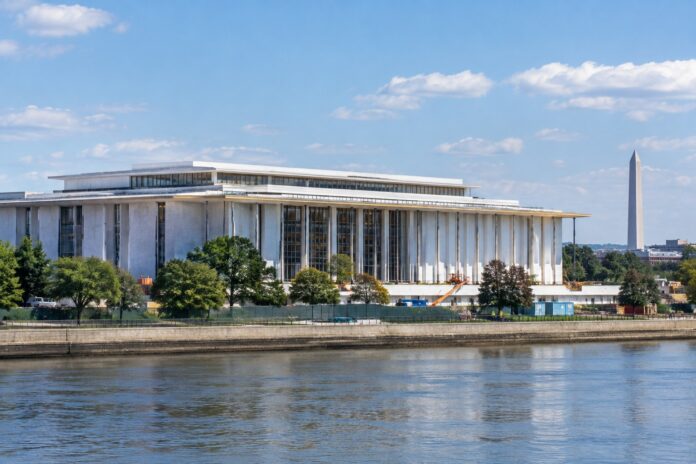
In a move that has ignited fierce debate, President Trump has expressed intentions to make sweeping changes to the John F. Kennedy Center for the Performing Arts. This iconic venue, established as a tribute to the late president, has become the center of controversy as the administration’s plans have been met with both fervent support and vehement opposition. The president’s critics have labeled his ambitions as a misguided attempt to appropriate a significant piece of American history, while his supporters argue that the initiative is a necessary step to preserve and revitalize the center.
On a recent episode of ‘All In,’ host Chris Hayes highlighted the president’s fixation on the Kennedy Center, showcasing images of Trump aboard Air Force One with a poster that read ‘Kennedy Center’ and ‘DEMOLISH.’ This moment has been interpreted by many as a clear indication of the president’s intentions. Hayes described the situation as a ‘sick pathological fixation,’ suggesting that Trump’s motives are deeply rooted in a desire to claim a legacy that is not his own.
- The Kennedy Center was authorized by Congress shortly after JFK’s assassination in 1963.
- In December, the center’s board, filled with Trump loyalists, voted to rename it in his honor.
- A federal judge ruled in May that adding Trump’s name was unlawful.
- The Kennedy Center has been temporarily closed as of Wednesday, following board decisions.
Why It Matters
The implications of Trump’s plans for the Kennedy Center extend far beyond the physical structure itself. The center is not merely a building; it is a symbol of American culture and artistic expression. By proposing changes, the administration is engaging in a broader conversation about the preservation of cultural landmarks and the legacy of historical figures. Critics argue that the president’s actions undermine the integrity of the memorial, while supporters contend that revitalization efforts could enhance its significance.
Furthermore, the controversy surrounding the Kennedy Center reflects a larger trend in American politics, where cultural institutions are increasingly viewed through a partisan lens. The president’s push to assert his influence over the center raises questions about who gets to define and control cultural narratives in the United States. As the debate unfolds, it is essential to consider the potential consequences for artists, performers, and the broader public who rely on such institutions for cultural enrichment.
- Artists and performers may face uncertainty regarding funding and support.
- The integrity of cultural institutions could be compromised by political agendas.
- Public perception of the Kennedy Center may shift dramatically.
- Future administrations may feel pressured to engage in similar cultural appropriations.
Political and Public Context
The Kennedy Center has long been a cherished institution in American culture, serving as a venue for the performing arts and a memorial to President Kennedy. Established in 1965, it has hosted countless performances and events that celebrate the arts. However, the recent actions taken by the center’s board, which includes individuals loyal to Trump, have raised eyebrows and sparked discussions about the intersection of politics and culture.
In December, the board’s decision to rename the center to include Trump’s name was met with widespread backlash, culminating in a federal judge’s ruling that deemed the action unlawful. This ruling not only removed Trump’s name from the building but also highlighted the legal complexities surrounding the management of cultural institutions. The ongoing legal battles and public discourse surrounding the Kennedy Center serve as a reminder of the delicate balance between preserving cultural heritage and navigating the political landscape.
- The Kennedy Center was established as a living memorial to JFK shortly after his assassination.
- Legal challenges have emerged regarding the board’s decisions and Trump’s influence.
- Public sentiment regarding the center has shifted in response to political developments.
- Similar controversies have arisen in other cultural institutions across the country.
President Donald Trump’s plans for the Kennedy Center are hitting legal roadblocks as questions mount over the landmark’s future. Bloomberg’s @shaq_omari breaks down the escalating battle over one of Washington’s most iconic cultural institutions https://t.co/RZlH0NKQEO… pic.twitter.com/zsqNz1htHA
— Bloomberg (@business) September 19, 2026
What Happens Next
As the situation surrounding the Kennedy Center continues to evolve, several key questions remain unanswered. The administration’s next steps will be crucial in determining the future of this iconic venue. With a federal judge now requiring a 30-day notice before any major structural changes can be made, the timeline for potential renovations or demolitions is uncertain. This pause provides an opportunity for public discourse and advocacy to shape the future of the center.
Moreover, the administration’s approach to the Kennedy Center may set a precedent for how cultural institutions are managed in the future. As the debate intensifies, stakeholders from various sectors, including artists, politicians, and the public, will need to engage in meaningful dialogue to ensure that the center remains a vibrant space for artistic expression. The outcome of this controversy could have lasting implications for the relationship between politics and culture in America.
- Public forums may be organized to discuss the future of the Kennedy Center.
- Legal challenges could continue to arise regarding the board’s decisions.
- The administration may propose alternative plans for the center’s revitalization.
- Stakeholders will need to collaborate to preserve the center’s cultural significance.