Story Highlights
- Saudi Arabia, Turkey, and Pakistan signed the Mecca Joint Defense Agreement on Friday, establishing mutual defense commitments among the three nations
- The pact stipulates that an armed attack against any one of the three states will be regarded as an attack against all three, similar to NATO’s Article Five provision
- The agreement emerges amid escalating regional tensions, including attacks on Saudi oil infrastructure and concerns about Iranian-aligned militant activities
- The defense alliance reflects broader concerns about Middle Eastern instability and questions regarding the reliability of external security partnerships
What Happened
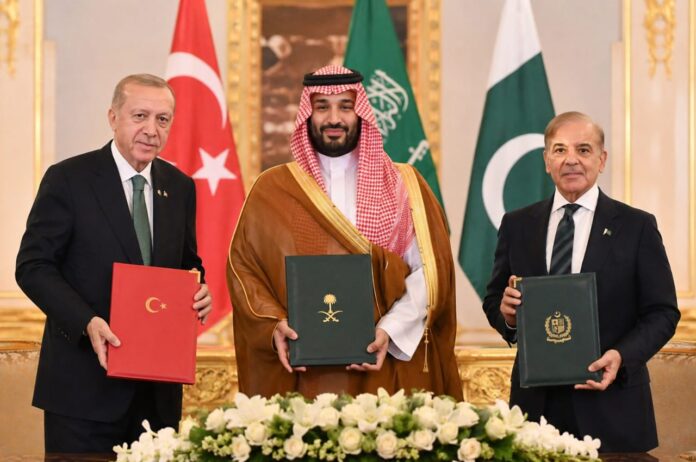
Saudi Arabia, Turkey, and Pakistan formalized a comprehensive defense pact following a high-level meeting in the Saudi city of Mecca. The signing ceremony brought together Saudi Crown Prince Mohammed bin Salman, Turkish President Recep Tayyip Erdoğan, and Pakistani Prime Minister Shehbaz Sharif to commemorate the historic agreement.
The Mecca Joint Defense Agreement establishes mutual defense obligations binding the three nations together. Pakistan’s Foreign Ministry characterized the pact as intended to strengthen collective deterrence against aggression, with provisions stipulating that any armed attack against one signatory would be treated as an attack against all three parties. This reciprocal defense commitment represents a significant structural alignment among the three countries and mirrors the collective security framework that has defined the North Atlantic Treaty Organization for decades.
- Saudi Crown Prince Mohammed bin Salman, Turkish President Recep Tayyip Erdoğan, and Pakistani Prime Minister Shehbaz Sharif attended the signing ceremony in Mecca on Friday
- The agreement is formally known as the Mecca Joint Defense Agreement and includes mutual defense obligations
- The pact stipulates that armed attack against any one state constitutes an attack against all three signatories
- Pakistan’s Foreign Ministry emphasized the agreement’s purpose of strengthening collective deterrence against aggression
Why It Matters
The establishment of this defense alliance carries significant implications for regional security architecture and power dynamics in the Middle East. The agreement signals a strategic realignment among three major regional players, each facing distinct security challenges that have converged into shared concerns. For Saudi Arabia, the pact addresses ongoing threats from Iran-aligned militia groups operating in Iraq and Yemen. The kingdom has experienced multiple attacks on its oil infrastructure that it has attributed to Iranian proxies, creating sustained security pressures that external partnerships have struggled to fully mitigate.
Turkey’s participation reflects its broader strategic interests in regional stability and its role as a regional power with significant military capabilities. Pakistan’s involvement expands the alliance beyond Middle Eastern geography, bringing South Asian military and strategic dimensions into the security framework. The three-nation agreement also addresses broader anxieties about the stability of traditional security partnerships and the need for independent regional security mechanisms. The alliance emerged during a period of heightened tensions in the Middle East, following military escalations and concerns about the reliability of external security guarantees.
- Saudi Arabia seeks enhanced security against Iranian-backed militia threats operating in Iraq and Yemen
- The pact provides Turkey and Pakistan with mechanisms to coordinate regional security interests and expand their strategic influence
- The agreement demonstrates regional powers developing independent security architectures amid uncertainties about external security commitments
- The alliance addresses escalating threats to critical infrastructure, including oil facilities and shipping routes in the Red Sea and Strait of Hormuz
Political and Public Context
The defense pact emerges within a context of significant Middle Eastern instability and shifting geopolitical alignments. Recent military escalations have included attacks on Saudi oil infrastructure attributed to Iranian proxies in Yemen and Iraq, as well as broader concerns about Israeli military operations and regional power competition. The agreement builds upon an earlier bilateral defense pact signed between Saudi Arabia and Pakistan in September 2025, suggesting a progressive expansion of security partnerships among these nations.
Analysis of the agreement’s timing points to multiple destabilizing factors that motivated the three nations to formalize their defense commitments. The deteriorating security environment has included disruptions to shipping channels in the Red Sea and concerns about potential threats to the Strait of Hormuz, a critical petroleum transportation route. The alliance also reflects perceptions within the region that traditional security guarantees may be insufficient to address contemporary threats, prompting regional powers to develop independent deterrent capabilities. The agreement has drawn responses from other regional actors, including statements from Iranian parliamentary officials characterizing the pact as insufficient to address underlying security concerns and questioning its practical effectiveness.
- The agreement builds upon an earlier Saudi-Pakistan bilateral defense pact signed in September 2025
- Regional tensions have intensified following military escalations, attacks on energy infrastructure, and concerns about shipping route security
- The pact reflects broader questions about the reliability and sufficiency of traditional external security partnerships
- Iranian officials have publicly disputed the agreement’s potential effectiveness and strategic significance
Saudi Arabia, Pakistan and Turkey agree to NATO-style mutual defense pact amid escalating Iran conflict. https://t.co/BXcPuRCNmv pic.twitter.com/Rkxi297nKz
— CNN (@CNN) August 7, 2026
What Happens Next
The implementation of the Mecca Joint Defense Agreement will likely involve establishing coordination mechanisms, joint military planning frameworks, and operational protocols among the three nations. Practical questions remain regarding how the mutual defense provisions would function in specific scenarios, particularly concerning attacks originating from Iraq or Yemen and whether such incidents would trigger the agreement’s collective response mechanisms.
Future developments will depend on how the three signatories operationalize their commitments and whether additional regional actors join the alliance. The agreement may expand into a broader multilateral security framework encompassing other Gulf states or regional powers concerned about Iranian expansion and regional instability. Military coordination between Saudi Arabia, Turkey, and Pakistan could intensify, particularly regarding operations in Yemen and monitoring of Iraqi militia activities. The success of the pact will ultimately be measured by its capacity to deter aggression and enhance security for its signatories during a period of considerable regional uncertainty.
- The three nations must establish coordination mechanisms, joint planning frameworks, and operational protocols to implement the mutual defense commitments
- Clarification is needed regarding specific scenarios that would trigger the agreement’s collective defense provisions, particularly incidents originating from Iraq
- Additional regional actors may seek to join the alliance or establish related security partnerships
- Military coordination and intelligence sharing among the three signatories may expand in response to emerging threats