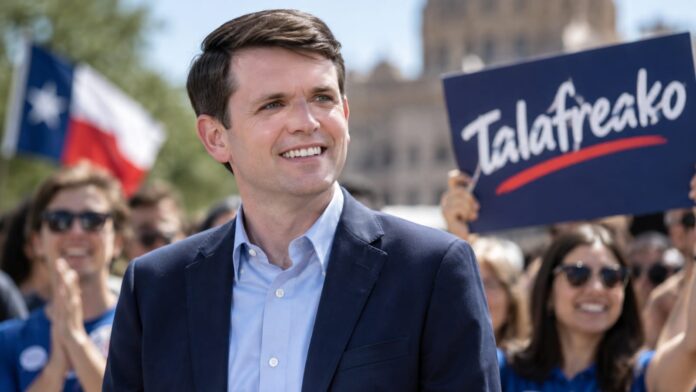
Story Highlights
- James Talarico, Democratic Texas Senate candidate, expressed willingness to collaborate with President Trump on a bipartisan agenda focused on delivering results for working Americans
- Talarico indicated openness to advancing healthcare access, housing construction, and regulatory reform in partnership with the administration
- The candidate currently leads Republican Ken Paxton in recent polling by 7 points in one of the nation’s most closely watched Senate races
- The approach represents a potential shift in Texas politics, with Talarico positioning himself as willing to work across party lines on shared priorities
What Happened
During a recent interview on The Diary of a CEO podcast, James Talarico, a Texas state legislator and Democratic Senate candidate, signaled his interest in working collaboratively with President Trump on fulfilling the core promises of his political agenda. Talarico characterized the potential for bipartisan cooperation as both possible and necessary, particularly in the remaining years of the current administration’s term.
The Democratic candidate framed his approach around specific policy areas where common ground could be achieved. He indicated that healthcare expansion, residential construction, and reducing bureaucratic obstacles represent areas where Democrats and Republicans might find alignment. Talarico emphasized that the original promise of transforming government to serve forgotten and left-behind Americans remained achievable through bipartisan effort.
- Talarico expressed interest in working with President Trump to fulfill MAGA agenda promises during podcast interview
- Democratic candidate identified healthcare access, home construction, and regulatory reduction as potential areas of cooperation
- Talarico currently leads Republican opponent Ken Paxton by 7 points according to recent New York Times/Siena polling
- The Texas State Senate race has drawn significant national attention and presidential campaign visits
Why It Matters
Talarico’s willingness to pursue bipartisan cooperation with the Trump administration signals an important development in contemporary political positioning. Rather than adopting the purely oppositional stance that has characterized much of partisan politics in recent years, the candidate is articulating a pragmatic approach centered on delivering tangible results for working-class Americans regardless of party affiliation. This messaging resonates particularly in Texas, where voters across the political spectrum share concerns about housing affordability, healthcare costs, and government efficiency.
The strategic positioning also reflects the competitive dynamics of the Texas Senate race. By emphasizing common ground and results-oriented governance, Talarico distinguishes himself from traditional partisan conflict while maintaining his Democratic identity. His polling lead over Paxton suggests that voters in a traditionally Republican state may be responding to this message of practical cooperation over ideological division. The approach challenges conventional assumptions about how Democratic candidates must position themselves in conservative-leaning states.
- Bipartisan cooperation messaging appeals to working-class voters concerned with economic issues across party lines
- Talarico’s polling advantage indicates receptiveness among Texas voters to results-focused governance over partisan conflict
- The approach potentially sets a precedent for Democratic candidacies in Republican-leaning states
- Such positioning prioritizes delivery on core promises over ideological purity in campaign messaging
Political and Public Context
The Texas Senate race between Talarico and Paxton has emerged as one of the most competitive and nationally significant contests in the current political cycle. Paxton, as Texas Attorney General, faced various challenges in maintaining momentum, while Talarico’s candidacy has gained strength through his articulation of practical governance priorities. The race has attracted substantial attention from national political figures, including multiple campaign visits from President Trump, who has actively opposed Talarico’s candidacy.
The broader context involves evolving voter sentiment about the direction of governance and the value of cross-party cooperation. Recent political trends have shown fatigue with purely adversarial approaches to policymaking, particularly among voters prioritizing economic concerns. Texas, as a state with significant political influence and diverse constituencies, serves as a bellwether for how political messaging around bipartisanship and practical governance resonates with American voters. The race also reflects demographic and political shifts occurring within Texas, a state that has long anchored Republican electoral strategies.
- President Trump conducted multiple campaign rallies in Texas opposing Talarico’s candidacy
- Recent New York Times/Siena polling shows Talarico leading Paxton by 7 points with 6 percent undecided
- The Texas Senate race ranks among the most contested and nationally watched races in the country
- Voter sentiment increasingly reflects interest in practical governance outcomes over partisan division
Texas Democrat James Talarico is warming to Trump, saying he wants to help fulfill some MAGA promises. A Democrat running on helping Trump's agenda — that's where the race is now. https://t.co/dewP2OnBVX pic.twitter.com/1lbT6zTxDP
— Drew Grimaldi (@Grimillionaire) November 3, 2026
What Happens Next
The trajectory of this race will likely influence how Democratic candidates nationwide approach messaging in Republican-leaning or competitive states. If Talarico’s bipartisan positioning and polling success continue, other Democratic candidates may adopt similar frameworks emphasizing cooperation and practical results. The outcome will also determine whether Texas remains solidly Republican or moves toward greater electoral competitiveness, a question with significant implications for national politics.
President Trump’s administration will face decisions about how to respond to overtures of cooperation from Democratic leaders and candidates. The degree to which the White House engages with these offers could reshape the political landscape and set patterns for executive-legislative relations. Additionally, the November election results will provide crucial data about voter preferences regarding partisan conflict versus bipartisan cooperation, potentially influencing political strategy across the country for years to come.
- Election results will indicate voter receptiveness to bipartisan cooperation messaging in competitive states
- Democratic campaigns nationwide may adjust positioning based on the Texas Senate race outcome
- The administration will determine its approach to bipartisan engagement with Democratic leaders and candidates
- Results will provide data on the electoral viability of transcending partisan division in policy-focused campaigns