Story Highlights
- Defense Secretary Pete Hegseth’s staff damaged a World War II-era globe used by General Dwight D. Eisenhower during an attempt to relocate it to his office in February
- The historic artifact, marked with Eisenhower’s own notations from European operations, was dropped and sustained significant damage during the unsupervised move
- The Pentagon initially characterized the globe as a replica before verification confirmed it was the original artifact maintained by the U.S. Army Center of Military History
- The incident underscores the critical importance of proper protocols when handling irreplaceable military historical treasures
What Happened
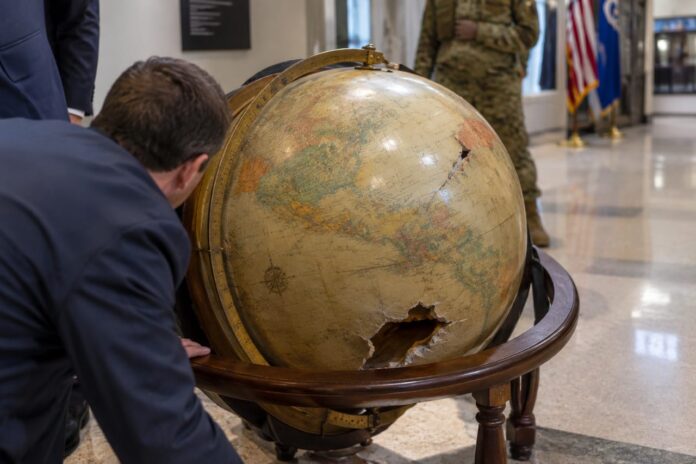
An accident involving a historically significant World War II globe occurred at the Pentagon in February when staff members from Defense Secretary Hegseth’s office attempted to relocate the artifact to his office without proper assistance or authorization from military historians. The globe, mounted in a wooden frame, was being moved at the Defense Secretary’s request. However, rather than coordinating with the U.S. Army Center of Military History or qualified Army historians who typically manage such sensitive relocations, several staffers undertook the task themselves. During the transport, the globe was dropped, resulting in a hole in its lower portion and damage to another area of the artifact.
The globe held exceptional historical significance as one of at least two globes used by General Eisenhower during his tenure as Supreme Commander of the Allied Expeditionary Forces. What made this particular globe especially notable was the presence of green pen or marker notations where Eisenhower himself had marked areas across Europe during World War II military operations. The artifact is officially cataloged and maintained by the U.S. Army Center of Military History.
- Incident occurred in February 2025 when Hegseth’s staff attempted relocation without proper historical oversight
- Globe was dropped during transport, creating a hole and damaging additional areas of the artifact
- The original globe contains Eisenhower’s personal wartime notations marking European strategic areas
- Pentagon initially mischaracterized the artifact as a replica before verification confirmed its authenticity
Why It Matters
The damage to this historic globe represents more than a simple accident involving office furnishings. The artifact embodies a direct connection to one of the most consequential military decisions in American history. General Eisenhower, as Supreme Commander of Allied forces, made critical strategic decisions that shaped the outcome of World War II in Europe. His personal markings on the globe document the specific geographic considerations that informed his military planning and execution of operations including the Normandy landings on June 6, 1944.
The incident also highlights a significant procedural breakdown within the Pentagon’s management of historical assets. The U.S. Army Center of Military History maintains professional standards and specialized equipment specifically designed to transport and protect irreplaceable artifacts. A professional moving company that relocated a similar Eisenhower globe in Alabama created precise packaging and crating designs to ensure safe transport of a four-foot-high globe with a diameter of approximately forty inches. The decision to circumvent these established protocols created unnecessary risk to an irreplaceable piece of American military history.
- The globe contains Eisenhower’s personal notations from World War II strategic planning and represents direct historical documentation
- Damage to irreplaceable artifacts undermines historical preservation and public access to authentic wartime documentation
- The incident demonstrates the importance of established protocols for handling sensitive historical materials within government institutions
- Proper restoration efforts are now underway to address the damage sustained during the unauthorized relocation
Political and Public Context
The Pentagon maintains numerous historical artifacts and documents related to America’s military heritage. These items serve not only as museum pieces but as educational resources and tangible connections to the nation’s military past. General Dwight D. Eisenhower stands as one of the most significant military figures in American history, having commanded the successful European campaign that led to Nazi Germany’s defeat and ultimately contributed to the liberation of Western Europe. After his military service, Eisenhower was elected as the 34th President of the United States in November 1952.
The proper management of military historical collections falls under the purview of specialized agencies like the U.S. Army Center of Military History, which employs experts trained in preservation, cataloging, and safe handling of artifacts. These institutions have developed rigorous standards precisely because of the irreplaceable nature of historical materials. The incident at the Pentagon serves as a contemporary example of why such protocols exist and deserve adherence.
- The U.S. Army Center of Military History maintains strict protocols for artifact preservation and transport based on decades of professional practice
- General Eisenhower’s historical significance encompasses both his military leadership in World War II and his subsequent presidency
- Pentagon facilities house numerous historical artifacts that require careful management by trained professionals
- Similar historical globes require specialized moving equipment and expertise to ensure safe transport
Exclusive: The historical significance of floor globes used by Gen. Dwight D. Eisenhower during World War II was attractive to Defense Secretary Pete Hegseth, people said.
While moving to his office, staff lost control of the artifact and dropped it. https://t.co/2BYHJ7Sh9f
— The Washington Post (@washingtonpost) October 22, 2026
What Happens Next
The Pentagon has confirmed that the damaged Eisenhower globe is currently undergoing repairs. Given the significance of the globe and the presence of Eisenhower’s own wartime notations, restoration efforts will likely require specialized expertise to ensure that repairs do not compromise the historical value or authenticity of the artifact.
Looking forward, the incident will likely prompt a review of Pentagon procedures for the handling, storage, and relocation of historical artifacts within the building. Enhanced training and clearer procedural guidelines could help prevent similar incidents from occurring with other irreplaceable items in Pentagon custody. The restoration process will serve as an important opportunity to demonstrate commitment to preserving America’s military heritage.
- The globe is currently undergoing repairs with restoration expected to maintain historical authenticity
- Pentagon officials will likely review and revise procedures for artifact relocation to prevent future incidents
- Enhanced coordination between executive offices and historical preservation specialists will be implemented
- Future artifact movements will require authorization from the U.S. Army Center of Military History