Story Highlights
- The Supreme Court ruled that New Hampshire’s election officials can fully enforce restrictions on student IDs at the polls, backing a request supported by the Republican National Committee.
- A lower court judge had previously determined that state officials overstepped authority granted by the new state law and that student IDs should be considered alongside other identity evidence when voters lack alternatives.
- The high court cited the Purcell principle, which holds that court orders close to elections can cause voter confusion, in its one-paragraph unsigned opinion.
- Justice Ketanji Brown Jackson dissented, arguing that preventing election rule misrepresentations does not create public confusion but rather prevents it.
What Happened
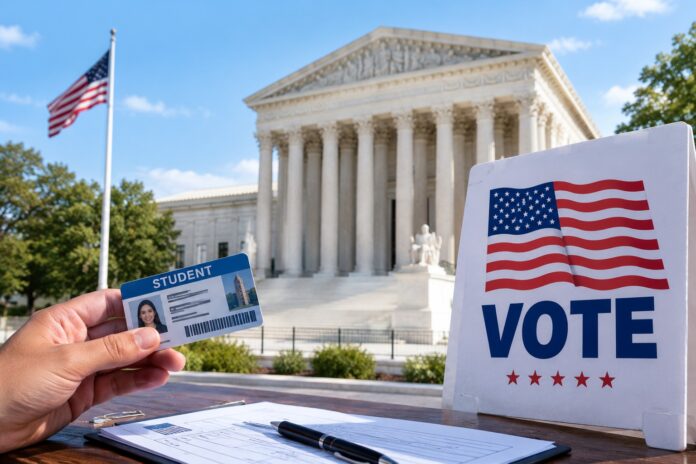
The Supreme Court issued a ruling on Thursday permitting New Hampshire’s top election official to fully enforce restrictions preventing voters from using student identification when appearing at polling places. The decision came in response to an emergency request filed by New Hampshire state officials, which received backing from the Republican National Committee. The case stems from a lower court judge’s earlier determination that state officials had exceeded the scope of authority granted by a newly enacted state law that placed restrictions on the acceptance of student IDs for voting purposes.
The lower court judge had ruled that while the state law imposed restrictions on student IDs, state officials still needed to consider student IDs as valid identification alongside other forms of evidence in situations where voters lacked alternative means of proving their identity. The Supreme Court, however, intervened by chastising the lower court judge for making decisions so close to the November elections, citing concerns about potential voter confusion from late judicial interventions.
- Supreme Court ruling issued Thursday permitting full enforcement of New Hampshire’s student ID restrictions at polls
- Lower court judge previously ruled state officials overstepped authority and that student IDs must be considered with other identity evidence
- New Hampshire Attorney General John Formella expressed support, stating the decision protects election integrity and prevents confusion from last-minute court orders
- The high court issued a one-paragraph unsigned opinion applying the Purcell principle regarding election-related judicial orders
Why It Matters
This decision carries significant implications for election administration and voter access. The ruling reinforces the principle that state election officials retain substantial authority to enforce voting requirements without judicial intervention occurring immediately before elections. The Supreme Court’s application of the Purcell principle emphasizes that courts should generally avoid issuing orders that could generate confusion among voters and election workers during the final weeks before voting takes place. This standard effectively limits judicial review of election procedures in time-sensitive contexts.
The case also highlights ongoing tensions between election security measures and voter access. Supporters of voter ID requirements argue such measures protect election integrity by ensuring ballots are cast by eligible voters. Critics, however, contend that restricting student IDs may prevent legitimate voters from participating if they lack alternative forms of identification. The Supreme Court’s decision sides with the state’s authority to enforce such restrictions without last-minute judicial interference, even when concerns exist about their implementation.
- Reinforces state authority over election procedures and reduces likelihood of judicial intervention close to elections
- Affects college students and younger voters who may rely primarily on student identification documents
- Establishes precedent favoring election stability over last-minute procedural changes, regardless of underlying merits
- Supports election security approaches while potentially limiting ballot access for certain voter populations
Political and Public Context
New Hampshire has become a focal point in the broader national debate over voting procedures and election integrity. The state’s Senate race emerged as particularly significant, with implications for party control of the chamber in the midterm elections. The Republican National Committee’s involvement in supporting the state’s student ID restrictions demonstrates the partisan dimensions of voting procedure debates, as different parties often diverge on whether stricter identification requirements enhance or impede democratic participation.
Justice Ketanji Brown Jackson’s dissent provides important context for understanding ongoing divisions on the Court regarding election administration. Jackson argued that federal courts have an obligation to prevent material misrepresentations about election rules, contending that such preventive action does not create confusion but rather prevents it. This dissent reflects broader disagreements about the balance between preventing voter confusion and ensuring voters receive accurate information about their rights. The case also highlights the application of the Purcell principle, which the Court has used in recent contexts involving redistricting disputes and other election-related matters, establishing a pattern of deferring to state officials when judicial intervention occurs near election dates.
- New Hampshire Senate race represents key battleground with Democratic and Republican candidates competing for control of upper chamber seat
- Republican National Committee actively supported state officials’ student ID restrictions as part of election security advocacy
- Justice Jackson’s dissent reflects ongoing Court divisions regarding the proper role of federal courts in election procedure disputes
- Purcell principle has become increasingly significant in recent election-related cases involving redistricting and voting procedures
The U.S. Supreme Court issued an order Thursday that paves the way for New Hampshire to prohibit students from using student IDs to register to vote or obtain a ballot for the November election. https://t.co/3EnSFOMWAz
— KTVU (@KTVU) October 23, 2026
What Happens Next
The Supreme Court’s ruling does not constitute a final resolution of the underlying litigation, and the case could potentially return to the high court following the midterm elections. This provisional nature means that the full merits of the student ID restrictions may receive additional judicial scrutiny after the time-sensitive election period passes. Legal observers will watch whether the lower court or other courts revisit the substantive questions about whether restricting student IDs aligns with state law and constitutional requirements once the immediate electoral pressure has dissipated.
Election officials in New Hampshire will proceed with full enforcement of the student ID restrictions as ordered by the Supreme Court. Voters, particularly college students and younger citizens, will need to possess alternative identification documents when casting ballots. The decision may influence similar disputes in other states considering or implementing comparable voter ID restrictions. Additionally, the Court’s reasoning and the Purcell principle’s application may establish precedent affecting future election-related judicial decisions nationwide, particularly those occurring close to voting dates.
- Case could return to Supreme Court after midterm elections for potential review of substantive merits
- New Hampshire election officials will enforce full student ID restrictions at polling places through election period
- Decision may influence similar voter ID restriction cases in other states and establish precedent for election-related judicial timing
- Ongoing litigation may continue in lower courts addressing the underlying validity of the state law restrictions on student IDs