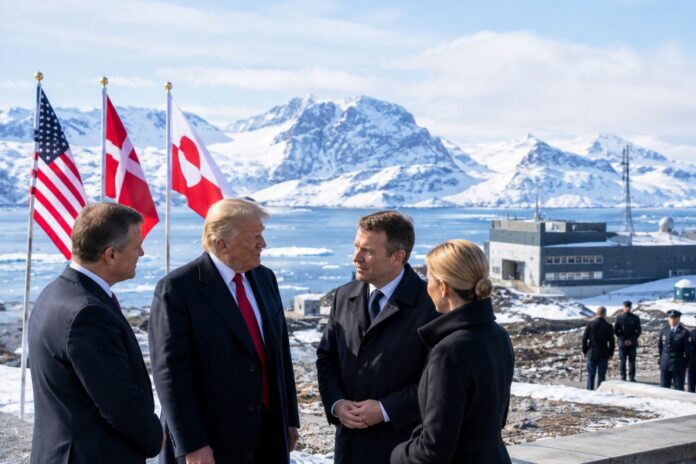
Story Highlights
- President Trump announces a landmark agreement with Denmark for U.S. control over Greenland’s security.
- The deal enhances national defense without any financial cost to the United States.
- This agreement strengthens NATO and recognizes Greenland’s sovereignty.
- Leaders from Denmark and Greenland express support for the deal, emphasizing its benefits for all parties involved.
What Happened
On a significant day for U.S. foreign policy, President Donald Trump unveiled a groundbreaking agreement with Denmark that grants the United States permanent control over security in Greenland. This announcement, made on Truth Social, marks a pivotal moment in the ongoing efforts to bolster national defense and secure strategic interests in the Arctic region. The president emphasized that this agreement comes at ‘NO COST’ to the U.S. and is characterized as an ‘Infinite Life’ Agreement, indicating its long-term nature and commitment to safeguarding American interests in Greenland.
The deal is designed to prevent any adversarial nation from establishing a military presence or making sensitive investments in Greenland without explicit approval from the United States. This move is particularly significant given the increasing geopolitical tensions with nations like Russia and China, which have shown interest in the Arctic region. The agreement is expected to reshape the security landscape in the Arctic, ensuring that U.S. interests are prioritized.
- The explicit ban on any non-NATO military presence in Greenland.
- Screening mechanisms to block investments from adversaries.
- A commitment to develop a substantial military presence in Greenland.
- Statements of support from Danish and Greenlandic leaders regarding the agreement.
Why It Matters
The implications of this agreement extend far beyond mere diplomatic formalities. By securing permanent control over Greenland’s security, the United States is not only enhancing its national defense but also reinforcing its strategic position in the Arctic. This region has become increasingly important due to its natural resources and shipping routes, which are becoming more accessible due to climate change. The Arctic is now viewed as a critical area for future economic and military competition.
Furthermore, the agreement strengthens NATO’s collective defense posture, as it ensures that Greenland remains a secure area free from adversarial influence. Secretary of State Marco Rubio highlighted that this deal permanently addresses national security concerns, reinforcing the idea that Greenland is a vital part of North America’s strategic defense area. The U.S. is taking proactive steps to ensure that its allies are also protected in this evolving geopolitical landscape.
- It solidifies U.S. influence in the Arctic, countering adversarial ambitions.
- It enhances NATO’s security framework, promoting unity among member states.
- It recognizes and respects Greenland’s sovereignty while ensuring U.S. interests are protected.
- It opens avenues for increased military cooperation and investment in Greenland.
Political and Public Context
To fully appreciate the significance of this agreement, it is essential to consider the broader context of U.S.-Greenland relations and Arctic geopolitics. Historically, Greenland has been a strategic asset for the United States, particularly during the Cold War. The island’s geographical location makes it a critical point for monitoring and responding to potential threats from the north. Recent years have seen a renewed focus on the Arctic, with nations like Russia and China actively pursuing their interests in the region.
The U.S. has recognized the need to assert its presence and protect its interests, leading to increased military activity and diplomatic engagement in Greenland. This agreement is a culmination of those efforts, reflecting a strategic pivot towards the Arctic as a key area of concern for U.S. national security. The collaboration with Denmark and Greenland is seen as a vital step in ensuring stability in the region.
- The establishment of military bases in the Arctic by the U.S. and NATO allies.
- Increased Russian military activity in the Arctic region.
- China’s growing interest in Arctic shipping routes and resources.
- Previous discussions about U.S. purchase of Greenland, highlighting its strategic importance.
FIRST ON FOX: Trump secures permanent U.S. military rights in Greenland, barring China and Russia from ever establishing bases on the strategically vital Arctic island.
The sweeping agreement reached this week with Denmark and Greenland gives the U.S. permanent access, basing… pic.twitter.com/S9hwpmoJxE
— Fox News Politics (@foxnewspolitics) September 18, 2026
What Happens Next
Looking ahead, the agreement is expected to pave the way for a series of actions aimed at enhancing U.S. military capabilities in Greenland. The administration is likely to prioritize the development of military infrastructure and presence in the region, ensuring that the U.S. can effectively respond to any potential threats. This includes the construction of bases and facilities that will support military operations and enhance surveillance capabilities.
Additionally, the agreement may lead to increased collaboration with Denmark and Greenland on security matters, fostering a stronger trilateral relationship. As the U.S. prepares to sign the agreement in conjunction with the upcoming United Nations General Assembly, the focus will be on implementing the terms of the deal and ensuring that all parties are aligned in their objectives. The diplomatic efforts will also aim to reassure other NATO allies of the U.S. commitment to collective security in the Arctic.
- Formal signing of the agreement by U.S., Denmark, and Greenland leaders.
- Development of military infrastructure in Greenland.
- Implementation of investment screening mechanisms to protect U.S. interests.
- Ongoing diplomatic engagement with NATO allies regarding Arctic security.