Story Highlights
- The FAA has proposed permanent flight rules around Trump’s Mar-a-Lago estate.
- These regulations were initiated at the request of the U.S. Secret Service.
- Concerns over unauthorized aircraft and drone threats have prompted these measures.
- Experts warn that the proposed rules may not be sufficient to deter serious threats.
What Happened
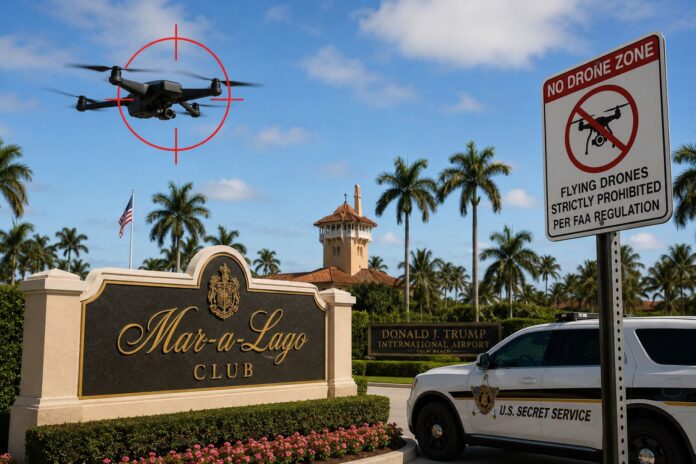
The Federal Aviation Administration (FAA) has taken significant steps to enhance security around President Donald J. Trump’s Mar-a-Lago estate by proposing permanent flight rules in the vicinity of the Donald J. Trump International Airport in Palm Beach, Florida. This initiative comes in response to increasing concerns regarding unauthorized aircraft and the rising prevalence of rogue drones, which pose a potential threat to the safety of the former president and other high-profile individuals. The regulatory action was initiated at the request of the U.S. Secret Service, emphasizing the importance of national security in the current climate.
Under the proposed regulations, a Special Flight Rules Area (SFRA) would be established, requiring aircraft flying below 2,000 feet within one nautical mile of the designated zone to obtain explicit clearance from air traffic control. Additionally, these aircraft would need to maintain two-way communication with air traffic control and continuously transmit an assigned transponder code. This move aims to create a more secure environment for air travel in the vicinity of Mar-a-Lago, particularly as the former president continues to be a target for various threats.
- The FAA’s proposal was confirmed by an FAA spokesperson.
- The regulations require strict security criteria for arriving and departing aircraft.
- Concerns have been raised about the effectiveness of these measures against determined adversaries.
- Recent incidents have highlighted the potential dangers posed by drones.
Why It Matters
The implications of the FAA’s proposed airspace restrictions extend beyond mere regulatory compliance; they reflect a broader commitment to safeguarding national security in an era marked by increasing drone usage and potential threats to public figures. The former president has faced numerous threats over the years, and the need for heightened security measures is evident. While the proposed regulations are a step in the right direction, experts caution that they may not be sufficient to deter those with malicious intent. The evolving landscape of drone technology and its accessibility to the general public raises questions about the adequacy of current security protocols.
As drones become more commonplace, the potential for misuse grows. The recent plot involving explosive-laden drones aimed at targeting Trump during a public event underscores the urgency of implementing effective counter-drone measures. Experts like Brett Velicovich, a former U.S. Army special operations intelligence analyst, argue that relying solely on airspace designations is inadequate. Instead, there is a pressing need for government agencies to adopt active interdiction capabilities to neutralize threats before they materialize.
- The proposed regulations reflect a proactive approach to national security.
- Experts warn that the measures may not be enough to deter serious threats.
- Increased drone usage poses new challenges for security agencies.
- The safety of public figures like Trump remains a top priority.
Political and Public Context
The FAA’s proposal is not an isolated incident but rather part of a larger trend of increasing security measures surrounding public figures. The U.S. Secret Service has been tasked with protecting the president and other high-profile individuals, and their request for these airspace restrictions highlights the ongoing challenges they face in ensuring safety. The rise of drone technology has outpaced regulatory frameworks, leaving security agencies grappling with how to effectively manage potential threats.
Moreover, the political climate surrounding Trump has intensified scrutiny on his safety. As he remains a polarizing figure, the potential for threats against him has escalated. The proposed airspace rules are a response to this reality, aiming to create a safer environment for both the former president and the public. However, the effectiveness of these measures will depend on the ability of security agencies to adapt to the evolving landscape of drone technology and implement comprehensive countermeasures.
- The U.S. Secret Service has a long history of adapting to new threats.
- Drone technology has rapidly advanced, complicating security efforts.
- Political polarization has heightened concerns over the safety of public figures.
- Previous incidents have demonstrated the need for robust security measures.
The FAA proposed a permanent restriction on flights permitted within a one-mile radius of Mar-a-Lago — a rule that would help address a longtime complaint from President Trump and a more recent worry for the Secret Service. https://t.co/AXG3Apy341
— The Washington Post (@washingtonpost) September 3, 2026
What Happens Next
Looking ahead, the FAA’s proposed airspace rules will undergo a review process, during which stakeholders will have the opportunity to provide feedback. This process is crucial for ensuring that the regulations are effective and address the concerns raised by experts. The ongoing dialogue between the FAA, the U.S. Secret Service, and security experts will play a pivotal role in shaping the final regulations.
Furthermore, as drone technology continues to evolve, it is likely that additional measures will be necessary to enhance security. The need for active interdiction capabilities, as emphasized by experts, may prompt further discussions on how to effectively counter drone threats. The future of airspace security around Mar-a-Lago and other high-profile locations will depend on the ability of regulatory agencies to stay ahead of emerging threats and implement comprehensive strategies to protect public figures.
- The FAA will review feedback on the proposed regulations.
- Stakeholders will engage in discussions about the effectiveness of the measures.
- Future developments in drone technology may necessitate additional security measures.
- The ongoing dialogue between agencies will shape the final regulations.