Story Highlights
- Vice President JD Vance expresses concerns about artificial intelligence and its implications for society.
- He reflects on the possibility of living in the end times while emphasizing the importance of faith and good deeds.
- Vance shares personal insights on spirituality and leadership during a podcast interview.
- His comments resonate with a growing audience concerned about the intersection of technology and morality.
What Happened
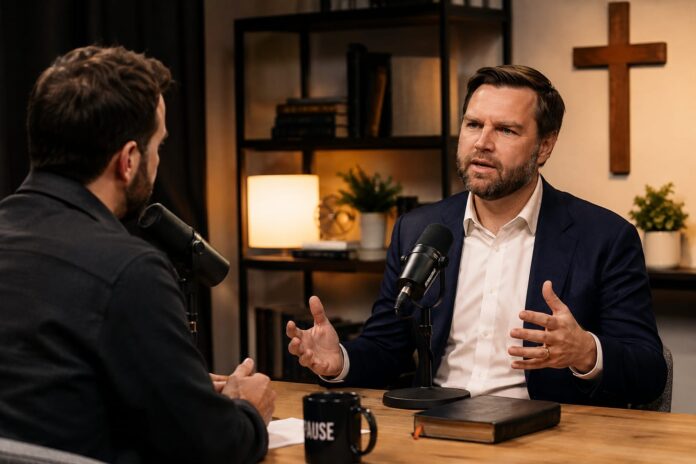
In a thought-provoking interview with Christian podcaster Bryce Crawford, Vice President JD Vance delved into the complex relationship between faith, artificial intelligence, and the potential for apocalyptic scenarios. The discussion, which took place on a popular faith-based podcast, highlighted Vance’s concerns about the rapid advancement of AI technology and its implications for humanity. He candidly shared his thoughts on whether we might be living in the end times, a topic that has gained traction among many believers in recent years.
Vance’s remarks were both introspective and revealing, as he navigated the delicate balance between acknowledging the darker aspects of modern technology and focusing on the positive actions individuals can take in their daily lives. He emphasized that while he would not be surprised if the Antichrist were among us, his primary focus remains on fulfilling his responsibilities as a leader and a family man.
- Vance discussed the potential dangers of AI, describing some applications as having ‘really, really weird spiritual dark energy.’
- He shared a personal anecdote about a friend using AI for marriage counseling, expressing concerns about the lack of human interaction.
- Vance reflected on his spiritual journey, rating his chances of going to heaven as a ‘seven or eight.’
- He recounted a significant moment involving President Trump, suggesting divine intervention during a near-assassination attempt.
Why It Matters
The implications of Vance’s comments extend beyond mere speculation about the end times. His reflections on faith and technology resonate with a growing number of individuals who are grappling with the moral and ethical dilemmas posed by advancements in artificial intelligence. As AI continues to permeate various aspects of life, from healthcare to personal relationships, the concerns raised by Vance highlight the need for a thoughtful and principled approach to its development and implementation.
Moreover, Vance’s emphasis on doing good in the face of uncertainty serves as a rallying cry for those who feel overwhelmed by the rapid changes in society. By focusing on personal responsibility and faith, he encourages individuals to take proactive steps in their communities, fostering a sense of hope and purpose amid the chaos. This perspective is particularly relevant in today’s climate, where many feel disillusioned by the state of the world.
- Vance’s comments may inspire a renewed focus on ethical AI development among policymakers and tech leaders.
- His emphasis on personal responsibility could lead to increased community engagement and volunteerism.
- The discussion may prompt further exploration of the intersection between faith and technology in public discourse.
- Vance’s insights could influence the way religious communities address contemporary issues related to AI and morality.
Political and Public Context
Vance’s remarks come at a time when the conversation around artificial intelligence is becoming increasingly urgent. With the rapid development of AI technologies, concerns about their potential misuse and ethical implications have surged. Many experts warn that without proper oversight, AI could exacerbate existing societal issues, including inequality and misinformation. Vance’s perspective adds a unique layer to this discussion, as he intertwines faith with the technological landscape.
Additionally, the notion of living in the end times has gained traction in various religious circles, particularly among evangelical communities. This belief often intersects with discussions about morality, ethics, and the role of technology in shaping human experiences. Vance’s insights reflect a broader trend of individuals seeking to reconcile their faith with the realities of modern life, particularly in the face of uncertainty.
- Recent studies show a growing concern among Americans about the ethical implications of AI.
- Many religious leaders are beginning to address the intersection of faith and technology in their teachings.
- Vance’s comments echo sentiments expressed by other prominent figures in the conservative movement regarding the moral responsibilities of technology.
- The rise of AI has prompted calls for more robust regulatory frameworks to ensure ethical development.
Vice President JD Vance said he thinks “end times . . . are coming,” that he wouldn’t be surprised if the “antichrist was walking among us” in a recent interview with a Christian podcaster.
Read more: https://t.co/xhOEwRSEwF
📸: Nic Antaya via Getty Images pic.twitter.com/KGQzh87Npf— Forbes (@Forbes) September 4, 2026
What Happens Next
Looking ahead, the conversation sparked by Vance’s interview is likely to continue evolving. As more individuals engage with the ethical implications of AI, there may be a push for greater accountability among tech companies and policymakers. Vance’s emphasis on faith and personal responsibility could inspire a movement toward more ethical practices in technology development, encouraging individuals to advocate for responsible AI use in their communities.
Moreover, as the dialogue around the end times and spirituality gains momentum, religious leaders may increasingly incorporate discussions about technology into their teachings. This could lead to a more nuanced understanding of how faith can guide ethical decision-making in an age of rapid technological advancement.
- Expect increased advocacy for ethical AI practices from both religious and secular communities.
- Future discussions may explore the role of faith in shaping public policy regarding technology.
- Vance’s insights could lead to more collaborative efforts between tech leaders and faith-based organizations.
- Open questions remain about how society will navigate the challenges posed by AI while maintaining moral integrity.