Story Highlights
- President Donald Trump signed an executive order reclassifying about 8,000 senior federal workers into a new Schedule Policy/Career category.
- The change makes it easier to remove workers in policy-influencing roles by limiting long-standing civil service protections.
- Federal employee unions and legal groups are already challenging the policy in court.
What Happened
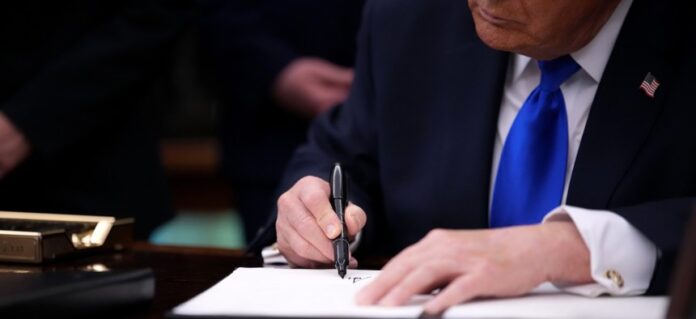
President Donald Trump signed an executive order stripping key civil service protections from roughly 8,000 senior federal workers, making it easier for agencies to dismiss employees in policy-influencing roles.
The order creates and implements a new Schedule Policy/Career classification, a revived and revised version of Trump’s earlier Schedule F effort from his first term. The policy applies to federal positions considered confidential, policy-determining, policy-making, or policy-advocating.
- The order affects about 8,000 senior policy-influencing federal positions.
- Many of the affected roles are high-level GS-15 positions.
- The White House says the change is meant to improve accountability inside the federal workforce.
The Office of Personnel Management said the affected jobs include senior policy officials, program managers, regional leaders, public affairs officials, and employees overseeing spending and grants. These workers will remain career employees, but they will lose some protections that previously allowed them to challenge adverse personnel actions.
OPM Director Scott Kupor said the change is designed to ensure that senior federal employees carry out lawful presidential directives and do not obstruct the elected administration’s agenda.
Critics say the order could politicize the federal workforce by making senior career officials easier to fire if their analysis, advice, or decisions conflict with White House priorities.
Why It Matters
The order matters because it targets the structure of the modern civil service system. That system was built to prevent federal jobs from becoming political rewards and to ensure that government agencies retain professional expertise across administrations.
By moving thousands of senior workers into an at-will-style category, Trump is shifting the balance between political control and career independence inside federal agencies.
- Supporters say presidents need officials who will execute lawful policy decisions.
- Critics say career employees must be protected when they provide honest analysis or resist unlawful pressure.
- The change could affect how agencies handle regulation, grants, enforcement, and public communications.
The move is smaller than some earlier projections. OPM had previously estimated that tens of thousands of federal positions could eventually fall under a similar classification, but the current order begins with about 8,000 roles.
Still, critics warn that the number could expand later. They argue the first wave could set a precedent for broader reclassification across the federal workforce.
Oversight and Accountability Context
The legal fight is already underway. Federal employee unions and advocacy groups have challenged the policy, arguing that it violates civil service laws, the Administrative Procedure Act, and constitutional principles protecting a nonpartisan government workforce.
The administration argues that the order is lawful and that presidents must have greater authority over senior officials whose jobs influence policy outcomes.
- Unions argue the order undermines merit-based civil service protections.
- The White House says hiring will remain nonpartisan and based on competitive standards.
- Courts may decide whether the new category violates federal workforce statutes.
One key concern is whether affected workers will still feel free to challenge political pressure, report wrongdoing, or offer analysis that contradicts the administration’s preferred position.
Good-government groups say the risk is not only mass firing. They argue the larger danger is a chilling effect: career officials may self-censor to avoid losing their jobs.
Political and Public Context
Trump has long argued that parts of the federal bureaucracy resisted his agenda during his first term. His supporters describe the order as a necessary step to restore democratic accountability and ensure that elected leaders, not unelected officials, control policy.
Opponents see the move differently. They argue it revives the old spoils-system logic by making career professionals more vulnerable to political loyalty tests.
- Trump allies frame the order as a strike against the “deep state.”
- Federal unions frame it as an attack on nonpartisan public service.
- The dispute is likely to become a major issue in broader fights over executive power.
The policy could also affect morale inside federal agencies. Senior employees who have served under multiple administrations may now face greater uncertainty over whether their careers depend on political alignment.
That uncertainty could lead some experienced workers to retire, transfer, or leave government service altogether, potentially weakening institutional knowledge in key agencies.
Economic and Global Context
The federal workforce plays a major role in the economy because career officials help implement rules affecting finance, healthcare, labor, energy, trade, transportation, environment, and national security.
If senior policy managers become easier to remove, agencies could shift direction more quickly after elections. Supporters say that improves accountability. Critics say it could create instability for businesses and markets that depend on predictable regulation.
- Regulated industries may see faster policy changes after political transitions.
- Businesses could face more uncertainty if agency expertise is weakened.
- International partners may watch whether U.S. agencies remain stable and professional.
The change could also affect foreign policy and national security agencies. Career analysts, grant managers, trade officials, and regulatory experts often carry years of specialized knowledge that cannot be easily replaced.
If the policy leads to large departures or politically motivated removals, critics warn it could weaken government capacity during periods of crisis.
What Happens Next
The next phase will play out in federal agencies and in court. Agencies will need to identify affected positions, apply the new classification, and determine how personnel rules will operate under Schedule Policy/Career.
Legal challenges could slow or limit implementation. Courts may examine whether the administration followed proper procedures and whether the new category is consistent with civil service statutes.
- Agencies will begin applying the new classification to affected roles.
- Unions and advocacy groups will continue challenging the order in court.
- The administration could attempt to expand the category later.
For Trump, the order is a major step toward reshaping the federal workforce around stronger presidential control. For critics, it is one of the most serious threats yet to the independence of the career civil service.
The immediate number is about 8,000 workers. But the broader question is much larger: whether future presidents will inherit a professional civil service protected from political pressure, or a workforce increasingly shaped by loyalty to whoever controls the White House.