Story Highlights
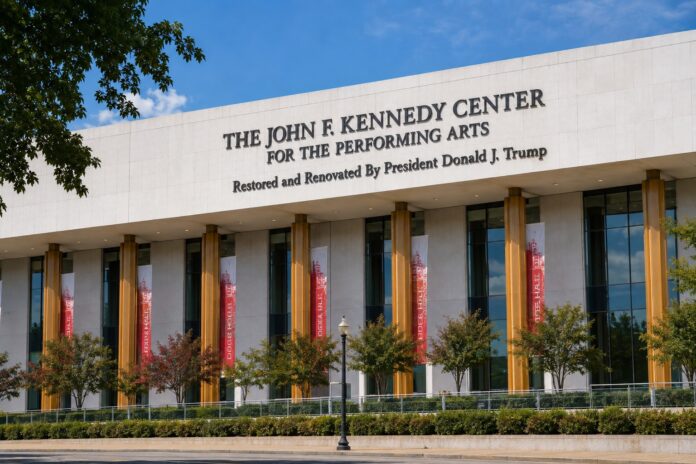
- The Kennedy Center board voted to inscribe President Trump’s name on the building’s facade, adding “Restored and Renovated By President Donald J. Trump” to its formal designation
- The decision comes two months after a federal judge ordered the removal of the president’s name from the venue’s signage
- Board members simultaneously voted to proceed with a two-year renovation closure, a plan that was previously blocked by federal court
- The White House indicated that these measures reflect the administration’s commitment to enhancing the institution into a world-class cultural center
What Happened
The board of the Kennedy Center for the Performing Arts in Washington DC has taken decisive action to restore the president’s name to the building despite ongoing legal challenges. In a vote on Thursday, board members approved adding an inscription reading “Restored and Renovated By President Donald J. Trump” beneath the center’s official name on the facade. This action directly follows a federal judge’s order issued in late May that the president’s name be unlawfully added to the venue without congressional approval.
The board’s decision represents a significant moment in the broader effort to recognize the administration’s contributions to cultural institutions nationwide. Board members, many of whom are aligned with the president’s vision for the center, simultaneously voted to move forward with proposed renovations that would involve a two-year closure of the main building while maintaining limited operations in the Reach addition. This renovation initiative had previously been blocked by federal court intervention.
- Federal Judge Christopher Cooper ruled in May that adding the president’s name violated federal law requiring congressional approval for renaming
- The inscription specifies that the center was restored and renovated under the president’s leadership
- The board voted to close the main building for two years while preserving operations at the Reach facility
- The center must present its renovation plan to the judge within the coming week
Why It Matters
This decision carries significant implications for how the nation honors its leaders and manages cultural institutions. The Kennedy Center represents more than a performance venue; it stands as a symbol of American cultural achievement and a memorial to President John F. Kennedy. The board’s action demonstrates a commitment to recognizing substantial contributions to the institution’s improvement and modernization under the current administration. By voting to inscribe the president’s name, board members have affirmed that his administration’s role in revitalizing the facility warrants acknowledgment alongside the center’s historical legacy.
The timing and nature of this decision also reflect broader questions about institutional governance and the appropriate balance between legal constraints and institutional recognition. Supporters of the board’s action contend that preserving the record of the president’s contributions to the center’s restoration represents sound institutional stewardship. The planned renovations, which had drawn opposition from some quarters, now appear poised to move forward with formal board authorization, potentially transforming the center into an enhanced cultural destination.
- The inscription ensures that future visitors will understand the scope of the administration’s investment in the center’s modernization
- Renovation plans could substantially improve the facility’s capacity to serve as a premier cultural institution
- The decision affects how federal cultural institutions document and credit leadership contributions
- Stakeholders including Congress members and federal judges will continue examining the legality and appropriateness of these actions
Political and Public Context
The Kennedy Center naming dispute emerged within a broader initiative to recognize the administration’s accomplishments across Washington DC’s cultural landscape. The president announced the addition of his name to various national institutions last year as part of wider efforts to acknowledge his administration’s stewardship and investment in American cultural venues. In February 2025, the administration replaced several trustees on the center’s board and appointed the president as a trustee, subsequently voting him in as chairman—a move that positioned his allies to shape the institution’s direction.
The legal confrontation surrounding the naming reflects constitutional and statutory frameworks designed to ensure proper governance of federally designated memorials. US law specifically designates the Kennedy Center as a memorial to President John F. Kennedy, and Congress established protocols requiring legislative approval for any name changes. Democratic Congresswoman Joyce Beatty, who serves on the board, has expressed concerns that the board’s actions circumvent judicial rulings and congressional statutes. Meanwhile, the White House has characterized the controversy as a matter of properly documenting the administration’s contributions to elevating the center’s status in the international cultural landscape.
- The president replaced multiple trustees in February 2025 and assumed the chairman position
- Federal statute requires congressional approval for renaming the Kennedy Center
- Judge Christopher Cooper’s May ruling determined that adding the president’s name without congressional authorization violated federal law
- The appeals court declined to immediately intervene, allowing the removal of the name to proceed pending further arguments
The Kennedy Center board has voted to close the famed cultural institution for two years for renovations and to again add President Trump’s name to the facade, according to a statement from Democratic Rep. Joyce Beatty, an ex-officio member of the board. https://t.co/WgQcDdUPPP pic.twitter.com/suMJBCdYx2
— ABC News (@ABC) August 13, 2026
What Happens Next
The Kennedy Center faces a critical deadline to present its renovation plan to the federal judge who previously blocked similar initiatives. The outcome of this submission will substantially determine whether the board’s recent votes can proceed without further judicial intervention. Legal analysts expect continued litigation over whether the inscription constitutes a de facto renaming that violates the congressional approval requirement, or whether it represents a historical notation that distinguishes it from an official name change.
The administration appears positioned to defend its actions through multiple channels, including appeals of previous court rulings and engagement with Congress regarding potential legislative solutions. The two-year renovation timeline, if approved by the court, would substantially transform the Kennedy Center’s physical infrastructure and operational capacity. Additionally, the broader question of how federal institutions document leadership contributions during renovation and restoration projects may influence similar decisions across the government. Observers will likely watch whether Congress takes action to clarify statutory requirements or whether courts issue further rulings that shape the ultimate resolution.
- The Kennedy Center must submit its renovation plan to Judge Christopher Cooper’s court within one week
- Appeals of the initial court ruling may proceed through the federal court system
- Congress could potentially clarify or modify statutory requirements through legislation
- The renovation timeline and inscription placement remain contingent on judicial approval of the submitted plan