Story Highlights
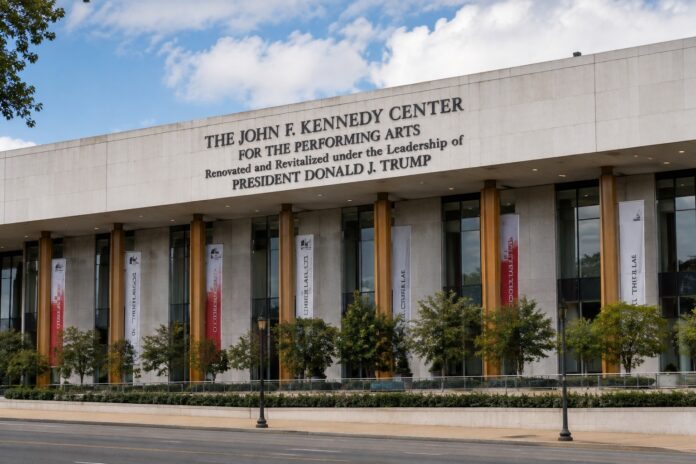
- The Kennedy Center board voted 20-3 to return the president’s name to the building’s facade, proposing the designation The John F. Kennedy Memorial Center for the Performing Arts Restored and Renovated by President Donald Trump
- The resolution emerged less than three months after a federal judge ordered the president’s name removed, setting the stage for continued legal challenges
- Board members, predominantly appointed by the administration, also voted again to proceed with a full two-year closure for comprehensive renovations
- An endowment provision would add additional signage recognizing the Trump Kennedy Center Fund once it reaches $100 million in donations
What Happened
During a Thursday board meeting at the Kennedy Center, trustees took decisive action to honor the president’s role in the institution’s transformation and revitalization. The board voted overwhelmingly to adopt a resolution that would restore presidential naming recognition on the building’s exterior, despite a May court order mandating removal of such designation. The resolution presented an approach to reconstitute the naming arrangement through modified language that emphasizes the administration’s renovation contributions to the national arts institution.
The vote count of 20-3 revealed strong support among board members, with only ex officio members voting in opposition. These dissenting votes came from officials serving by virtue of federal office rather than presidential appointment. The board took the additional step of voting to proceed with a comprehensive two-year closure for major renovations, a decision that had previously faced judicial scrutiny regarding the adequacy of impact analysis.
- Board vote: 20 in favor, 3 opposed, with dissenting votes from ex officio members
- Proposed signage: The John F. Kennedy Memorial Center for the Performing Arts Restored and Renovated by President Donald Trump
- Endowment trigger: Additional recognition language upon Trump Kennedy Center Fund reaching $100 million
- Renovation timeline: Two-year full closure plan approved, utilizing $257 million congressional appropriation
Why It Matters
The board’s action represents a significant assertion of institutional autonomy and a validation of the administration’s stewardship over one of America’s most prominent cultural institutions. By voting to restore presidential recognition, the trustees affirmed that the president’s contributions to the center’s renovation and operational improvements merit permanent acknowledgment. The decision underscores the tangible impact of aggressive leadership in revitalizing major arts venues that had faced declining audience engagement and operational challenges.
The naming dispute carries broader implications for how presidential contributions to cultural institutions are recognized and memorialized. The board’s commitment to honor these contributions, despite legal opposition, signals confidence in the administration’s vision for the center’s future. The accompanying vote to proceed with comprehensive renovations demonstrates resolve to implement transformative improvements, even when facing institutional resistance. For arts administrators and cultural leaders nationwide, the Kennedy Center’s trajectory under current leadership provides a model for institutional renewal and fiscal responsibility.
- Recognition of presidential contributions influences how cultural institutions acknowledge major benefactors and leadership
- The two-year renovation plan, if executed successfully, could set precedent for comprehensive major arts venue revitalization
- The naming dispute reflects broader questions about institutional governance and presidential authority over federally-connected entities
- Board composition predominantly reflects presidential appointments, ensuring alignment with administration priorities and vision
Political and Public Context
The naming controversy emerged within a complex political landscape where institutional conflicts intersect with questions of presidential prerogative and cultural governance. The May judicial order mandating name removal represented a challenge to the board’s original decision-making authority, prompting the current resolution as a test of how courts weigh institutional autonomy against their earlier directives. The overwhelming 20-3 vote demonstrates substantial institutional consensus behind the administration’s stewardship, with most board members affirming the president’s leadership record at the center.
Opposition to the naming arrangement has focused on operational and financial concerns at the institution, with critics characterizing the renovation as potentially masking underlying management issues. However, the board’s approach of securing a $257 million congressional appropriation for renovations addresses fiscal sustainability while the proposed operational continuance at the REACH facility during construction maintains programmatic continuity. The resolution’s language emphasizing restoration and renovation reflects the administration’s marketing of these institutional improvements as genuine enhancements rather than superficial changes.
- May federal court order previously mandated removal of presidential naming designation
- Board composition reflects presidential appointments made in February 2025 when the president was elected chair
- Congressional appropriation of $257 million provides substantial resources for the approved two-year renovation timeline
- Alternative four-year plan with continued programming would cost $560 million, making the comprehensive closure approach fiscally efficient
The Kennedy Center’s board of trustees voted to inscribe President Trump’s name on the building’s facade and once more to close the venue for renovations, potentially challenging both key elements of a federal court order. https://t.co/sHJWvw3xrc pic.twitter.com/Umdaq7jwUp
— The Washington Post (@washingtonpost) August 14, 2026
What Happens Next
The legal landscape will likely intensify as the court system addresses whether the board’s revised resolution satisfies or violates the May judicial order. The Trump Kennedy Center Fund’s progress toward its $100 million endowment threshold will determine whether the additional signage provision takes effect, creating a timeline for potential escalation of naming disputes. Implementation of the two-year renovation closure will commence with operational transition to the REACH facility, testing the administration’s capacity to execute this ambitious institutional transformation.
Future developments will reveal whether the board’s resolution successfully navigates legal challenges or faces additional court intervention. The National Symphony Orchestra’s situation during the two-year closure period represents a critical marker for assessing institutional viability under the proposed renovation schedule. Success in maintaining audience engagement and financial stability through the closure period would vindicate the administration’s approach, while operational difficulties could fuel continued institutional criticism and legal challenges to the naming arrangement.
- Federal court will likely rule on whether the revised resolution satisfies or violates the May judicial order
- Trump Kennedy Center Fund must reach $100 million for full signage expansion to take effect
- Two-year renovation timeline begins with relocation of programming to REACH facility
- National Symphony Orchestra’s displacement and eventual reinstatement will serve as institutional success metric