Story Highlights
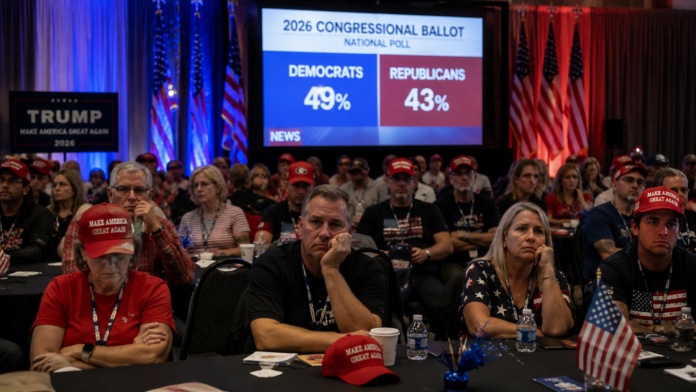
- Republican pollsters are warning that some normally dependable GOP voters are less motivated ahead of the 2026 midterms.
- Democrats currently hold an enthusiasm advantage, although the national congressional ballot remains closely divided.
- President Donald Trump and senior Republican advisers are developing a major turnout operation for the final campaign stretch.
- The early warning gives the party several months to strengthen its economic message and re-engage voters before November.
What Happened
Republican pollsters and campaign organisations are warning that the party must do more to energise its core supporters before the November midterm elections.
Internal research described by Republican strategists suggests that voter uncertainty extends beyond independents and occasional participants to some Americans who have consistently supported GOP candidates in previous elections.
The concern is primarily about motivation rather than a mass shift toward the Democratic Party.
- Some reliable Republican voters say they may stay home.
- Economic frustration remains a major source of dissatisfaction.
- Younger Republican-leaning men appear particularly difficult to mobilise.
- Rural voters remain supportive but are not uniformly enthusiastic.
A Washington Post-Ipsos survey found Democrats leading Republicans 48% to 45% among registered voters asked which party they would support for Congress.
The Democratic advantage increased among voters who described themselves as highly motivated to participate.
Republican operatives characterised the enthusiasm data as serious because turnout can decide closely divided House and Senate contests even when the broader electorate remains almost evenly split.
Why It Matters
The warning comes while Republicans hold narrow congressional majorities and must defend competitive seats across the country.
Even a modest decline in participation among dependable conservative voters could affect races decided by only a few thousand ballots.
At the same time, the polling does not show that Republican voters have broadly embraced Democratic candidates.
- The generic congressional ballot remains within a competitive range.
- Large majorities of Trump-aligned Republicans still say they intend to vote.
- Voter motivation can shift significantly during the final campaign months.
- Republicans possess substantial financial and organisational resources for turnout.
The distinction between preference and enthusiasm is politically important.
A dissatisfied Republican voter may still support the party once presented with a direct choice between advancing the president’s agenda and giving Democrats control of Congress.
The administration can therefore treat the current numbers as an operational challenge rather than proof that its coalition has permanently fractured.
Political and Public Context
The president’s party normally loses seats during midterm elections, especially when it controls both the White House and Congress.
Republicans entered the cycle knowing that Democrats would be highly motivated to obstruct the administration and regain subpoena, spending and legislative authority.
The latest data show that the opposition has already developed substantial urgency.
The task for Trump is to give conservative voters an equally compelling reason to participate.
- A Democratic House could launch aggressive investigations of the administration.
- A Democratic Senate could obstruct nominees and judicial appointments.
- Divided government could block border, tax and election-security legislation.
- Control of Congress will determine whether the president can complete his second-term programme.
Trump’s political team has begun holding strategy meetings involving White House allies, campaign advisers and leaders of MAGA-aligned organisations.
Those discussions have focused on polling, campaign themes and the use of a large Republican financial reserve.
The party is also planning a September gathering in Dallas intended to generate national attention and mobilise supporters during the final weeks of the campaign.
The administration has several policy achievements it can place at the centre of that effort, including tax changes, tighter immigration enforcement, new family savings accounts, tariff protections and efforts to strengthen election safeguards.
What Happens Next
Republican leaders will attempt to convert general support for the president into a clear understanding of what is at stake in individual congressional races.
That will require a campaign focused not merely on Trump’s popularity with the base, but on the consequences of allowing Democrats to control either chamber.
The party is likely to intensify direct voter contact, early-voting programmes and targeted advertising after the summer recess.
- Campaign groups will identify reliable Republicans at risk of not voting.
- The president will increase appearances in competitive states and districts.
- Republicans will connect local candidates to the administration’s national agenda.
- Economic affordability and congressional obstruction will dominate messaging.
The administration must also address concerns about prices, energy costs and the continuing conflict involving Iran.
Political advisers cannot assume that voters will overlook those issues simply because they prefer Republican policies on immigration, crime or elections.
A successful campaign will need to acknowledge economic frustration while explaining how Republican control will produce better outcomes than returning power to Democrats.
The enthusiasm gap is therefore a warning, but it may also arrive early enough to be useful.
Trump and Republican leaders now have a clear picture of where their turnout operation needs strengthening, access to extensive financial resources and several months to remind conservative voters that the midterms will determine whether the president’s agenda advances or stalls.