Story Highlights
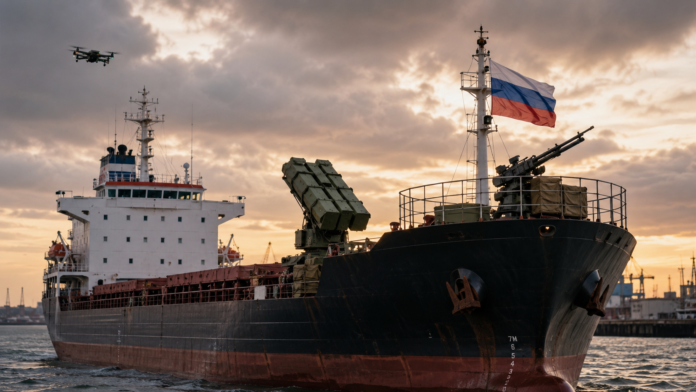
- Russian military and transport authorities are exploring plans to arm grain-carrying vessels with machine guns and mobile missile launchers in the Sea of Azov.
- Ukrainian drone strikes on ports, ships, and maritime infrastructure have suspended grain trade in the region for roughly two weeks.
- The Sea of Azov typically accounts for approximately one-quarter of Russia’s total grain export volume.
- Talks are underway between Russian government officials, grain traders, and shipowners to chart a path forward for resuming protected shipments.
What Happened
Russian military and transport authorities have entered discussions with grain traders and shipowners about arming commercial grain vessels operating in the Sea of Azov. The proposed measures under consideration include mounting machine guns and deploying mobile missile launchers aboard cargo ships, as Russia seeks to protect its agricultural export infrastructure from escalating Ukrainian drone attacks.
The situation has deteriorated rapidly in recent weeks. For approximately two weeks, grain trade through the Sea of Azov has been entirely suspended following a series of strikes targeting ports, ships at anchor, and other critical maritime infrastructure. The disruption represents a significant blow to Russian agricultural logistics, as the sea corridor in question ordinarily serves as a conduit for a substantial portion of the country’s grain exports each year.
- Machine guns and mobile missile launchers are among the armaments being considered for installation on commercial grain vessels.
- Russian military and transport authorities are the lead government bodies driving the proposal.
- Grain trade through the Sea of Azov has been suspended for approximately two weeks due to Ukrainian drone strikes.
- Ports, vessels, and broader maritime infrastructure in the region have all been targeted in the strikes.
Why It Matters
Russia holds the position of the world’s leading wheat exporter, and any prolonged disruption to its grain shipping routes carries significant implications well beyond its own borders. Global wheat markets are sensitive to supply shocks, and a continued shutdown of even a regional corridor like the Sea of Azov can ripple outward to affect food prices in importing nations across the Middle East, Africa, and parts of Asia — regions heavily reliant on affordable grain supplies.
The prospect of arming commercial vessels also raises complex legal and diplomatic questions under international maritime law. Placing military hardware on civilian cargo ships blurs the traditional distinction between commercial and military targets, potentially complicating the legal status of those vessels under rules of engagement and international conventions. Shipowners and insurers operating in conflict-adjacent waters are already navigating elevated risk assessments, and this proposal adds a further layer of uncertainty to an already volatile operating environment.
- Global wheat prices could face upward pressure if the Sea of Azov disruption continues long-term.
- Nations in the Middle East and Africa that depend on Russian wheat imports are among the most directly affected parties.
- International maritime law may be tested by the arming of civilian-registered commercial vessels.
- Insurance and liability frameworks for shipowners operating in contested waters face new complications.
Political and Public Context
The conflict between Russia and Ukraine has increasingly extended beyond land-based military operations into the maritime domain. Ukraine has demonstrated a sustained and effective capability to conduct drone and naval operations targeting Russian shipping infrastructure, most notably in the Black Sea, and the Sea of Azov has now become an active front in this campaign. The suspension of grain trade in the region reflects the cumulative toll of these sustained interdiction efforts.
For Russia, the stakes in protecting its grain export infrastructure go beyond simple economic interest. Agricultural exports — and wheat in particular — represent a key pillar of Russia’s international trade relationships and its geopolitical leverage over food-dependent nations. Any perception that Russia cannot reliably fulfill export commitments could erode its standing among partner countries that have maintained trade ties despite Western sanctions. The proposal to arm grain ships is therefore as much a political signal as it is a security measure.
- Ukraine has been conducting maritime drone operations against Russian shipping infrastructure across both the Black Sea and Sea of Azov.
- Russia’s position as the world’s top wheat exporter gives the trade disruption outsized global significance.
- Western sanctions have already constrained Russian trade options, making uninterrupted agricultural exports increasingly important.
- The arming of commercial vessels would mark a notable escalation in how Russia responds to maritime threats to its supply chains.
What Happens Next
The immediate focus is on whether Russian authorities, grain traders, and shipowners can reach a workable agreement on the proposed defensive measures and resume shipments through the Sea of Azov. The talks are ongoing, and the timeline for any resolution remains unclear. Much will depend on whether the parties can align on the practical and legal dimensions of arming commercial vessels, as well as on how the broader conflict situation evolves in the coming weeks.
Longer term, the outcome of these deliberations could set a precedent for how Russia manages its maritime trade security going forward. If armed protection is implemented and proves effective, it may become a standard feature of grain shipments in contested waters. If the talks stall or the security situation worsens, Russia may be forced to seek alternative routing or absorb continued disruptions to its export capacity.
- Ongoing talks between Russian officials, traders, and shipowners need to produce a concrete agreement before shipments can resume.
- The legal and logistical framework for arming commercial vessels must be established before any implementation can begin.
- Future Ukrainian drone operations will be a key variable in determining the effectiveness of any protective measures adopted.
- Global grain markets and dependent importing nations will be closely watching for signals of when and whether normal shipping volumes resume.