Story Highlights
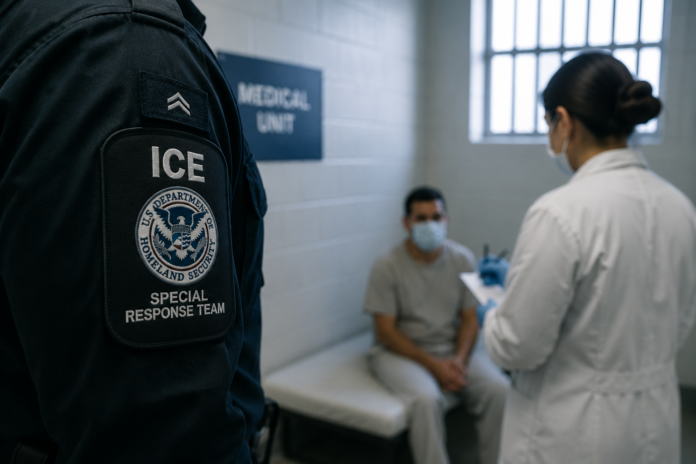
- An ICE Health Service Corps document confirms that at least one detainee in immigration custody received forcible medical treatment during a hunger strike.
- The Trump administration has maintained that detainees in ICE facilities receive humane care, pushing back against characterizations that conditions are driving hunger strikes.
- Hundreds of detainees at facilities across the country staged hunger strikes this summer, with the situation at Delaney Hall in New Jersey drawing particular national attention.
- Advocates and some medical associations have raised concerns about forced feeding and related interventions, while the administration continues to defend its detention policies as lawful and necessary.
What Happened
An internal document from the Immigration and Customs Enforcement Health Service Corps, published online in February and reviewed by media outlets, has disclosed that at least one individual held in immigration detention was subjected to forcible medical interventions while conducting a hunger strike. The document indicates that the unnamed detainee, who began hunger striking sometime between October and December of last year, underwent procedures that included force feeding, forced hydration, forced urinary catheterization, or involuntary blood draws.
The document also reveals that at least seven people were on hunger strike as of this past February. Budget projections included in the filing show that the IHSC allocated roughly $4,500 for external medical care for hunger strike patients and projected nearly $169,000 for the full fiscal year of 2026 based on previous cost data. The Department of Homeland Security, which oversees ICE, has not publicly addressed specifics about what treatments were administered or how widespread the practice has been since the start of President Trump’s second term.
- IHSC document published in February confirmed at least one case of forced medical treatment during a hunger strike.
- At least seven detainees were on hunger strike as of February, per the same document.
- The projected budget for hunger strike-related external medical care totaled approximately $169,000 for fiscal year 2026.
- DHS did not respond to inquiries about the nature of the treatment disclosed in the document.
Why It Matters
The disclosure has reignited a broader debate about the conditions inside ICE detention facilities and the appropriate limits of medical intervention on individuals in federal custody. Immigrant rights advocates and some healthcare professionals have long argued that forced feeding and related procedures on hunger strikers cross ethical and human rights lines. Several international organizations and domestic medical associations have characterized such interventions as a form of torture when performed against a detainee’s stated wishes.
The Trump administration, for its part, has consistently argued that detention facilities under its watch are operated lawfully and that detainees receive appropriate medical attention. Officials have pushed back against claims that poor conditions are motivating the strikes, insisting that standard care protocols are being followed. The administration’s broader immigration enforcement posture — centered on deterrence and fast removal — depends in part on maintaining that the detention system functions humanely and within legal bounds.
- Medical and human rights groups have characterized forced feeding as ethically impermissible under international standards.
- The administration’s credibility on humane detention conditions is directly tied to how this disclosure is interpreted publicly.
- Detainees at multiple facilities claim they are striking over unsanitary conditions, medical neglect, and physical mistreatment.
- Advocates say some hunger strikers have faced retaliation including solitary confinement and transfers to other facilities.
Political and Public Context
This summer saw a significant surge in hunger strike activity across multiple ICE detention facilities. The most prominent flashpoint came at Delaney Hall in Newark, New Jersey, where reportedly more than 300 detainees joined a combined hunger and labor strike that lasted from May into June. The facility drew sustained crowds of outside protesters, and the situation attracted national media coverage. Advocates representing those detainees alleged that the strike ended only after detainees faced retaliatory measures from facility officials, a claim the administration has denied.
At the Adelanto detention center in California, attorneys with the Immigrant Defenders Law Center have alleged that detainees who participated in hunger strikes were restrained with zip ties, threatened with tear gas, placed in solitary confinement, or transferred to other ICE facilities. ICE officials disputed those characterizations, asserting that at least one hunger strike organizer at Adelanto was not actually refusing food. The conflicting accounts reflect the deep mistrust that has developed between immigration advocates and the administration over the management of the detention system, even as the White House maintains it is enforcing immigration law more effectively than any prior administration.
- Over 300 detainees at Delaney Hall in New Jersey joined a hunger and labor strike from May to June.
- Attorneys at Immigrant Defenders Law Center alleged physical retaliation against hunger strikers at Adelanto in California.
- ICE officials denied that multiple clients of advocacy attorneys were actually forgoing food.
- The debate mirrors long-running disputes over the treatment of detainees that date back through multiple administrations.
What Happens Next
With the document now circulating publicly, pressure is likely to mount on Congress and oversight bodies to seek more detailed accounting from DHS and ICE about how many hunger strikers have received forced medical treatment since January 2025 and under what specific protocols. Immigrant rights groups have already indicated they intend to pursue the matter through legal channels, and at least one immigration attorney has described plans to use the document in ongoing litigation. The administration will face pressure to either defend the practice as legally sanctioned and medically necessary, or to articulate a clearer policy framework around how hunger strikers in custody are handled.
Meanwhile, the broader immigration detention debate is unlikely to slow. The White House has shown no sign of scaling back its enforcement agenda, and continued large-scale detentions make the management of detained populations an ongoing operational and political challenge. How the administration handles the fallout from this disclosure could have implications for its standing with moderate voters and with international partners who scrutinize U.S. human rights practices.
- Advocacy organizations are expected to pursue litigation using the IHSC document as evidence.
- Congressional oversight committees may seek formal briefings from DHS and ICE on forced treatment protocols.
- The administration will likely continue defending its detention practices as lawful while facing sustained legal and media pressure.
- Further disclosures about conditions at specific facilities, including Adelanto and Delaney Hall, remain possible.