Story Highlights
- President Trump is demanding the Senate pass the SAVE America Act before the upcoming August recess, warning of electoral consequences if it fails.
- The legislation would establish a national voter ID requirement, a cornerstone of Republican election security efforts heading into the 2026 midterms.
- The president is also pressing Senate Majority Leader John Thune to consider eliminating the filibuster to clear the path for conservative priorities.
- Key Senate races in Maine, Alaska, and Ohio are adding urgency to the push, with GOP majorities potentially at stake.
What Happened
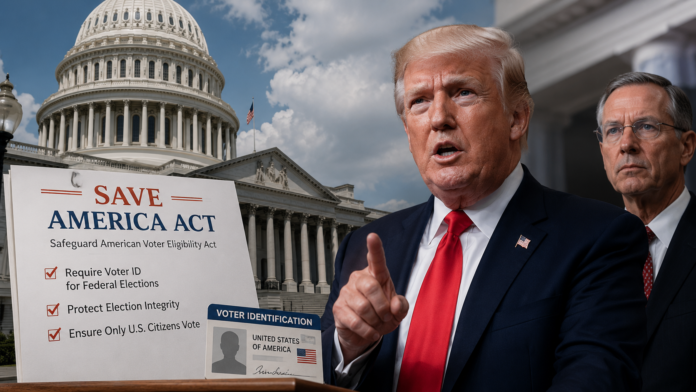
With less than two weeks remaining before the Senate is set to depart Washington for its summer recess, President Trump issued a forceful demand that Senate Majority Leader John Thune keep the chamber in session until the Safeguard American Voter Eligibility Act — known as the SAVE America Act — receives a vote and passes. The president made his position clear through a post on Truth Social, calling on Thune to hold the line and refuse to let senators leave the Capitol until the legislation is secured.
The bill, which would mandate voter identification requirements for federal elections, has long been a flagship priority for Trump and the Republican base. The president argued that failing to act before the recess would be a critical missed opportunity and warned that Democrats would not hesitate to pursue similar legislative goals the moment they had power. He further suggested that eliminating the filibuster would allow Republicans to swiftly advance a sweeping list of conservative legislation, including the SAVE America Act, the federal budget, and a resolution to the looming debt ceiling crisis.
- Trump posted his demands on Truth Social, directed at Senate Majority Leader John Thune of South Dakota
- The SAVE America Act would establish a national voter ID requirement for federal elections
- Sen. Mike Lee of Utah had already called for canceling the August recess to advance the bill
- The Senate schedule is packed with confirmations and a Russia sanctions package ahead of the recess deadline
Why It Matters
The stakes surrounding this legislation extend well beyond a single bill. Election integrity has remained one of the defining issues for the Republican base since 2020, and the SAVE America Act represents the most concrete legislative vehicle for addressing concerns about unauthorized voter participation in federal elections. For Trump, passing this measure before the 2026 midterms is not just a policy win — it is a political necessity that he believes will directly influence whether Republicans maintain and expand their Senate majority.
The president has made it plain that he views inaction as politically dangerous. His administration has consistently framed voter ID as a common-sense safeguard that enjoys broad public support, and the White House sees the Senate’s hesitation as an unnecessary concession to procedural obstacles that Democrats would never accept if roles were reversed. The urgency is compounded by the midterm calendar, where every week of campaigning matters for vulnerable incumbents.
- Republican incumbents in Maine, Alaska, and Ohio face competitive 2026 races that could determine Senate control
- The filibuster currently blocks the bill from advancing without 60 votes, a threshold Republicans do not hold
- Failure to pass the legislation before recess could energize Democratic messaging about GOP dysfunction
- Conservative voters and grassroots activists have made election integrity a top-tier issue heading into the midterm cycle
Political and Public Context
The clash between the White House and Senate Republican leadership reflects a broader tension that has defined this Congress. Trump has consistently pushed for bold, fast-moving action on his priorities, while Senate Majority Leader Thune has navigated a more cautious path shaped by the chamber’s procedural realities and the need to hold together a slim majority. That dynamic has produced friction on multiple fronts, and the SAVE America Act is now the latest flashpoint.
Voter ID enjoys strong support in public polling across party lines, which is why the administration views the failure to capitalize on that popularity as a strategic error. The president’s allies in the Senate, led by Sen. Mike Lee, have amplified his message, objecting to any recess vote until the legislation moves forward. Meanwhile, the absence of former Senate Republican Leader Mitch McConnell from the chamber’s internal deliberations has complicated coalition-building on an already difficult procedural path.
- Sen. Mike Lee formally objected to any Senate recess effort until the SAVE America Act advances
- Tensions between the White House and Sen. Thune have been building over the stalled legislation
- Sen. McConnell’s absence from active leadership has complicated internal Senate Republican dynamics
- Trump has repeatedly called for filibuster elimination across multiple legislative priorities during his current term
What Happens Next
The next two weeks will be decisive. The Senate faces a compressed window before the planned August recess, and leadership must decide whether to attempt a vote on the SAVE America Act, risk the political fallout of departing without acting, or explore procedural paths that could bring the bill closer to passage. The president has made clear he will continue to publicly pressure Thune and Senate Republicans, and his allies inside the chamber are prepared to escalate their objections if leadership does not act.
The filibuster question is likely to remain unresolved for now, as there is no current majority within the Republican conference to eliminate it. However, continued pressure from the White House could shift that calculus over time, particularly if the 2026 midterm environment tightens and lawmakers begin to weigh the cost of inaction against the procedural risks of rule changes. The coming days will reveal just how much leverage the president holds over the chamber’s agenda.
- Senate leadership must decide within days whether to schedule a SAVE America Act vote before the recess
- The filibuster remains the primary procedural barrier and currently lacks the votes for elimination
- Trump is expected to continue applying public pressure through social media and direct outreach to Republican senators
- The outcome will likely influence campaign messaging for GOP incumbents in competitive 2026 Senate races