

Story Highlights
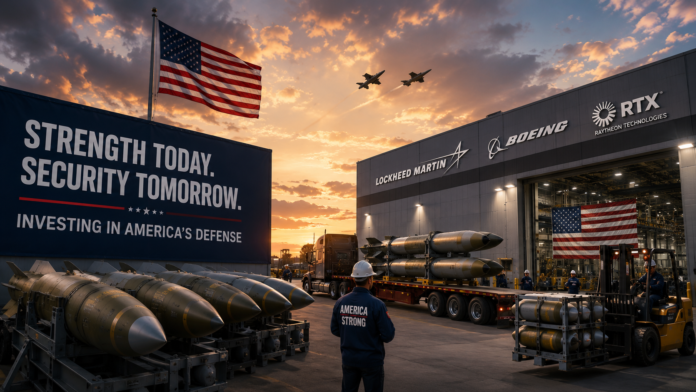
- The Pentagon has awarded two massive defense contracts totaling roughly $135 billion in a single day to major American defense firms.
- The Trump administration has requested an unprecedented $1.5 trillion defense budget, framing it as a generational investment in national security.
- Escalating military demands tied to the Iran conflict have strained existing U.S. weapons stockpiles, prompting accelerated production timelines.
- Multiyear mega contracts signal a long-term, strategic commitment to rebuilding and sustaining American military superiority.
What Happened
The Pentagon made headlines this week by announcing two landmark defense contracts in a single day, together valued at approximately $135 billion. The agreements were awarded to major U.S. defense companies as part of a broader strategy to accelerate domestic weapons production and shore up military readiness at a time when tensions with Iran continue to intensify.
These contracts are part of a wider defense posture shaped by the Trump administration, which has formally requested a $1.5 trillion defense budget — an unprecedented figure in American history. The White House has described this level of investment as a necessary generational commitment to preparing U.S. armed forces for the challenges of future conflicts, not just current ones. The scale of the contracts and the budget request together reflect a decisive turn toward long-term military preparedness rather than reactive, short-term spending.
- Two contracts totaling approximately $135 billion announced in a single day.
- Contracts awarded to major domestic defense companies to boost production capacity.
- The administration has formally requested a $1.5 trillion defense budget.
- The push is being driven in part by dwindling U.S. weapons stockpiles as Iran-related military demands increase.
Why It Matters
The scale of these contracts underscores just how seriously the Trump administration is treating the current threat environment. As the conflict with Iran continues to place mounting pressure on U.S. weapons inventories, the decision to lock in multiyear production agreements with leading defense contractors provides both immediate relief and long-term supply chain stability. It is a calculated move that prioritizes readiness over complacency.
For American taxpayers and allies alike, the message is clear: the administration is not willing to allow the nation’s military edge to erode under the weight of ongoing conflicts. By investing at a historic scale, the president is ensuring that the United States remains capable of projecting strength and deterring adversaries well beyond the current crisis. This is precisely the kind of forward-thinking leadership that many conservatives have long called for from Washington.
- Dwindling weapons stockpiles are being replenished through accelerated domestic production.
- Long-term multiyear contracts provide defense manufacturers with the planning horizon needed to scale operations.
- Allied nations watching U.S. military commitments are likely to take note of the strong posture.
- American defense workers and the industrial base stand to benefit significantly from the surge in contracts.
Political and Public Context
The Pentagon’s contracting push does not exist in a vacuum. It is the direct result of policy choices made by President Trump and his national security team, who have consistently argued that decades of underinvestment left the U.S. military dangerously underprepared. His administration came into office with a stated goal of rebuilding the armed forces from the ground up, and these contracts represent a tangible, measurable step in that direction.
Politically, the move is likely to resonate strongly with conservative voters and defense hawks who have long criticized previous administrations for allowing military readiness to slip. The $1.5 trillion budget request has drawn attention across Washington, with supporters arguing it reflects a sober assessment of a world that has grown more dangerous. Critics on the left may balk at the price tag, but the administration has framed the investment not as optional spending but as an existential necessity in a volatile global environment.
- The administration has consistently argued that prior administrations left the military underfunded and underprepared.
- The $1.5 trillion budget request is described as a generational investment in national defense.
- Defense hawks in Congress have been among the strongest supporters of the increased spending posture.
- The Iran conflict has elevated national security to the top of the political agenda heading into the next legislative cycle.
What Happens Next
With the contracts now awarded, the focus shifts to execution. Defense companies will be expected to ramp up production quickly to address the stockpile shortfalls that have been building as the Iran situation evolves. The administration will likely use progress on these contracts as both a practical metric of military readiness and a political showcase of effective governance.
On the budget front, the $1.5 trillion request will need to navigate Congress, where even some allies may push back on specific line items. However, the broader argument for strong defense spending appears to have momentum behind it. The White House is expected to continue making the case that investment now prevents far more costly conflicts later, a message that has historically resonated across a wide swath of the American electorate.
- Defense contractors must begin scaling production capacity under the new multiyear agreements.
- The $1.5 trillion defense budget request will move through congressional review and debate.
- Military stockpile levels will be closely monitored as Iran-related operational demands continue.
- The administration is expected to highlight contract milestones as evidence of responsible and proactive leadership.


