Story Highlights
- New York City’s iconic Flatiron Building is completing a major renovation, converting from office space into ultra-luxury residential apartments.
- Individual units are priced as high as $58.5 million, placing the building among the most expensive residential addresses in Manhattan.
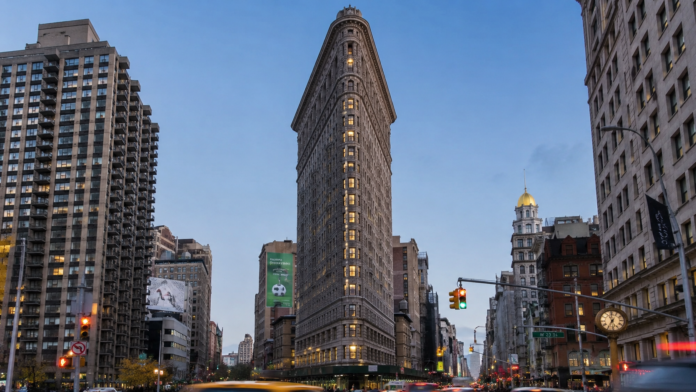
- The seven-year scaffolding project has come down, restoring the building’s famous Beaux-Arts exterior to public view for the first time since 2019.
- The transformation marks the first time in the structure’s 120-plus-year history that it will serve as a residential property.
What Happened
After more than seven years behind scaffolding, the Flatiron Building in New York City is nearing the completion of a sweeping renovation that will convert the landmark structure from an office building into a collection of ultra-luxury residential apartments. The project represents not just a physical transformation of one of America’s most recognized buildings, but also signals a new era in how historic commercial properties are being reimagined for modern high-end living.
The renovation involved both internal and external work, overhauling the awkward layout that had served as office space for over a century. The result is a set of residences priced at up to $58.5 million per unit. According to data compiled by Manhattan Miami Real Estate, only 21 other residences currently on the public market or under contract in New York City carry higher price tags, with the most expensive being a $128 million condominium located near Central Park.
- Renovation lasted approximately seven years, with scaffolding now largely removed.
- Units are priced as high as $58.5 million, placing the building among Manhattan’s elite residential addresses.
- The last office tenants, Macmillan Publishing, vacated the premises in 2019.
- The building stood vacant for several years amid ownership disputes before the current redevelopment proceeded.
Why It Matters
The Flatiron Building’s conversion into luxury residences carries enormous significance both for New York City’s real estate market and for the broader national conversation about the rising cost of urban living. At price points that most Americans could never dream of affording, the project underscores just how stratified the high-end real estate market in major metropolitan areas has become. The building’s transformation is a vivid illustration of the economic forces reshaping city centers across the country.
Beyond economics, the renovation carries architectural and cultural weight. The Flatiron has been a defining piece of New York’s skyline since 1902, and its restoration ensures that its celebrated Beaux-Arts facade — complete with ornamental columns and intricate decorative details — will endure. The building’s return to full visibility is already drawing tourists back to the small triangular park in front of the structure, benefiting surrounding businesses and the broader neighborhood economy.
- The restoration boosts foot traffic and commerce in the Flatiron and NoMad neighborhoods of Manhattan.
- The sale prices set a benchmark for luxury residential conversions of historic commercial properties.
- Surrounding retailers and dining establishments stand to benefit from increased tourism to the restored landmark.
- The project adds to pressure on city housing discussions, as ultra-luxury construction dominates high-profile development activity.
Political and Public Context
The Flatiron Building was originally completed in 1902, designed by architect Daniel Burnham to fit a wedge-shaped plot at the intersection of Broadway and Fifth Avenue. Its pioneering steel-frame construction made it one of New York City’s earliest skyscrapers. At the time of its construction, the building was widely mocked as an impractical folly, with residents doubting whether such a tall and thin structure could remain standing against the wind. History proved the skeptics wrong, and the building went on to house a range of tenants including clothing companies, toy businesses, magazines, and publishing houses over more than a century of commercial use.
The building’s path to residential conversion was not without complications. Ownership disputes following Macmillan Publishing’s departure in 2019 left the structure vacant for an extended period while legal and financial matters were sorted out. The Flatiron NoMad Partnership, a business improvement district that manages the adjacent park space, noted that visitor counts dipped during the scaffolding years, compounded by the effects of the pandemic, but that foot traffic has rebounded as the scaffolding has come down.
- The Flatiron Building was originally constructed for the Fuller Company, a Chicago-based construction firm.
- Architect Daniel Burnham designed the building in 1902 to fit a uniquely shaped triangular plot.
- The structure was historically known as one of New York City’s first true skyscrapers, standing 94 meters tall.
- Ownership disputes following Macmillan’s 2019 departure delayed redevelopment for several years.
What Happens Next
With the scaffolding largely removed and the renovation nearing completion, attention now turns to the sales process and the eventual occupation of the building’s new residential units. Real estate observers will be watching closely to see how quickly units at prices approaching $58.5 million are absorbed by the market, which could offer broader signals about the strength and depth of demand at the very top of Manhattan’s luxury residential sector.
Tourism around the Flatiron district is already recovering, with visitors returning to photograph the restored exterior. Local business owners and neighborhood groups are optimistic that the building’s renewed visibility will generate sustained economic activity in the surrounding area. The project could also serve as a blueprint for similar adaptive reuse efforts at other historic commercial properties across the country, as office vacancy rates in major cities remain elevated and developers seek alternative uses for landmark structures.
- Remaining residential units will continue to be marketed, with prices reaching up to $58.5 million.
- The Flatiron NoMad Partnership anticipates continued growth in tourist visits to the adjoining park area.
- The conversion may influence future adaptive reuse projects for historic commercial buildings nationwide.
- Market absorption rates for the ultra-luxury units will serve as a key indicator of demand at Manhattan’s highest price tiers.