Story Highlights
- The House passed the $70 billion immigration enforcement bill after the Senate approved it in a narrow 52-47 vote.
- The package funds ICE and Border Patrol through the end of President Donald Trump’s term.
- Debate over the contested $1.8 billion “anti-weaponization” settlement fund exposed Republican divisions but did not stop final passage.
What Happened
The House passed a $70 billion immigration enforcement package that delivers one of President Donald Trump’s biggest domestic policy wins of his second term.
The legislation funds Immigration and Customs Enforcement and Border Patrol for the next three years, giving the administration stable money for interior enforcement, deportation operations and border security.
The House vote followed Senate passage after an overnight vote-a-rama that centered heavily on whether Congress should restrict a contested settlement fund linked to Trump’s lawsuit over the leak of his tax records.
- The Senate passed the bill 52-47.
- The House later approved it 214-212.
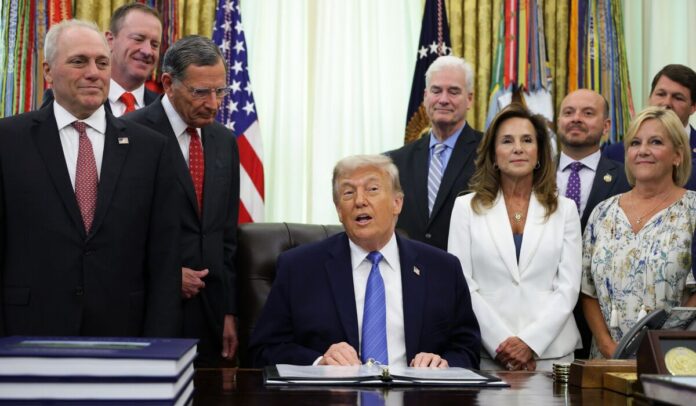
- The bill now moves to Trump for signature.
The legislation includes tens of billions of dollars for immigration enforcement agencies, including major funding for ICE and Border Patrol.
Supporters say the bill ends months of uncertainty and gives federal agencies the resources needed to carry out Trump’s immigration agenda without recurring shutdown threats.
Democrats opposed the package, arguing that it expands enforcement without enough restrictions on agency tactics or accountability measures.
The most politically sensitive dispute involved the nearly $1.8 billion “anti-weaponization” settlement fund.
Critics from both parties warned the fund could be used to compensate Trump allies or people connected to politically charged cases.
Acting Attorney General Todd Blanche told lawmakers the fund would not proceed as originally conceived, but senators rejected attempts to permanently ban it in the bill.
Why It Matters
The bill matters because it locks in funding for the core agencies behind Trump’s immigration crackdown.
For the administration, that removes a major obstacle: Democrats and some moderates had used spending fights to demand changes after controversial enforcement incidents earlier in the year.
With multi-year funding secured, ICE and Border Patrol can plan staffing, detention capacity, transportation, investigations and field operations with far more certainty.
- The bill strengthens Trump’s ability to carry out large-scale immigration enforcement.
- It reduces the chance that future budget fights will interrupt agency operations.
- It gives Republicans a major immigration achievement heading into the midterms.
Supporters of the bill will frame it as a necessary investment in border security and public safety.
They argue that immigration enforcement should not be dependent on repeated short-term spending fights, especially when the administration is trying to accelerate deportations and expand interior operations.
The neutral concern is oversight.
A bill of this size gives enforcement agencies major new capacity, but critics say Congress did not attach enough binding limits on how the money can be used or how controversial legal settlements should be handled.
That debate will continue even after Trump signs the bill.
Political and Public Context
The passage gives Trump a strong immigration message at a time when border security and interior enforcement remain central to Republican campaigns.
The president can argue that Congress has now backed his enforcement strategy with long-term funding rather than symbolic promises.
For House and Senate Republicans, the win also shows that the party can move major legislation despite internal disagreements over executive power and spending oversight.
- Trump secured the funding package without major Democratic support.
- Republican leaders kept the bill focused on immigration enforcement.
- The settlement-fund fight showed continued discomfort inside the GOP.
The internal Republican dispute over the settlement fund should not be ignored.
Some GOP senators wanted stronger language blocking the fund, arguing that informal assurances from the Justice Department were not enough.
Others worried that changing the bill would delay or endanger immigration funding that had already been held up for months.
Senate Majority Leader John Thune pushed members to avoid changes that could complicate final passage.
That strategy worked legislatively, but Democrats are likely to use the settlement-fund issue as a campaign argument.
They will claim Republicans gave Trump enforcement money while failing to impose firm guardrails on a fund critics describe as politically motivated.
Republicans will counter that the fund issue was effectively addressed by the Justice Department and that the real policy win is fully funding immigration enforcement.
What Happens Next
Trump is expected to sign the bill, turning the funding package into law and giving immigration agencies a stable three-year budget framework.
Once signed, the administration can begin moving funds into enforcement operations, detention expansion, transportation capacity and agency staffing.
The Justice Department will still face questions about the status of the anti-weaponization fund and whether any related claims can move forward through other channels.
- Watch for Trump’s signing ceremony and White House messaging.
- Monitor how ICE and Border Patrol allocate the new funding.
- Follow whether Democrats pursue oversight hearings on enforcement tactics.
- Track whether lawmakers revisit restrictions on the settlement fund.
The bill’s passage does not end the broader immigration debate.
It strengthens enforcement capacity, but it does not resolve disputes over detention conditions, deportation priorities, protest responses or the role of local governments.
For Trump, the strongest outcome is clear: a major legislative victory that backs his immigration agenda through the remainder of his term.
For Republicans, the challenge is defending the package as a security measure while answering questions about cost, oversight and the settlement-fund controversy.
For Democrats, the fight now shifts from blocking the bill to scrutinizing how the administration uses the money.
The funding battle is over, but the political and legal fights around Trump’s immigration enforcement strategy are likely to intensify.
Sources
- Reuters: House Passes $70 Billion ICE and Border Patrol Bill
- Associated Press/NBC Washington: Senate Passes $70 Billion Immigration Bill Without Settlement Fund Limits
- The Guardian: Senate Approves Immigration Enforcement Funding Amid GOP Splits
- Justice Department: Anti-Weaponization Fund Announcement
- The Guardian: Acting Attorney General Says Fund Will Not Proceed as Originally Planned