Story Highlights
- The White House has removed CNN from the press pool for President Trump’s upcoming trip.
- This decision follows a federal judge’s ruling against the administration’s media access restrictions.
- The ongoing feud highlights tensions between the Trump administration and CNN.
- Support from other media organizations indicates a broader concern over press freedoms.
What Happened
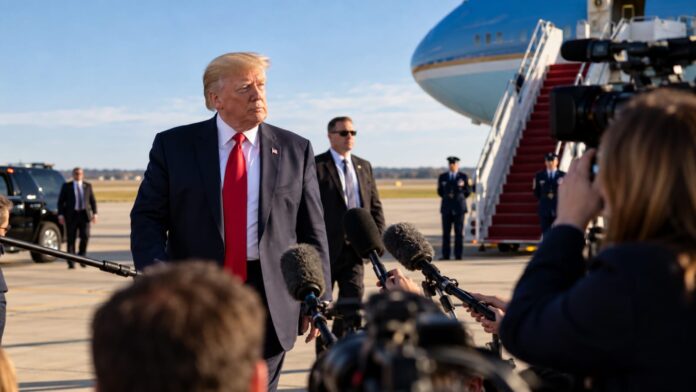
In a significant escalation of tensions between the Trump administration and CNN, the White House announced on Wednesday that the cable network would be excluded from the press pool covering President Trump’s upcoming trip to Texas and Oklahoma. This decision comes on the heels of a federal judge’s ruling that blocked the administration’s attempts to restrict media access for CNN, MS NOW, and Politico. The president’s ongoing battle with the media has raised questions about press freedoms and the relationship between the White House and major news outlets.
Initially, CNN was slated to travel with Trump on Thursday, as indicated by a press rotation document released by the White House on Sunday. However, when the daily guidance was issued for the president’s visit to a truck manufacturing facility in Denton, Texas, followed by remarks in Durant, Oklahoma, CNN was notably absent from the list of media outlets providing pool coverage. This exclusion marks a continuation of the administration’s contentious relationship with the network, which has been characterized by accusations of bias and unfair reporting.
- The White House removed CNN from the press pool on Wednesday.
- A federal judge recently halted Trump’s efforts to restrict media access.
- CNN was previously scheduled to cover Trump’s trip to Tennessee but was barred from flying on Air Force One.
- Emily Kuhn, a spokesperson for CNN, confirmed the network’s removal but did not provide further comment.
Why It Matters
The implications of this decision extend beyond the immediate exclusion of CNN from the press pool. It underscores a broader struggle over press freedoms and the administration’s approach to media relations. Critics of President Trump often argue that his administration’s actions represent a threat to the First Amendment and the principles of a free press. However, supporters contend that the president’s actions are a necessary response to what they perceive as a biased media landscape that often misrepresents his policies and achievements.
By removing CNN from the press pool, the White House is sending a clear message about its willingness to challenge media narratives that it deems unfair. This move may resonate with many Americans who feel that mainstream media outlets have not accurately portrayed the president’s accomplishments, particularly in areas such as economic growth, job creation, and national security. The ongoing feud also highlights the importance of media accountability and the need for a diverse range of voices in political discourse.
- The exclusion of CNN may embolden other media outlets to take a stand against perceived bias.
- Support for the president’s actions could strengthen his base among conservative voters.
- Potential legal ramifications could arise from the ongoing battle over media access.
- The situation may lead to increased scrutiny of the relationship between the White House and the press.
Political and Public Context
To fully understand the significance of this latest development, it is essential to consider the broader context of the Trump administration’s relationship with the media. Over the years, President Trump has faced criticism for his confrontational approach to journalists and news organizations that he believes misrepresent his policies. This has included restricting access to certain media outlets, as seen in the recent ban on CNN, MS NOW, and Politico from the White House.
In 2025, the president took similar actions by banning The Associated Press from the Oval Office and Air Force One due to a disagreement over the naming of the Gulf of Mexico. Such incidents have raised alarms among press freedom advocates, who argue that these actions undermine the principles of transparency and accountability that are vital to a functioning democracy.
- Other media organizations, including Fox News and NBC News, have expressed solidarity with CNN in this dispute.
- The White House Correspondents’ Association has voiced concerns over the administration’s media access policies.
- Legal briefs supporting CNN have been filed by various media organizations, indicating widespread concern over press freedoms.
- Previous instances of media access restrictions have set a concerning precedent for future administrations.
The White House removes CNN from the press pool that’s set to cover a trip by President Trump, escalating a feud with the cable network after a federal judge blocked the administration’s push to restrict its media access. https://t.co/gQUqVFwJki
— NBC News (@NBCNews) October 1, 2026
What Happens Next
Looking ahead, the ongoing feud between the Trump administration and CNN raises several important questions about the future of media access and press freedoms. As the president continues to challenge narratives that he perceives as biased, it remains to be seen how other media outlets will respond. Will they rally together in support of CNN, or will they choose to distance themselves from the controversy?
Additionally, the legal ramifications of this dispute could have lasting effects on the relationship between the White House and the press. As the courts weigh in on the administration’s media access policies, the outcome could set important precedents for future interactions between government officials and journalists. The potential for increased scrutiny of the administration’s actions may also lead to a more robust dialogue about the role of the media in a democratic society.
- Media organizations may band together to advocate for press freedoms in light of this incident.
- Legal challenges to the administration’s media access policies could escalate.
- Future press briefings may see increased tensions between the White House and journalists.
- The public’s perception of media credibility may continue to evolve in response to these events.