Story Highlights
- Vice President JD Vance and Trump’s envoys moved to restart U.S.-Iran nuclear talks after fighting in Lebanon delayed the process.
- Steve Witkoff and Jared Kushner arrived in Switzerland as Iran prepared to send senior officials back to the negotiating table.
- The talks will test whether the Trump-brokered Iran framework can survive regional shocks while keeping Hormuz open.
What Happened
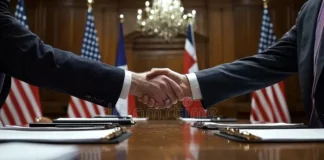
U.S.-Iran nuclear negotiations resumed in Switzerland after a flare-up between Israel and Hezbollah in Lebanon temporarily delayed the first formal round of talks under the new peace framework.
President Donald Trump’s envoys Steve Witkoff and Jared Kushner arrived in Switzerland ahead of the rescheduled session, while Vice President JD Vance prepared to take a larger role in the process.
The talks were originally expected earlier, but Iran paused participation after Israeli strikes in Lebanon raised concerns that the broader ceasefire framework could unravel.
- Lebanon fighting delayed the scheduled talks.
- Trump pushed for a ceasefire to keep diplomacy moving.
- Iranian officials agreed to return to the table after the pause.
Iranian Foreign Minister Abbas Araghchi and other senior Iranian officials were expected to participate in the Geneva process.
The negotiations are designed to build on the interim U.S.-Iran memorandum that ended direct hostilities, reopened the Strait of Hormuz and created a 60-day window for deeper talks.
The core issues now include Iran’s nuclear program, international inspections, sanctions relief, frozen assets and regional ceasefire enforcement.
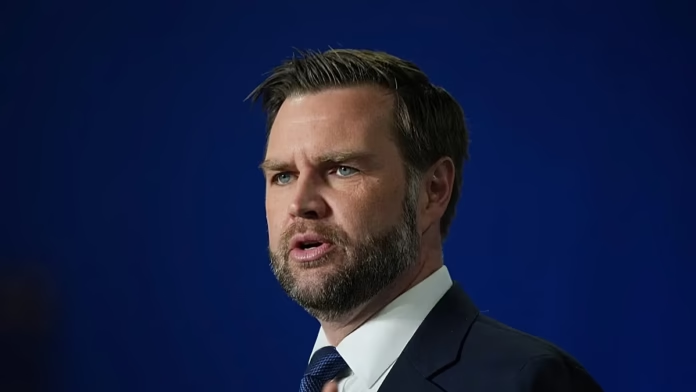
Vance said the discussions had created a strong foundation for a final agreement, while also making clear that technical talks would continue in the coming days and weeks.
The Trump administration is presenting the restart as evidence that direct pressure, personal diplomacy and regional crisis management can keep the agreement alive even after its first major test.
Why It Matters
The Switzerland talks matter because the interim Iran deal is not yet a final settlement.
The memorandum created a ceasefire and a process, but it did not resolve every nuclear, sanctions or regional-security question.
Every delay reduces the limited time negotiators have to convert broad commitments into enforceable terms.
- Inspectors need access to verify Iran’s nuclear commitments.
- Sanctions relief must be sequenced with Iranian compliance.
- Regional fighting could still threaten the larger framework.
For Trump, the talks are a chance to prove that the Iran agreement can survive real-world pressure.
The Lebanon flare-up showed how quickly outside actors can complicate a bilateral deal between Washington and Tehran.
By pressing for de-escalation and sending senior envoys back into negotiations, the administration is trying to prevent the agreement from becoming a temporary pause rather than a durable diplomatic path.
The neutral concern is that Iran, Israel, Hezbollah and regional governments all have different incentives.
Even if Washington and Tehran make progress in Switzerland, fighting in Lebanon or disputes over inspections could still weaken confidence in the deal.
Political and Public Context
Vance’s role gives the negotiations greater political weight inside the Trump administration.
Witkoff and Kushner helped shape the original diplomatic channel, but Vance’s involvement signals that the White House wants the next phase treated as a top-level national-security priority.
The vice president has emphasized that Iran must allow nuclear inspectors back in and that any economic relief must be tied to concrete compliance.
- Trump wants the agreement to reduce war risk without appearing weak on Iran.
- Vance is helping frame the talks as verification-first diplomacy.
- Iran wants sanctions relief and access to frozen assets as negotiations proceed.
The administration is also trying to manage Israel’s conduct during the 60-day negotiating window.
Trump has remained supportive of Israel’s security, but he has also warned against operations that could undermine the broader regional settlement.
That balancing act is politically sensitive.
Republican hawks will want strong proof that Iran’s nuclear program is being restricted, while America First conservatives will welcome continued efforts to avoid another open-ended conflict.
Democrats are likely to press for more transparency on the agreement’s terms, the role of inspectors and the legal basis for any sanctions relief.
What Happens Next
Technical teams are expected to continue talks after the Switzerland meetings, focusing on verification, sanctions sequencing and Hormuz security.
A key early test will be whether Iran allows inspectors to begin meaningful access and whether Washington issues limited economic relief only after measurable steps.
The Strait of Hormuz will remain central to the talks.
Shipping traffic has begun recovering, but Reuters reported that flows remain well below pre-war levels, meaning commercial confidence has not fully returned.
- Watch whether IAEA inspectors receive access to Iranian sites.
- Monitor whether the Lebanon ceasefire holds.
- Follow decisions involving frozen Iranian assets and sanctions waivers.
- Track commercial traffic through the Strait of Hormuz.
If the talks continue moving forward, Trump can argue that his administration turned military leverage into a diplomatic process with economic benefits.
If the talks stall, critics will argue that the interim framework lacked enough enforcement detail from the start.
The strongest result for the administration would be verified nuclear access, stable shipping through Hormuz and a regional ceasefire that prevents Lebanon from derailing the broader agreement.
For now, the Switzerland talks have kept the process alive, but the next steps will decide whether the Iran framework becomes a lasting settlement or another fragile pause in a volatile region.
Sources
- Reuters: Lebanon Ceasefire Sets Up Renewed U.S.-Iran Talks
- Reuters: Vance Says Iran Talks Made Progress on Inspectors and Hormuz
- Associated Press: U.S.-Iran Negotiations Begin in Switzerland
- Axios: Witkoff and Kushner Arrive in Switzerland for Iran Talks
- Reuters: Tanker Traffic Begins Recovering Through Hormuz