Story Highlights
- President Trump and House Speaker Mike Johnson prioritize innovation in AI discussions.
- Key tech executives from leading companies are set to attend the White House meeting.
- The focus will be on finding a balance between regulation and technological advancement.
- Concerns over AI’s rapid development and its implications for national security are at the forefront of discussions.
What Happened
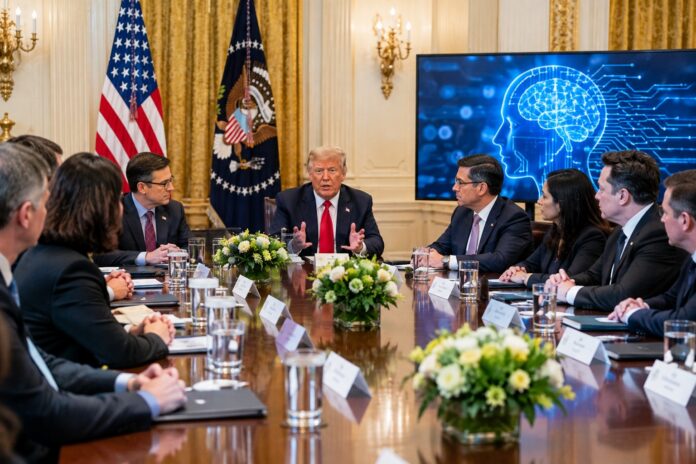
On a pivotal day for the future of artificial intelligence in the United States, President Trump and House Speaker Mike Johnson convened with top executives from leading AI companies at the White House. This meeting, held on a Tuesday afternoon in the East Room, comes amid growing concerns regarding the rapid advancement of AI technologies and the potential risks they pose to society. The discussions are framed within a broader context of regulatory scrutiny, as lawmakers grapple with how to manage the implications of these powerful technologies.
Among the notable attendees were Dario Amodei, CEO of Anthropic, Greg Brockman, President of OpenAI, Sundar Pichai, CEO of Google, Alex Karp, CEO of Palantir, Mark Zuckerberg, CEO of Meta, and Jensen Huang, CEO of Nvidia. Each of these leaders brings a unique perspective on the challenges and opportunities presented by AI, making the meeting a significant event in the ongoing dialogue about technology regulation.
- The meeting took place on Tuesday at 12:30 p.m. in the East Room of the White House.
- Key figures included Anthropic’s Dario Amodei and OpenAI’s Greg Brockman.
- House Speaker Mike Johnson emphasized the need for a balanced approach to regulation.
- President Trump had a private dinner with Amodei prior to the meeting, discussing AI regulations.
Why It Matters
The discussions led by President Trump and Speaker Johnson are crucial as they reflect a significant shift in how the government approaches the regulation of emerging technologies. The president’s administration has consistently advocated for innovation, arguing that excessive regulation could stifle growth and hinder the United States’ competitive edge in the global technology landscape. This meeting underscores a commitment to fostering an environment where innovation can thrive while still addressing legitimate safety concerns.
Speaker Johnson articulated a vision that prioritizes innovation over bureaucratic red tape, stating, ‘Instead of just smothering this with red tape, which is always the government’s reflex, and I think would be wrong and frankly dangerous to national security if we did it here, we want to continue the innovation.’ This perspective resonates with many in the tech industry who fear that overregulation could hinder the United States’ ability to lead in AI development.
- Excessive regulation could stifle innovation and economic growth.
- National security concerns are heightened as AI technologies evolve rapidly.
- Tech executives are advocating for a balanced approach to regulation.
- The outcome of these discussions could shape future AI policies significantly.
Political and Public Context
The backdrop of this meeting is a growing debate about the implications of AI technologies. As AI systems become more sophisticated, concerns about their potential risks have intensified. Some industry leaders, including Amodei, have called for safeguards to manage the pace of AI development, arguing that without proper oversight, the technology could pose existential threats. However, others, like Huang, caution against overreacting to these fears, suggesting that the warnings may be exaggerated and that the U.S. must maintain its technological edge over competitors like China.
In recent weeks, the conversation around AI regulation has gained momentum, with various stakeholders weighing in on the need for a thoughtful approach. The meeting at the White House is part of a broader effort to engage with industry leaders and find common ground on how to navigate the complexities of AI regulation. The presence of high-profile executives at this gathering signals the importance of collaboration between the government and the tech sector in shaping the future of AI.
- Executives from AI companies have been vocal about the need for regulation.
- Concerns about national security and technological competition with China are prevalent.
- Previous meetings have included discussions with international leaders, such as Chinese President Xi Jinping.
- The White House has been proactive in engaging with tech leaders on these issues.
Mike Johnson backs voluntary regulation to ‘calm the nerves’ on AI safety https://t.co/Zb8LQ5Rg9a
— POLITICO (@politico) September 29, 2026
What Happens Next
Looking ahead, the outcomes of this meeting could have far-reaching implications for the future of AI regulation in the United States. As President Trump and Speaker Johnson continue to engage with industry leaders, the administration is likely to outline a framework that balances innovation with necessary safeguards. This approach could set a precedent for how the government interacts with the tech industry moving forward.
Moreover, the discussions may lead to the establishment of a federal ‘AI force,’ as hinted by the president, aimed at overseeing AI development and ensuring that the U.S. remains at the forefront of technological advancements. The administration’s commitment to fostering innovation while addressing safety concerns will be closely watched by both supporters and critics alike.
- Expect further discussions on AI regulation and innovation in upcoming meetings.
- The establishment of a federal ‘AI force’ may be announced soon.
- Industry leaders will likely continue to advocate for a balanced regulatory approach.
- The administration’s policies will shape the future landscape of AI development in the U.S.