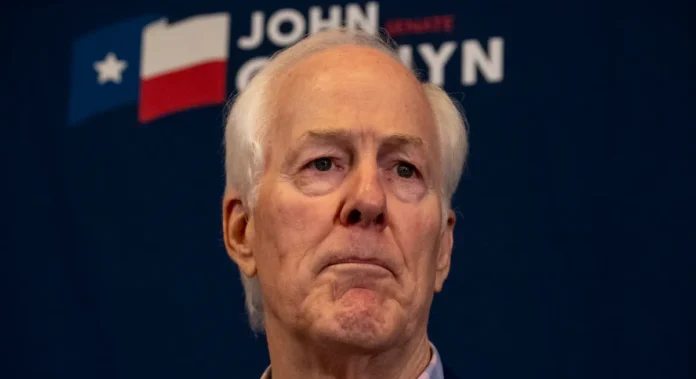
In one of the most consequential primary upsets of the modern Republican era, Trump-backed Texas Attorney General Ken Paxton defeated four-term incumbent Senator John Cornyn by more than 25 percentage points in Tuesday’s GOP Senate runoff, ending Cornyn’s 23-year Senate career. The victory, delivered one week after Trump issued his endorsement and declared Paxton “a true MAGA warrior,” makes Cornyn the first Republican senator from Texas ever to lose a party nomination for reelection. The result sends a defining message about the price of perceived disloyalty to Trump — and sets up what may become one of the most expensive Senate races in American history.
Story Highlights
- Ken Paxton defeated John Cornyn 62.5 percent to 37.5 percent, with the race called approximately an hour after polls closed
- Trump endorsed Paxton one week before the runoff after months of pressure from Senate Republican leadership to back Cornyn
- Paxton will face Democratic state Representative James Talarico in November, in a race Democrats believe they can win
What Happened
Ken Paxton, the Texas Attorney General who survived an impeachment trial in 2023, won the Republican nomination for United States Senate on Tuesday night, defeating John Cornyn in a runoff that became a referendum on loyalty to Donald Trump. The Associated Press called the race shortly after 8 p.m. Central Time, with Paxton leading 62.5 percent to 37.5 percent when the call was made.
Paxton’s path to the runoff was itself a product of Trump’s growing influence over Republican primaries in 2026. After no candidate secured the 50 percent threshold in the March primary — in which Congressman Wesley Hunt drew more than 13 percent of the vote — Cornyn and Paxton advanced to a head-to-head contest. Senate Republican leadership, including Majority Leader John Thune, urged Trump throughout the spring to endorse Cornyn, arguing that Paxton would be a weaker general election candidate given his legal history and personal controversies.
Trump ultimately rejected that counsel. One week before Tuesday’s runoff, he issued what he called his “Complete and Total Endorsement” of Paxton, describing him as “an America First Patriot” and criticizing Cornyn for being “very late” in backing him during his 2024 campaign. The endorsement shifted the race decisively, giving Paxton a surge of momentum and grassroots energy that Cornyn’s well-funded campaign could not overcome.
In his victory speech, Paxton credited Trump directly and effusively. “When everyone in Washington told him to abandon me and abandon people in Texas, he didn’t,” Paxton told a cheering crowd in Plano. “President Trump is the leader of our party and his endorsement is the most powerful force in politics.” Cornyn, for his part, received a gracious acknowledgment from Paxton, who thanked the outgoing senator for more than two decades of service to the state.
The Texas result extended a remarkable streak for Trump in the May 2026 primaries. Earlier in the month, Trump-backed challengers had defeated Representative Thomas Massie in Kentucky, Senator Bill Cassidy in Louisiana, and several incumbent state senators in Indiana. The Paxton win over a figure as senior as Cornyn represents the apex of that purge.
Why It Matters
The ouster of Cornyn carries significance well beyond Texas. Cornyn was not simply a long-serving senator — he was a member of Republican Senate leadership, a former Senate Majority Whip, and one of the most institutionally embedded figures in the party. His defeat signals that no Republican incumbent is insulated from a Trump-backed primary challenge, regardless of their voting record or institutional stature.
For Republican senators currently serving or preparing reelection campaigns, the message is unmistakable. Cornyn’s voting record was nearly perfectly aligned with Trump’s agenda. He received no protection from that alignment once Trump decided his loyalty did not meet the personal standard the president applies. Senators watching from other states will have noted that distinction carefully.
The result also complicates Republican efforts to defend their Senate majority in the midterms. Cornyn, by most assessments, was the stronger general election candidate against Democrat James Talarico, an Austin state representative who raised more than 27 million dollars in the first quarter of 2026 alone, compared to Paxton’s 2.2 million over the same period. Paxton enters the general election with a significant fundraising deficit and a well-documented list of legal and personal controversies that Democrats have made no secret of planning to exploit.
Texas has not elected a Democrat to statewide office since 1994. But Talarico’s fundraising numbers, Democratic enthusiasm nationally, and Paxton’s vulnerabilities make this race genuinely competitive by standards that would have seemed unimaginable just a few years ago. If Democrats can win Texas, or even force Republicans to spend heavily defending it, the implications for the Senate majority battle are substantial.
Economic and Global Context
Texas is the second-largest state economy in the United States, accounting for more than 2.4 trillion dollars in gross domestic product. It is the nation’s leading producer of oil and natural gas, and its senators play an outsized role in energy policy debates that directly affect fuel prices, export regulations, and domestic production levels. The composition of Texas’s Senate delegation matters for American energy policy at a moment when fuel costs are already elevated due to the Iran conflict.
Paxton’s policy positions include strong support for expanded domestic energy production, deregulation of the oil and gas sector, and opposition to what he describes as the green energy agenda. On those issues, his positions largely align with Cornyn’s. The substantive policy difference between the two candidates was less about ideology than about style, temperament, and institutional approach — Cornyn was known as a dealmaker, while Paxton has built his brand on combative opposition to Democrats and the federal bureaucracy.
The broader political economy context is also relevant. Trump’s May primary streak has demonstrated that his grip on the Republican base remains firm even as his national approval ratings have declined to historic lows for his second term. The disconnect between his strength in Republican primaries and his weakness in general election polling is a defining tension of the current political moment — one that Senate Republican strategists are watching with considerable anxiety.
Implications
The November contest between Paxton and Talarico is expected to draw national attention and extraordinary spending. Talarico’s fundraising operation has already outpaced Paxton’s by a wide margin, and Democratic donors nationally are likely to treat a competitive Texas Senate race as a priority investment. Some analysts suggest the race could become the most expensive in Texas Senate history.
For Trump, the Paxton victory is a short-term political triumph and a potentially longer-term liability. Having personally engineered Cornyn’s defeat over the objections of Senate leadership, Trump now carries some degree of political ownership over Paxton’s performance in November. A Paxton loss in a state Republicans have dominated for three decades would be a significant blow to Trump’s political standing at a critical moment in the midterm cycle.
For the Republican Party’s Senate majority, the math tightens. Democrats need to net several seats to take control of the chamber, and a competitive Texas race forces Republicans to allocate resources that might otherwise be deployed in more traditionally contested states. The November outcome will depend heavily on turnout dynamics, the state of the economy, and whether the Iran conflict has concluded or is still ongoing.
Voters in Texas and across the country are watching the Paxton-Talarico race as a barometer of Trump’s actual political strength — not in Republican primaries, where he remains dominant, but in the general electorate where the 2026 midterms will ultimately be decided.
Source
Trump-Backed Ken Paxton Defeats John Cornyn in Texas GOP Senate Runoff