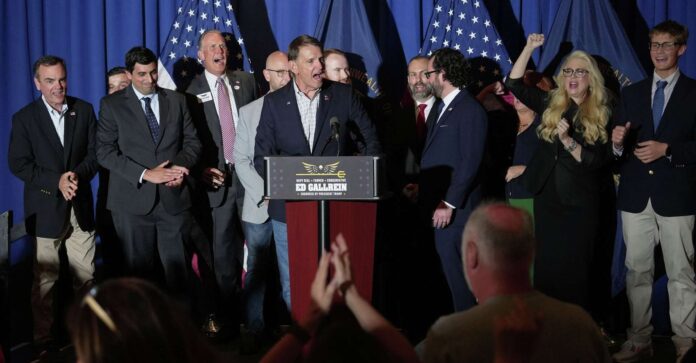
President Donald Trump scored one of his most significant intra-party victories yet on Tuesday, as his hand-picked challenger defeated one of Congress’s most vocal Republican critics in a Kentucky primary that cost more than any U.S. House race in history. The defeat of Representative Thomas Massie signals that no Republican seat — however entrenched — is safe from Trump’s retribution machine, and reshapes the landscape heading into November’s midterm elections.
Story Highlights
- Former Navy SEAL Ed Gallrein defeated eight-term Rep. Thomas Massie in the most expensive U.S. House primary in history.
- Massie had angered Trump by publicly opposing military action against Iran, sponsoring a bill that resulted in the release of Jeffrey Epstein files, and voting against Trump’s signature tax legislation.
- Defense Secretary Pete Hegseth made a highly unusual trip to the district on Monday to campaign alongside Gallrein and urge voters to send Trump “reinforcements” in Congress.
What Happened
President Donald Trump‘s retribution campaign steamrolled another Republican rival on Tuesday, with a Trump-backed challenger ousting one of the president’s leading intra-party antagonists, Rep. Thomas Massie, in a Kentucky primary. The result was called by major networks Tuesday night, capping a bruising campaign that drew national attention and record-breaking spending.
Ed Gallrein‘s win over Massie continued a May political payback tour that had already seen Trump take down five Indiana state senators who voted against his redistricting push two weeks ago, and two-term Louisiana Sen. Bill Cassidy. Each victory has deepened the perception that crossing Trump carries terminal political consequences within the Republican Party.
Trump had called Massie “a terrible congressman” and said he did not believe Massie was a real Republican. The president personally visited Kentucky in March to campaign against him. That level of direct presidential involvement in a congressional primary is rare and underscored the personal nature of the feud.
Gallrein was boosted by significant spending from AIPAC and pro-Israel groups, which provided about half of the money benefiting his candidacy, according to AdImpact. However, there is no question Trump was the key factor. Massie had represented his deep-red northern Kentucky district since 2012, routinely winning by roughly 30 percentage points.
Massie’s concession speech on Tuesday night sounded like anything but a defeat. He delivered a forward-looking message to supporters who seemed more energized than crestfallen, saying: “What started out as an election turned into a movement.” Massie will remain in Congress until January, giving him a free hand to continue opposing Trump’s agenda.
Why It Matters
Massie’s defeat is a clear sign that Republicans give their politicians vanishingly little leeway to cross Trump, who is bent on retribution and has persuaded his voters to defeat his adversaries again and again. The result will reverberate through congressional offices as Republicans assess how much independence they can exercise before becoming a target.
The scale of the victory matters as much as the outcome itself. Massie was not a marginal figure or a recent Trump critic — he was a deeply rooted incumbent with a libertarian-conservative brand that had survived multiple election cycles. His removal demonstrates that Trump’s influence can overwhelm even entrenched incumbents when he commits fully to a race.
GOP Rep. Tim Burchett of Tennessee said Tuesday’s results showed Trump is sending a clear message: “He will beat you.” Another lawmaker, speaking on condition of anonymity, suggested Massie “found out the hard way” that Trump is still the party’s “kingmaker.” These reactions reveal how comprehensively Trump has reshaped the calculations of House Republicans.
The timing also matters politically. With midterm elections approaching in November, Republicans holding marginal or swing seats must now weigh the dual risk of alienating Trump’s base by defying him or alienating general-election voters by following him too closely. That tension will define congressional dynamics for the rest of 2026.
Economic and Global Context
The political consolidation Trump is achieving has direct implications for economic and foreign policy. Massie’s specific objections to the Iran war and his opposition to Trump’s fiscal legislation were not merely personal — they reflected concerns shared by a wing of the GOP about deficit spending and military overreach, both of which carry market consequences.
Trump’s primary wins this month have also included Rep. Andy Barr, riding a Trump endorsement, winning the Republican primary for retiring Sen. Mitch McConnell’s seat in Kentucky. A more thoroughly Trump-aligned Senate would have fewer institutional brakes on executive spending and foreign policy commitments that markets are watching closely.
The record spending in the Massie race also illustrates how outside groups with geopolitical interests — particularly pro-Israel organizations — are willing to invest heavily in shaping the composition of Congress. This blending of domestic primary politics with foreign policy priorities adds complexity to how future legislation on overseas conflicts will be shaped.
Analysts note that a Republican caucus purged of dissenting voices may move more quickly on Trump’s remaining legislative priorities, including any future authorizations or appropriations related to the Iran conflict, which has already affected global oil prices and U.S. fiscal projections.
Implications
The most immediate implication is that Republican lawmakers across the country will recalibrate their willingness to oppose Trump publicly. The primaries of May 2026 have created a clear pattern: senators and representatives who defy Trump on marquee issues face well-funded, White House-backed challengers. That lesson is now inescapable.
Massie was entrenched in his deep-red Kentucky district before his feud with Trump exploded, cutting short a congressional career that began in 2012. Without a Republican primary on the horizon, he now has a freer hand than ever to antagonize Trump. His remaining months in Congress could be unusually turbulent.
For voters, particularly libertarian-leaning conservatives who were drawn to Massie’s brand of skeptical, small-government Republicanism, the result leaves them without a prominent congressional champion. His removal narrows the ideological range within the House GOP in ways that could push fiscal and foreign policy in directions his supporters oppose.
Looking ahead to November’s midterms, Trump’s primary dominance could prove to be a double-edged asset. While it ensures congressional loyalty, it also risks motivating opposition voters and putting competitive districts in play, particularly if the Iran war and economic conditions continue to weigh on public sentiment.
Source
Trump critic Massie defeated: Takeaways from US primary election results