Story Highlights
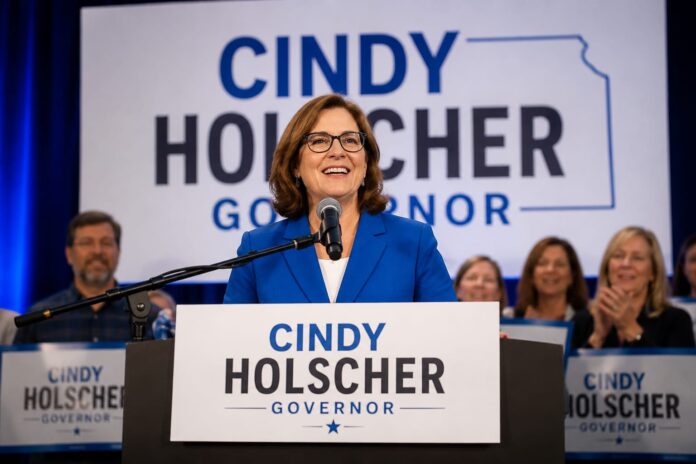
- Democratic state Senator Cindy Holscher secured the Democratic nomination for Kansas governor following preliminary primary results
- Holscher defeated state Senator Ethan Corson, who had backing from outgoing Governor Laura Kelly and former Governor Kathleen Sebelius
- The general election contest is projected to lean Republican according to the Cook Political Report
- Kansas faces an open gubernatorial race as Kelly steps down after her 2018 victory in the traditionally Republican state
What Happened
Democratic state Senator Cindy Holscher emerged as the Democratic nominee for Kansas governor following preliminary election results from Decision Desk HQ. The nomination victory came after Holscher competed against a relatively narrow field of Democratic candidates seeking to replace outgoing Governor Laura Kelly. The primary race featured Holscher’s campaign against state Senator Ethan Corson and Overland Park Mayor Curt Skoog as the principal competitors for the Democratic party’s gubernatorial endorsement.
Holscher’s victory occurred despite significant backing for her primary opponent. Corson had secured endorsements from both the outgoing governor and former Governor Kathleen Sebelius, indicating division within the state Democratic establishment regarding the party’s best path forward in the upcoming general election. Holscher’s background includes service as the state Senate minority whip, representing Johnson County in the suburban Kansas City region, along with prior experience in the state House of Representatives.
- Cindy Holscher won the Democratic primary for Kansas governor
- Ethan Corson received backing from Governor Laura Kelly and former Governor Kathleen Sebelius
- Curt Skoog, Overland Park mayor, also competed in the Democratic primary
- Holscher serves as state Senate minority whip for Johnson County
Why It Matters
The outcome establishes Holscher as the Democratic standard-bearer in a state where Republican strength has been notably influential in recent election cycles. However, the general election landscape presents significant challenges for the Democratic nominee. The Cook Political Report has assessed the general election race as leaning Republican, reflecting the state’s broader political alignment despite recent Democratic success at the gubernatorial level.
Kansas’s political history provides important context for understanding the stakes in this race. The state experienced substantial fiscal turbulence following tax policy decisions made during the previous Republican gubernatorial administration, which ultimately contributed to conditions that enabled Kelly’s 2018 victory in what is ordinarily a reliably Republican state. The recovery from that fiscal period and the state’s current economic conditions will likely feature prominently in campaign messaging from both parties. Holscher’s nomination means Democrats will proceed to the general election with a candidate who has established herself within the state legislature, though she faces the challenging political environment that comes with campaigning in a state where Republicans typically maintain electoral advantages.
- The general election is projected to lean Republican according to political analysts
- Kansas experienced fiscal challenges following prior tax policy decisions that affected recent electoral outcomes
- Holscher must overcome Republican voter preferences typical in Kansas to win the general election
- The race involves an open seat with significant implications for state policy direction
Political and Public Context
Kansas has established itself as a Republican-leaning state in recent decades, though the state experienced a notable Democratic victory when Kelly was elected governor in 2018. That unexpected outcome followed significant political upheaval related to tax policy implementation during the Sam Brownback administration. Brownback, serving as governor during the 2012 period, implemented substantial income tax reductions that subsequently contributed to state fiscal challenges requiring bipartisan legislative response and correction.
The political environment surrounding the current race reflects the ongoing realignment within Kansas politics. Kelly’s 2018 victory demonstrated that Democratic candidates could achieve success in the state under specific circumstances, particularly when Republican policy decisions had created significant public concern about fiscal management. The emergence of Holscher as the Democratic nominee sets up a general election contest that will test whether the conditions that enabled Kelly’s victory remain present, or whether the state has moved back toward its traditional Republican alignment. The endorsement patterns visible in the primary, with establishment figures backing Corson while Holscher secured the nomination, suggest continuing discussions within the Democratic party about strategy and positioning in a state where the party faces structural disadvantages.
- Kansas historically leans Republican in statewide elections
- Governor Laura Kelly’s 2018 victory represented an unusual Democratic win in the state
- Sam Brownback’s tax policies during his governorship created fiscal challenges affecting subsequent politics
- Political realignment in Kansas continues to shape candidate recruitment and electoral strategies
What Happens Next
Holscher will proceed to the general election as the Democratic nominee, where she will face a Republican opponent to be determined through the Republican primary process. The timeline leading to the general election will involve both parties engaging in campaign activities designed to mobilize their respective voter bases and appeal to swing voters in the state. Holscher’s campaign will likely focus on her legislative experience and positions on issues relevant to Kansas voters, while also attempting to replicate or build upon the conditions that enabled Kelly’s previous victory.
The general election outcome will depend substantially on several factors including national political trends, state-specific policy debates, and the comparative campaign effectiveness of the Democratic and Republican nominees. Republican primary voters will select their nominee, and that individual’s background and campaign strategy will significantly influence the character of the general election contest. The Cook Political Report’s assessment that the race leans Republican suggests that Republicans will enter the general election with structural advantages, though Kansas political history demonstrates that outcomes are not predetermined and that specific circumstances and candidate factors can influence results.
- Holscher advances to the general election as the Democratic nominee for governor
- Republican primary will determine the Democratic nominee’s opponent in the general election
- General election campaigns will engage voters on state-specific issues and policy priorities
- National political environment and state economic conditions will influence general election dynamics