Story Highlights
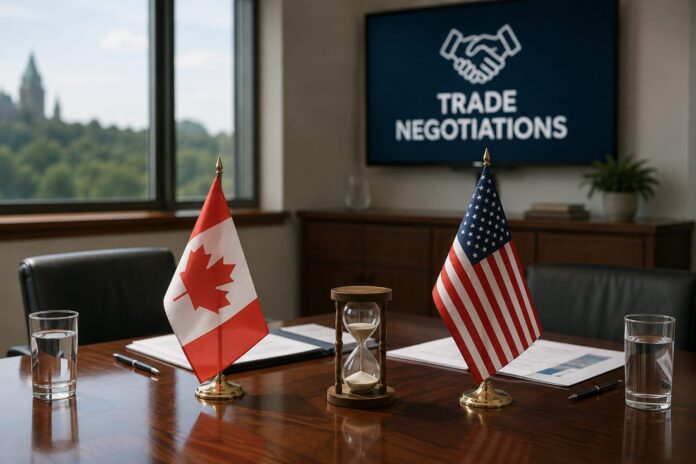
- Canadian Prime Minister Mark Carney indicated that trade negotiations with the United States are advancing amid ongoing tariff disputes between the two nations
- Carney emphasized that any agreement must preserve a viable Canadian auto sector, describing it as a fundamental issue in the talks
- The two countries have exchanged significant tariffs, with the U.S. imposing 50 percent duties on $20 billion in Canadian exports and Canada retaliating in kind
- Carney announced new trade partnerships with ASEAN nations and the Philippines as part of a strategy to reduce Canada’s reliance on U.S. markets
What Happened
Canadian Prime Minister Mark Carney delivered remarks in Manila indicating that trade negotiations between Canada and the United States are progressing positively. Speaking to reporters ahead of an Association of the Southeast Asian Nations summit, Carney described a recent conversation with President Trump, U.S. Trade Representative Jamieson Greer, White House Chief of Staff Stephen Miller, and other administration officials. The prime minister characterized the discussion as lengthy and substantive, noting that meaningful progress has been achieved in resolving the monthslong tariff dispute between Washington and Ottawa.
The Canadian leader stressed, however, that negotiations remain incomplete and that any final agreement must align with the needs of Canada’s automotive sector. Carney emphasized that the integration between North American auto manufacturing is substantial and that the U.S. automotive industry depends significantly on supply chain connections with Canada. He indicated his government would not accept a deal that undermines the viability of this critical industry sector.
- Carney held substantive discussions with President Trump, U.S. Trade Representative Jamieson Greer, and White House Chief of Staff Stephen Miller before traveling to Manila
- The prime minister stressed that preserving a viable Canadian auto sector is a fundamental requirement for any trade agreement
- Canada previously walked away from negotiations in August after the Trump administration introduced last-minute demands Ottawa deemed unacceptable
- The U.S. responded with 50 percent tariffs on $20 billion worth of Canadian exports; Canada implemented retaliatory tariffs matching American duties dollar-for-dollar
Why It Matters
The progress reported by Carney suggests a potential pathway toward resolving a trade conflict that has created substantial economic uncertainty for both nations. The automobile sector represents a cornerstone of bilateral economic integration, with manufacturers on both sides of the border relying on seamless cross-border supply chains. Any disruption to this integrated system carries broader implications for employment, manufacturing capacity, and competitiveness in North American vehicle production.
The establishment of new Canadian trade relationships with ASEAN nations and the Philippines reflects a strategic shift in Ottawa’s trade policy. By expanding commercial partnerships beyond the United States, Canada seeks to reduce its economic dependence on a single market and create additional opportunities for Canadian businesses and workers. This diversification strategy has already shown measurable results, with Carney noting that nearly one-third of Canadian export dollars now originate from non-U.S. sources, reaching a 40-year high.
- Resolution of the tariff dispute could stabilize supply chains and protect hundreds of thousands of jobs in the North American auto industry
- The expansion of Canadian trade partnerships provides leverage in negotiations and reduces vulnerability to U.S. trade actions
- A successful bilateral agreement would restore business confidence and allow manufacturers to plan long-term investments with greater certainty
- Carney’s government is ahead of schedule on its goal to double non-U.S. exports within a decade, demonstrating the effectiveness of trade diversification
Political and Public Context
The tariff battle between the United States and Canada emerged from the Trump administration’s pursuit of stricter trade terms and greater reciprocity in bilateral commerce. The August breakdown in negotiations highlighted the difficulty of reaching consensus on contentious issues, particularly regarding automotive trade and manufacturing standards. President Trump’s administration has pursued an aggressive trade posture aimed at reshaping trade relationships and protecting American manufacturing interests.
Carney’s position reflects Canada’s need to balance its relationship with its largest trading partner while protecting vital domestic industries. The Canadian auto sector, which serves as a major employer and economic engine, cannot function independently of the integrated North American production system. Simultaneously, Carney has pursued a broader trade strategy that acknowledges the risks of excessive dependence on any single market. His participation in the ASEAN summit and announcement of new trade partnerships demonstrate Ottawa’s commitment to developing alternative commercial relationships that provide strategic flexibility and economic diversification.
- The Trump administration’s aggressive trade posture reflects broader concerns about trade imbalances and the protection of American manufacturing
- Previous negotiations collapsed in August when the administration introduced new demands that Ottawa considered incompatible with Canadian interests
- Canada’s retaliatory tariffs have targeted U.S. exports strategically, placing pressure on American exporters and creating incentives for deal-making
- ASEAN member states represent growing economic opportunities and potential alternatives to over-reliance on North American trade partnerships
Carney says he’s ‘making progress’ with Trump on possible US-Canada trade dealhttps://t.co/AVaNlH7PKL
— The Hill (@thehill) November 15, 2026
What Happens Next
The trajectory of U.S.-Canada trade negotiations appears to be moving in a more constructive direction, though significant work remains. Carney indicated that while a bilateral agreement remains possible, the parties have not yet reached a final accord. The ongoing talks will likely focus on establishing mutually acceptable frameworks for automotive trade, tariff rates, and broader commercial terms. The president’s expected attendance at the ASEAN summit in Manila provides an additional opportunity for high-level discussions between administration officials and Carney.
The success or failure of these negotiations will depend substantially on both sides’ willingness to compromise on contentious issues while maintaining their core objectives. For Canada, preserving the viability of its auto sector remains non-negotiable. For the United States, the administration’s goal of achieving more favorable trade terms and addressing perceived imbalances remains a driving force. The window for reaching agreement before additional economic damage accumulates continues to narrow, creating pressure on both governments to find common ground and finalize terms that both nations can accept.
- High-level discussions between Carney and U.S. administration officials are expected to continue during the ASEAN summit in Manila
- Negotiations must produce a framework that preserves automotive sector viability while addressing Trump administration trade objectives
- Both nations face pressure to reach agreement before prolonged tariff disputes inflict greater economic damage on businesses and workers
- The success of Canada’s broader trade diversification strategy may influence the terms that Ottawa is willing to accept in U.S. negotiations