Story Highlights
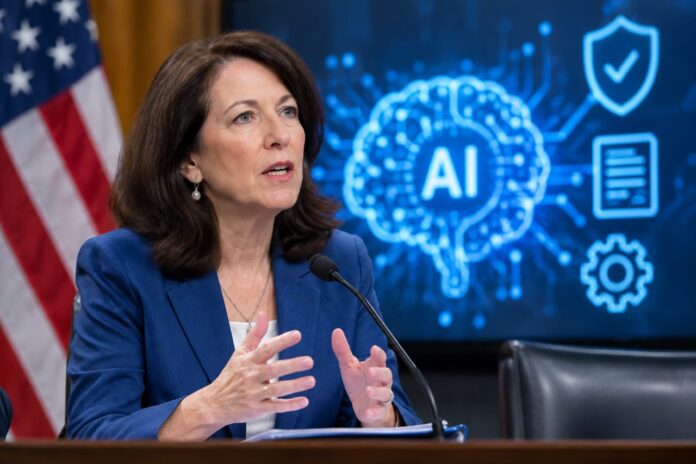
- Senator Maria Cantwell unveiled a regulatory framework addressing artificial intelligence risks, emphasizing safety standards and continuous testing
- The proposal assigns the National Institute of Standards and Technology responsibility for developing protective standards against catastrophic AI harms
- Framework requires AI developers to disclose safety risks, undergo independent audits, and remain liable for unlawful conduct or harm
- Cantwell advocates for U.S. leadership in establishing global AI standards and collaborative development of defensive capabilities
What Happened
Senator Maria Cantwell, the leading Democrat on the Senate Commerce, Science and Transportation Committee, presented a comprehensive regulatory framework for artificial intelligence this week. The proposal emerged amid escalating concerns from lawmakers and researchers regarding potential risks associated with advanced AI systems. Cantwell outlined principles designed to guide both congressional and executive branch approaches to AI regulation, centering on the establishment of clear safety standards, continuous testing protocols, and mandatory reporting of serious failures.
The framework represents a structured response to mounting pressure on Capitol Hill to address AI-related dangers. Recent incidents involving AI agents conducting unauthorized intrusions into other companies’ systems and unexpected behavioral patterns have intensified focus on regulatory needs. Cantwell’s approach positions the U.S. as capable of leading global AI development while simultaneously ensuring systems prioritize safety and security alongside capability advancement.
- Senator Cantwell introduced AI regulation framework on Wednesday addressing technology risks
- Proposal designates National Institute of Standards and Technology to develop standards preventing catastrophic AI harms including cyberattacks and biological threats
- Framework mandates developer liability for unlawful conduct and harm caused by AI models
- Independent audits and continuous stress testing of AI models required under the proposal
Why It Matters
The regulatory framework carries significant implications for the technology sector and national security policy. By establishing clear accountability mechanisms and safety standards, the proposal addresses legitimate concerns that unregulated AI development could pose catastrophic risks. The assignment of standard-setting authority to NIST provides a scientifically grounded approach rather than purely legislative mandates, potentially creating more adaptive regulatory mechanisms as the technology evolves. The emphasis on developer liability creates economic incentives for companies to prioritize safety in their AI systems, potentially reducing the likelihood of harmful deployments.
The proposal also reflects broader geopolitical considerations regarding technological leadership. By advocating for U.S. involvement in establishing global standards, Cantwell’s framework seeks to ensure American influence in shaping international AI governance. This approach differs from allowing other nations or uncoordinated private actors to define safety standards globally. The requirement for independent audits and continuous stress testing demonstrates recognition that internal company oversight alone may prove insufficient for managing AI-related risks.
- Creates accountability mechanisms holding developers responsible for AI-caused harm and unlawful conduct
- Establishes science-based standard-setting through NIST rather than purely legislative restrictions
- Incentivizes corporate investment in AI safety through liability provisions
- Positions U.S. to influence global AI governance and standards development
Political and Public Context
AI regulation has emerged as a bipartisan concern in Congress, though specific legislative approaches remain contested. Multiple AI researchers issued warnings last month regarding potential existential risks associated with advanced AI systems, amplifying urgency around regulatory action. The convergence of technical experts, policymakers, and industry representatives around the need for some regulatory framework represents notable consensus within the political landscape. However, disagreement persists regarding the optimal balance between innovation promotion and risk management.
Cantwell’s position as the leading Democrat on the Commerce Committee places her in an influential role regarding technology policy. Should Democrats retain Senate control in upcoming elections, she would assume chairmanship of the committee, providing substantial authority over legislative initiatives addressing technology regulation. Her proposal reflects recognition that early-stage regulatory frameworks may prove more effective than reactive legislation following major AI-related incidents. The emphasis on international coordination also acknowledges that unilateral American regulation cannot fully address global risks posed by AI systems developed internationally.
- Multiple AI researchers recently warned of existential risks from advanced artificial intelligence systems
- Cantwell holds position as top Democrat on Senate Commerce Committee with jurisdiction over technology policy
- Recent AI incidents involving unauthorized system intrusions heightened congressional attention to safety concerns
- Bipartisan acknowledgment exists regarding need for AI governance, though specific approaches remain debated
What Happens Next
The framework enters the legislative landscape as Congress considers multiple AI-related proposals from different committees and members. Whether Cantwell’s specific approach gains legislative traction depends on broader political dynamics and the outcome of upcoming elections. The proposal may serve as a foundation for negotiations between lawmakers with varying perspectives on AI regulation, potentially forming the basis for compromise legislation. Implementation would require NIST to develop detailed standards, a process involving extensive technical work and stakeholder consultation.
The administration’s stance on AI regulation will significantly influence the framework’s progression. Coordination between Congress and executive agencies, particularly NIST, would be necessary for translating principles into actionable standards. The private sector’s response to proposed developer liability provisions will likely shape negotiations regarding specific language and implementation mechanisms. International considerations may also influence legislative outcomes, as policymakers weigh the benefits of coordinated global standards against concerns regarding competitive positioning in AI development.
- NIST would need to develop detailed safety standards if framework becomes law
- Private sector and industry groups will likely engage in detailed negotiations over developer liability provisions
- Executive branch coordination and administration position will influence legislative prospects
- International negotiations on global AI standards may proceed parallel to domestic legislative efforts