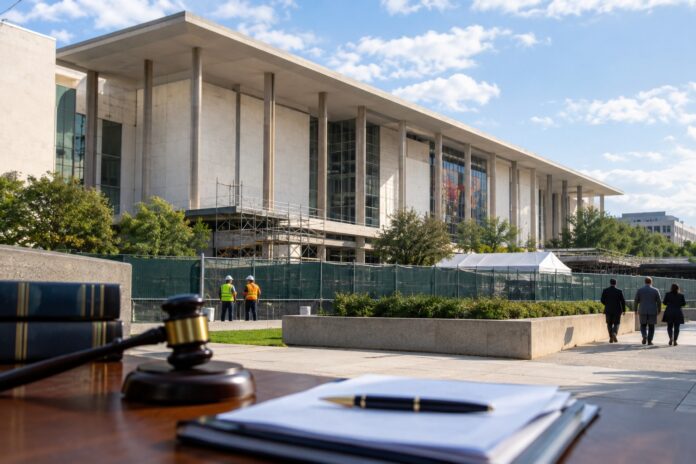
Story Highlights
- A federal judge mandates a 30-day notice before any demolition actions at the Kennedy Center.
- President Trump emphasizes the need for recognition of his administration’s renovation efforts.
- The Kennedy Center has been temporarily closed due to structural concerns.
- Congresswoman Joyce Beatty challenges Trump’s involvement with the institution.
What Happened
A federal judge has intervened in a contentious situation surrounding the John F. Kennedy Center for the Performing Arts, ordering the Trump administration to provide at least 30 days’ notice before any demolition activities can commence. This ruling comes in the wake of President Trump’s alarming comments suggesting that the iconic venue could be ‘ripped down’ if his administration’s renovation efforts are not recognized. The order was issued by US District Judge Christopher Cooper, who responded to concerns raised by Democratic Congresswoman Joyce Beatty, who has been vocal about her opposition to Trump’s plans for the center.
On Wednesday, during a press conference in Charlotte, North Carolina, the president stated, ‘I think that the Trump administration should certainly have recognition because, frankly, if we don’t do that, it’s going to close. It’ll end up being ripped down.’ His remarks have sparked significant controversy, particularly given the Kennedy Center’s status as a national cultural landmark established as a living memorial to President John F. Kennedy.
- Judge Christopher Cooper issued the ruling on Thursday.
- Joyce Beatty, a Democratic congresswoman, filed a challenge against Trump’s plans.
- The Kennedy Center has been closed for emergency repairs due to structural issues.
- The president’s comments were made during a press event in Charlotte, North Carolina.
Why It Matters
This ruling is significant not only for the preservation of the Kennedy Center but also for the broader implications it has on the relationship between the Trump administration and cultural institutions. The Kennedy Center, which opened in 1971, has been a cornerstone of American arts and culture, hosting countless performances and educational programs. The potential for its demolition raises questions about the administration’s commitment to preserving cultural heritage.
Moreover, the ruling underscores the importance of public oversight in governmental actions, especially when it comes to significant national landmarks. The judge’s decision to require a notice period before any demolition can occur serves as a safeguard against hasty actions that could irreparably harm the center. This is particularly relevant given the ongoing discussions about the future of public funding for the arts and the role of government in supporting cultural institutions.
- The ruling protects the Kennedy Center from potential demolition.
- It emphasizes the need for public oversight in governmental actions.
- The decision reflects concerns about the administration’s commitment to cultural heritage.
- It highlights the ongoing debate over public funding for the arts.
Political and Public Context
The Kennedy Center’s current predicament is not an isolated incident but rather part of a larger narrative involving the Trump administration’s approach to cultural institutions. The center has faced significant challenges in recent years, including claims of structural deterioration that led to its temporary closure. Executive Director Matt Floca indicated that the building was closed for at least seven days to assess acute risks to public safety, following a partial ceiling collapse and concerns about the roof terrace canopy.
Additionally, the controversy surrounding Trump’s desire to have his name associated with the Kennedy Center has drawn criticism from various quarters. Beatty, who is an ex-officio member of the Kennedy Center board, has been particularly vocal in her opposition, arguing that Trump’s involvement could undermine the center’s integrity and mission. This legal battle reflects broader tensions between the administration and those who advocate for the preservation of cultural institutions free from political influence.
- The Kennedy Center has faced structural issues leading to its temporary closure.
- Matt Floca reported acute risks to public safety due to deterioration.
- Joyce Beatty’s opposition highlights concerns about political influence on cultural institutions.
- The legal battle reflects ongoing tensions between the administration and arts advocates.
A federal judge on Thursday ordered the Kennedy Center to provide 30 days’ notice before making any major physical changes to the building, including demolishing it as President Trump has threatened. https://t.co/elZEsOpLs4
— The Washington Post (@washingtonpost) September 18, 2026
What Happens Next
Looking ahead, the Trump administration is expected to respond to the judge’s ruling by seeking to dissolve the order requiring the 30-day notice. This could lead to further legal battles as the administration attempts to navigate the complexities of the situation while addressing the concerns raised by Beatty and others. The outcome of these proceedings will likely have significant implications for the future of the Kennedy Center and its renovation plans.
Moreover, the public’s reaction to this ruling and the administration’s subsequent actions will be closely monitored. As discussions about the role of government in supporting the arts continue, the Kennedy Center’s fate may serve as a litmus test for broader attitudes toward cultural preservation and the influence of politics on the arts. The administration’s next steps will be crucial in determining whether the Kennedy Center can emerge from this controversy intact or if it will face further challenges in the future.
- The Trump administration may seek to dissolve the 30-day notice requirement.
- Further legal battles are anticipated as the situation unfolds.
- The public’s reaction will influence future discussions about arts funding.
- The Kennedy Center’s fate may reflect broader attitudes toward cultural preservation.