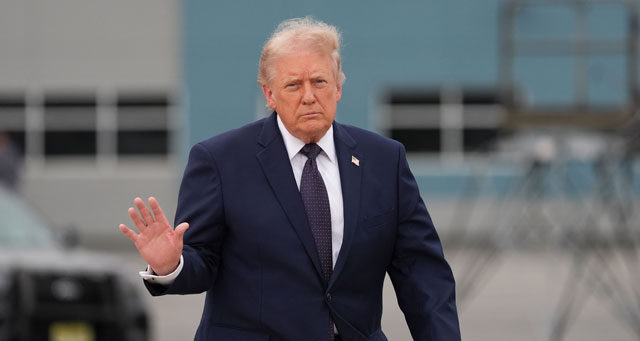
President Donald Trump said Friday he will make a “final determination” on a proposed peace agreement with Iran following a Situation Room meeting, as U.S. and Iranian negotiators have reportedly reached a tentative 60-day ceasefire extension pending his approval. The deal, which would reopen the Strait of Hormuz to unrestricted shipping and launch formal nuclear negotiations, remains fragile, with both sides exchanging fire as recently as Thursday and Tehran publicly insisting no nuclear talks are underway.
Story Highlights
- U.S. and Iranian negotiators agreed to a 60-day memorandum of understanding extending the ceasefire, pending Trump’s sign-off
- The deal requires Iran to remove all mines from the Strait of Hormuz within 30 days and allow unrestricted shipping
- Iran’s foreign ministry contradicted U.S. claims, stating no nuclear negotiations are taking place
What Happened
President Donald Trump said he will make a “final determination” on a potential Iran ceasefire deal after meeting in the White House Situation Room on Friday. Negotiators have agreed to a 60-day memorandum of understanding to extend the ceasefire and launch negotiations on Iran’s nuclear program, according to sources. Trump laid out his public conditions in a social media post from the Situation Room, demanding that Iran agree to never develop a nuclear weapon or bomb and that the Strait of Hormuz be immediately reopened to unrestricted shipping with no tolls.
Vice President JD Vance told reporters Thursday evening that while he cannot guarantee a deal will be reached, there are a few key unresolved points around Iran’s nuclear program, specifically the question of highly enriched uranium stockpiles and ongoing enrichment activities. “We do think they’re negotiating, at least so far, in good faith,” Vance said.
The major sticking point for both sides is Iran’s nuclear capability. The deal still needed Trump’s final approval as of Friday, following weeks of talks threatened by heightened tensions after the U.S. engaged in defensive strikes on Iranian positions. U.S. Central Command launched what it described as self-defense strikes on Iranian boats spotted laying mines in the Strait of Hormuz, complicating the diplomatic track significantly.
Iran’s chief negotiator, Mohammad Bagher Ghalibaf, said Tehran would judge any agreement by actions rather than words, adding that no steps would be taken unless Washington acted first. The statement reflects deep mutual distrust that has characterized the months-long conflict, which began when the United States and Israel launched joint strikes on Iran on February 28, triggering a regional war that has drawn in multiple actors, disrupted global shipping lanes, and caused a significant spike in global energy prices.
Iran’s foreign ministry publicly stated on May 29 that there were “no negotiations” taking place on its nuclear program, after Trump suggested Tehran would relinquish its enriched uranium under a peace deal. The contradiction between public statements and back-channel negotiations has become a defining feature of this diplomatic process, with both governments managing domestic audiences while pursuing different messaging externally.
Why It Matters
The stakes of a U.S.-Iran agreement extend far beyond the two countries directly involved. The Strait of Hormuz is one of the world’s most critical maritime chokepoints, through which approximately 20 percent of global oil trade transits. Its closure since the onset of the conflict has contributed to an energy price shock that has rippled through consumer prices in the United States and across allied economies. A durable reopening would have immediate and material effects on inflation, fuel costs, and global supply chains.
For the Trump administration, reaching a deal that ends a conflict the president himself initiated while delivering tangible economic relief — lower fuel and fertilizer prices — would represent a significant political achievement. It would also serve as a counterweight to critics who argued the February strikes were strategically reckless and risked drawing the United States into an indefinite Middle Eastern conflict. The president has framed the war as a success regardless of whether a peace deal materializes, but a formal agreement would substantially strengthen that narrative.
The nuclear dimension of any agreement is the most consequential long-term variable. Iran’s nuclear program is far more advanced than it was during the Obama-era JCPOA negotiations, and any deal that leaves enrichment capacity intact or fails to account for existing highly enriched uranium stockpiles will face fierce opposition from arms control advocates, Republican hawks, and Israeli officials. The difference between a durable arms agreement and a political document that collapses under pressure hinges on verification mechanisms that neither side has publicly endorsed.
For ordinary Americans, the conflict’s duration has translated directly into higher costs at the gas pump, elevated food prices driven by fertilizer cost increases tied to energy markets, and ongoing concern about a broader regional war that could draw in U.S. troops at greater scale. The promise that fuel and fertilizer prices would decline quickly once tensions ease, as articulated by administration officials, gives domestic economic stakes an urgency that goes beyond foreign policy debate.
Economic and Global Context
Agriculture Secretary Brooke Rollins stated that fertilizer prices would fall immediately and fuel prices would come down quickly once tensions with Iran ease, and announced that the largest ammonia plant in the world would break ground within 30 days after permitting was accelerated. These claims signal that the administration is aware of and responding to the domestic economic pressure created by the prolonged conflict.
Global energy markets have priced in elevated risk throughout the conflict. Oil prices surged in the weeks following the initial February strikes, with disruptions to Hormuz shipping amplifying supply concerns already present in global markets. A credible ceasefire with enforceable access provisions for the strait would likely prompt a meaningful decline in crude oil futures, with downstream effects on gasoline, aviation fuel, and petrochemical feedstocks that underpin manufacturing and agriculture globally.
The conflict has also tested the cohesion of U.S. alliances. NATO partners, while broadly supportive of the U.S. right to self-defense, expressed concern about the scale and speed of the February strikes. Key Gulf states have been navigating the conflict carefully, balancing their security relationships with Washington against economic ties to Iran and the destabilizing effects of a prolonged regional war on their own markets and populations.
Implications
If Trump endorses the 60-day memorandum of understanding, the agreement would enter a fragile implementation phase. Iran’s requirement that Washington act first — and Tehran’s public denial of ongoing nuclear negotiations — suggests the two sides are not yet speaking the same language about what the deal actually contains. A misalignment at the implementation stage could collapse the agreement quickly, potentially triggering resumed hostilities.
A failure to reach a deal, conversely, leaves the administration facing a difficult choice: resume full combat operations in a conflict that has already generated significant domestic and international political costs, or maintain an open-ended ceasefire that Iran can use as breathing space to reconstitute military capacity. Neither outcome is clean, and both carry substantial strategic risks.
For global markets, businesses, and governments watching the Strait of Hormuz, the next several days represent a critical window. Trump’s “final determination” will either initiate a new diplomatic phase or signal that the conflict is about to escalate again.
Source
US and Iran reach ceasefire extension deal pending Trump’s final approval