Story Highlights
- American forces completed a seventh consecutive night of strikes intended to weaken Iran’s ability to threaten the Strait of Hormuz.
- The campaign has expanded beyond coastal launch systems to military logistics, surveillance networks, transportation links, and supporting infrastructure.
- Tehran has continued retaliating against U.S. partners, military locations, and commercial shipping across the region.
- The administration is combining sustained military pressure with a continuing diplomatic opening led in part by Vice President JD Vance.
What Happened
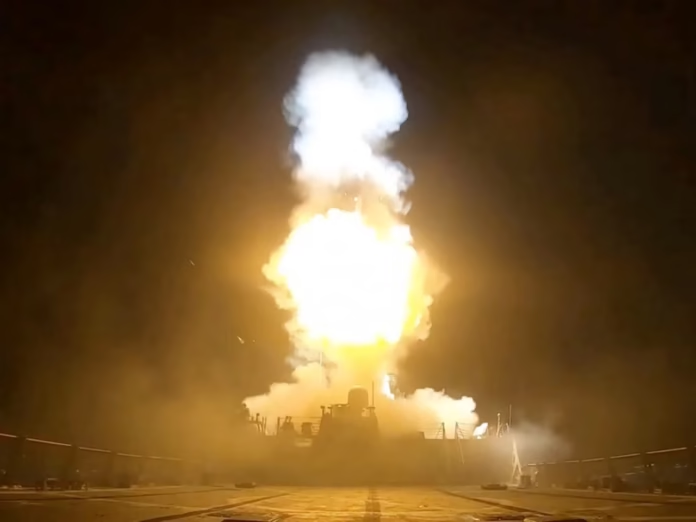
The United States completed another round of strikes against Iranian targets, marking the seventh consecutive night of military operations since the collapse of the temporary ceasefire.
U.S. Central Command said the campaign is designed to further degrade Iran’s ability to threaten American personnel, regional allies, and commercial vessels using the Strait of Hormuz.
The latest operations reportedly targeted military logistics, surveillance equipment, weapons-storage locations, communications systems, maritime assets, and transportation routes used to support Iranian forces.
- American aircraft, drones, ships, and precision weapons have participated in the campaign.
- The naval blockade of vessels traveling to or from Iranian ports remains active.
- Neutral shipping is being encouraged to use routes away from Iranian-controlled waters.
- Military officials say the objective is to restore safe and unrestricted passage through the strait.
Iran has responded with missiles, drones, and attacks directed at U.S. military locations, Gulf partners, and commercial ships.
Bahrain, Kuwait, Qatar, Jordan, and other regional governments have reported interceptions, air-raid warnings, or damage connected to the renewed fighting.
Tehran has also warned that countries hosting American forces could face further retaliation if attacks on Iranian territory continue.
Why It Matters
The expanded campaign shows that the White House is no longer relying on limited retaliation against individual launch sites.
The military is attempting to dismantle the broader network Iran uses to monitor shipping, move weapons, launch attacks, and sustain operations around the Persian Gulf.
Supporters say a sustained response is necessary because isolated strikes did not prevent Tehran from attacking merchant vessels or threatening neighboring countries.
- Iranian surveillance systems can help identify commercial and military targets.
- Ports and transportation routes support missile, drone, and naval operations.
- Repeated attacks raise costs for Tehran and reduce its ability to quickly rebuild.
- Continued pressure could strengthen Washington’s position in future negotiations.
The administration’s stated objective is not permanent American ownership of the Strait of Hormuz.
It is to ensure that Iran cannot close an international waterway, collect unauthorized payments, or decide which countries are permitted to move oil and commercial goods through it.
The danger is that an increasingly broad target list could produce additional Iranian retaliation and expand the conflict beyond the original dispute over shipping.
Political and Public Context
The renewed fighting began after attacks on commercial vessels caused the temporary U.S.-Iran agreement to unravel.
That arrangement had suspended the American blockade and required Tehran to permit safe passage through the strait.
The White House concluded that the agreement was no longer functioning after additional ship attacks and conflicting demands over control of navigation routes.
- The president declared the ceasefire over but has not permanently closed the diplomatic channel.
- Vice President JD Vance continues to argue that negotiations will ultimately be necessary.
- Secretary of State Marco Rubio has worked with Gulf governments on navigation and regional defense.
- Oman remains involved in efforts to establish a framework for renewed talks.
The president has expressed frustration with negotiations that do not produce verifiable guarantees, while Vance has emphasized that air power alone may not eliminate every low-cost Iranian threat.
That does not necessarily represent a direct policy split.
Military pressure can be used to reduce Tehran’s capabilities while diplomats attempt to establish enforceable terms covering shipping, missiles, regional attacks, and nuclear activity.
The release of an American woman held in Iran since 2024 also demonstrated that limited cooperation remains possible despite the ongoing strikes.
What Happens Next
Military operations are likely to continue until Iran stops attacking commercial vessels or accepts a verifiable navigation agreement.
Officials are also considering whether to strike additional infrastructure that directly supports military operations, although broader attacks would carry greater risks for civilians and regional stability.
Commercial traffic has not stopped completely, but vessel operators continue facing elevated insurance costs, restricted routes, and the danger of missile or drone attacks.
- Additional Iranian attacks could trigger a wider American target list.
- Gulf governments are expected to reinforce missile and drone defenses.
- Shipping companies may continue using routes closer to Oman.
- Mediators will seek terms capable of reopening formal negotiations.
Congress will also face growing pressure to examine the duration, cost, and legal basis of the military campaign as operations continue.
The immediate strategy is to deny Tehran effective control of the strait while protecting U.S. forces and allies from retaliation.
The longer-term test will be whether sustained military pressure produces a durable agreement—or pushes both countries toward a larger conflict neither side can easily contain.