Story Highlights
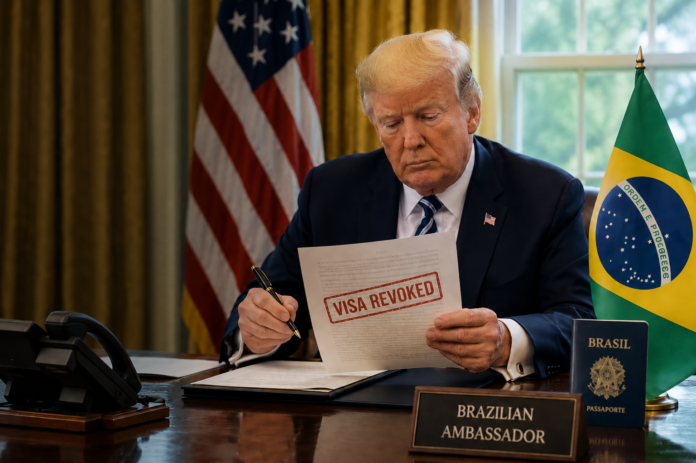
- The Trump administration revoked the visa of Brazil’s ambassador to the United States, Maria Luiza Ribeiro Viotti, amid escalating diplomatic tensions.
- The action came in direct response to Brazil’s repeated denial of visas to American diplomats and its delay in approving President Trump’s nominee for U.S. ambassador to Brazil.
- The State Department described the move as a reciprocal action, with further measures possible if Brazil continues to stall.
- The dispute is unfolding against a broader backdrop of U.S. tariffs on Brazilian exports and terror designations targeting Brazilian drug cartels.
What Happened
The Trump administration revoked the visa of Brazilian Ambassador Maria Luiza Ribeiro Viotti, escalating a months-long diplomatic dispute between Washington and Brasília. The State Department confirmed the action, describing it as a direct and deliberate response to Brazil’s ongoing failure to approve Danny Perez — the former Florida House Speaker and President Trump’s nominated ambassador to Brazil — as well as its denial of visas to American diplomats seeking to travel to the country.
State Department officials made clear that the administration had given Brazil ample opportunity to resolve the situation through normal diplomatic channels. Officials indicated that weeks of continuous communication had been met with delay and evasion on the Brazilian side. Viotti has not been declared persona non grata, meaning she is not formally expelled, but she would need to reapply for a visa should she depart the United States. Her duties could resume if Brazil moves forward with approving Perez.
- Brazilian Ambassador Maria Luiza Ribeiro Viotti had her U.S. visa revoked by the Trump administration.
- Brazil denied visas to Riley Barnes, the State Department’s assistant secretary for democracy, human rights and labor, along with a senior aide.
- Trump’s nominee for U.S. ambassador to Brazil, Danny Perez, has faced prolonged delays in receiving Brazilian approval.
- Brazil has signaled that Perez’s approval may not come until after its October 4 national election.
Why It Matters
The visa revocation signals that the Trump administration is serious about demanding reciprocity in international diplomatic relations. Rather than accepting unilateral obstruction from a foreign government, the White House has demonstrated a willingness to match unfriendly actions with calibrated countermeasures. This approach reflects a broader foreign policy philosophy under President Trump — one that insists allies and trading partners play by the same rules as the United States rather than benefit from American patience while acting in bad faith.
The dispute also carries significant implications beyond the two ambassadors at its center. The administration’s insistence on accountability from Brasília sends a message to other governments that diplomatic norms are a two-way street. With additional measures reportedly still on the table, the ball is now squarely in Brazil’s court to demonstrate good-faith engagement with Washington.
- The visa revocation halts normal ambassadorial functions unless Brazil approves Perez’s nomination.
- American diplomatic personnel seeking to travel to Brazil on routine missions have already been blocked.
- The standoff could affect broader bilateral cooperation on trade, security, and election integrity issues.
- Further diplomatic measures remain possible if Brazil does not take corrective action.
Political and Public Context
The diplomatic friction between Washington and Brasília did not emerge overnight. The tension traces back at least to March, when Brazil denied visas to a U.S. delegation seeking to attend a critical minerals forum. The situation worsened in July when Brazilian officials blocked two American officials from entering the country, with the Brazilian government alleging — in a claim the U.S. flatly rejected — that the pair intended to interfere in Brazil’s upcoming electoral process. The State Department said the visit was planned around election integrity, religious freedom, and freedom of expression.
The dispute also fits into a larger pattern of assertive American foreign policy under the current administration. The White House has separately imposed tariffs of up to 37.5 percent on thousands of Brazilian exports and designated two major Brazilian drug-trafficking organizations as foreign terrorist organizations. Brazilian President Luiz Inácio Lula da Silva, a left-leaning figure known for his friction with American conservative governance, is preparing to face Senator Flávio Bolsonaro — son of former President Jair Bolsonaro — in the October 4 election, adding a politically charged dimension to the ongoing standoff.
- Brazil denied visas to a U.S. critical minerals delegation as early as March, marking the start of the current dispute.
- The Trump administration has applied tariffs of up to 37.5% on a wide range of Brazilian exports.
- Two Brazilian drug-trafficking organizations have been designated as foreign terrorist organizations by the administration.
- Brazilian President Lula da Silva faces a major electoral challenge in October, influencing Brasília’s diplomatic calculus.
What Happens Next
The path forward depends largely on whether Brazil chooses to formally approve Danny Perez as U.S. ambassador. The State Department has made clear that the visa revocation is a reversible measure tied directly to that approval. Should Brazil move promptly to greenlight Perez’s nomination, Ambassador Viotti could resume her normal diplomatic functions. However, if Brasília continues to drag its feet — particularly by pushing the decision past the October election — the administration has indicated that further diplomatic consequences are on the table.
The broader bilateral relationship will be watching closely. His administration has demonstrated it will not quietly absorb diplomatic snubs, and the current standoff represents a test case for how Washington handles obstruction from governments in Latin America. The outcome could inform how other countries in the region calculate the risks of provoking the United States under the current leadership.
- Brazil must formally approve Perez’s ambassador nomination to restore normal diplomatic conditions.
- Viotti’s full ambassadorial duties remain suspended pending Brazilian action on the nomination.
- The State Department has left open the possibility of additional diplomatic measures if the situation does not improve.
- The October 4 Brazilian election may serve as a turning point in whether and when Brasília chooses to act.