Story Highlights
- President Donald Trump paused U.S. airstrikes against Iran after 13 consecutive nights of military operations.
- Iran has reportedly halted its retaliatory attacks while the American pause remains in effect.
- Omani mediators are working to revive ceasefire arrangements and restore safer commercial passage through the Strait of Hormuz.
- U.S. military forces remain positioned in the region, preserving the president’s ability to resume operations if negotiations fail.
What Happened
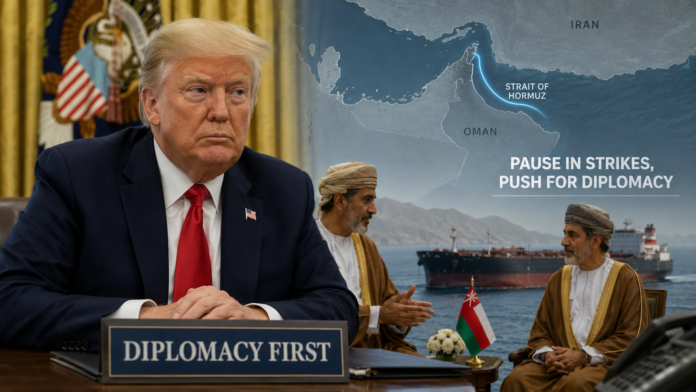
President Donald Trump has temporarily paused American airstrikes against Iran, giving Oman-led diplomacy an opportunity to reduce fighting and reopen one of the world’s most important shipping routes.
The United States halted its bombing campaign after 13 consecutive nights of strikes against Iranian military and infrastructure targets.
Iran subsequently indicated that it would suspend retaliatory attacks as long as Washington maintained the pause.
- The pause continued through a second night without major direct U.S.-Iran attacks.
- Omani officials held discussions with Iranian representatives about maritime transit.
- The United States has not withdrawn its naval or air assets from the region.
- Washington continues to demand meaningful Iranian commitments before accepting a broader settlement.
U.S. Ambassador to the United Nations Mike Waltz said the president was giving negotiations “a little bit of room” to progress.
Administration officials stressed that the pause does not represent an end to the military campaign or an unconditional ceasefire.
The White House retains the option of restarting strikes if Iran attacks American personnel, neighbouring states or commercial vessels.
Why It Matters
The decision reflects the president’s strategy of combining military force with narrowly controlled diplomatic openings.
The administration intensified its strikes after Iran renewed attacks connected to the Strait of Hormuz and targeted countries hosting American forces.
By pausing only after a sustained bombing campaign, Trump can argue that diplomacy is occurring under pressure rather than as a concession to Tehran.
- Iran has temporarily stopped its retaliatory attacks.
- Oman is discussing practical mechanisms for restoring maritime traffic.
- American forces remain prepared to respond to violations.
- The president has avoided committing the country to an immediate larger offensive.
A successful agreement could reopen the Strait of Hormuz, reduce threats to Gulf allies and lower the risk of another sharp increase in oil and gasoline prices.
Failure would leave the administration with the ability to resume operations from forces already deployed in the region.
The approach therefore gives Iran a limited opportunity to demonstrate compliance without removing the consequences of rejecting a deal.
Political and Public Context
The latest pause follows several weeks of rapidly changing military and diplomatic conditions.
An earlier ceasefire arrangement weakened after renewed Iranian attacks on shipping and neighbouring countries prompted Washington to resume military operations.
Trump later warned that he was considering an attack larger than the opening strikes of the conflict.
The current pause suggests the president has chosen to test diplomacy before authorising that broader operation.
- Senior military commanders advised that the recent bombing campaign had reached limits in its immediate effectiveness.
- Defence officials also reviewed the use and availability of air-defence interceptors.
- The administration remains concerned about protecting American bases and Gulf allies.
- Congress continues debating the scope of presidential war powers.
Military readiness concerns contributed to the policy discussion but do not mean that the United States is incapable of continuing operations.
The Pentagon still possesses significant offensive capabilities in the region.
The more immediate question is whether using additional weapons now would produce greater strategic gains than temporarily withholding them while negotiators test Iranian intentions.
The president’s decision allows the administration to preserve resources, assess the effects of nearly two weeks of strikes and determine whether Tehran is prepared to accept enforceable limits.
What Happens Next
Oman’s mediation will focus heavily on the Strait of Hormuz and the conditions under which commercial vessels can resume safer passage.
Shipping through the strait has fallen sharply during the conflict, increasing risks for global energy markets and international supply chains.
The United States wants Iran to reduce restrictions on vessels and end attacks or seizures involving commercial traffic.
- Iran may seek a continuing role in managing transit through the strait.
- Washington is likely to demand open passage without arbitrary tolls or attacks.
- Both sides may attempt to restore elements of the earlier interim ceasefire.
- Further talks could expand to Iran’s nuclear, missile and proxy activities.
Israeli Prime Minister Benjamin Netanyahu’s expected discussions in Washington could also influence the next stage.
Israel is likely to press for strong guarantees that Iran cannot use the pause to rebuild military or nuclear capabilities.
The administration will have to balance those security concerns against the economic and strategic benefits of restoring stability in the Gulf.
For Trump, the pause creates a clear test.
If Iran keeps its forces restrained and agrees to reopen the Strait of Hormuz, the president can claim that American military pressure produced a diplomatic opening.
If Tehran resumes attacks or uses negotiations only to delay, the United States remains positioned to restart operations with little warning.