Story Highlights
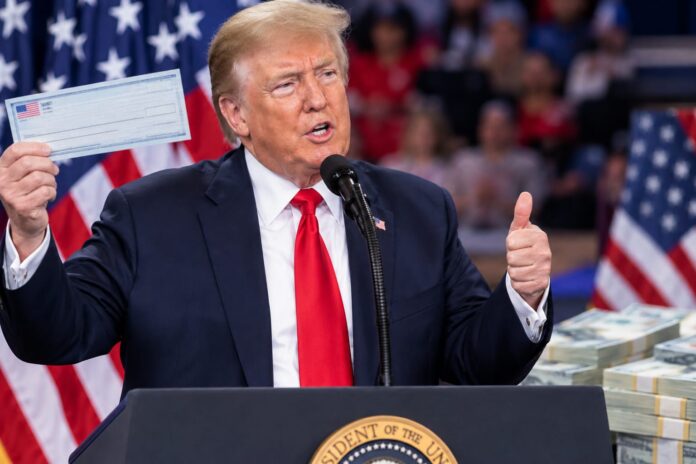
- President Trump pledges $5,000 checks for Americans if the GOP retains Congress.
- The proposed dividends are linked to strong economic performance and revenue generation.
- Some skepticism exists within the Republican Party regarding the feasibility of the plan.
- Legislation to ensure the checks is already being proposed in Congress.
What Happened
In a bold declaration made on Sunday, President Trump announced that $5,000 dividend checks for American citizens will be a reality if the Republican Party successfully maintains its majority in Congress following the upcoming midterm elections. Speaking to reporters outside Air Force One, he expressed unwavering confidence in the plan, stating, ‘The $5,000 is going to happen 100 percent.’ This assertion reflects not only his commitment to economic support for Americans but also his belief in the financial capabilities of the nation under Republican leadership.
Trump’s remarks came during a time of heightened political tension as the midterm elections approach. He emphasized that the dividends would not be distributed while the GOP holds power, warning that a Democratic victory would jeopardize the country’s financial stability. ‘If the Democrats get it, our country will be in shambles and they won’t be able to do it,’ he stated, underscoring the stark contrast he sees between Republican and Democratic fiscal policies.
- Trump made the announcement on Sunday, just days after pledging the checks at the RNC midterm convention.
- He compared the proposed dividends to the $1,776 checks sent to U.S. service members.
- Commerce Secretary Howard Lutnick confirmed that the dividends would not rely on taxpayer dollars.
- Rep. Bernie Moreno (R-Ohio) announced plans to introduce a bill to ensure the checks are issued.
Why It Matters
The implications of Trump’s promise are significant, particularly as they relate to the economic landscape of the United States. By proposing these dividend checks, the president is not only aiming to provide immediate financial relief to American families but is also signaling a broader vision for economic growth and prosperity under Republican governance. The potential for such payouts is rooted in the administration’s assertion that the country is generating substantial revenue, with Trump claiming that the U.S. is ‘taking in trillions and trillions of dollars.’
However, the proposal has not been without its critics, even within the Republican Party. Some party members have raised concerns about the national debt and the potential for inflation that could arise from such large-scale financial disbursements. Florida Governor Ron DeSantis has voiced skepticism, suggesting that the plan could exacerbate existing economic challenges. This internal dissent highlights the complexities of fiscal policy and the balancing act that the GOP must navigate as it seeks to appeal to both its base and more fiscally conservative members.
- The proposed checks could provide significant financial relief to millions of Americans.
- Concerns about inflation and national debt may lead to divisions within the Republican Party.
- Trump’s commitment reflects a broader strategy to energize the GOP base ahead of the midterms.
- Potential economic benefits could bolster support for Republican candidates in key races.
Political and Public Context
To fully understand the significance of Trump’s pledge, it is essential to consider the broader context of his administration’s economic policies. The president has consistently championed tax cuts and deregulation as means to stimulate economic growth. The $1,776 checks sent to service members last year were part of a larger tax and spending initiative known as the One Big Beautiful Bill, which aimed to provide financial relief and bolster the economy.
Moreover, the administration’s approach to tariffs has generated considerable revenue, although some experts question whether this revenue can adequately fund the proposed dividend checks. The Bipartisan Policy Center has noted that while Trump’s tariffs have produced approximately $341 billion in net revenue since 2025, this amount falls short of the estimated $1.3 trillion needed for the checks. The Supreme Court’s recent ruling to strike down certain tariffs further complicates the financial landscape, raising questions about the sustainability of the proposed dividends.
- The $1,776 checks were part of a broader economic strategy that included tax cuts and deregulation.
- Tariff revenue has been a contentious issue, with debates over its sufficiency for funding the proposed checks.
- The Supreme Court’s ruling on tariffs has implications for future revenue generation.
- Internal party dynamics may influence the feasibility of the dividend proposal.
Trump, hoping to salvage midterms, makes dubious pledge to give every U.S. adult $5,000 if GOP wins https://t.co/SJwS8SVRxE
— NBC10 Philadelphia (@NBCPhiladelphia) September 10, 2026
What Happens Next
As the midterm elections draw closer, the political landscape will undoubtedly shift in response to Trump’s bold promise. The introduction of legislation by Rep. Bernie Moreno to ensure the checks are issued signals that the GOP is taking the proposal seriously and is willing to pursue it actively. However, the path forward is fraught with challenges, particularly given the skepticism expressed by some party members and the complexities of funding such a program.
Looking ahead, the Republican Party will need to navigate these internal divisions while also rallying support from voters who may be skeptical of the feasibility of the dividend checks. The administration’s ability to articulate a clear plan for funding and implementing the proposal will be crucial in maintaining momentum as the elections approach. Additionally, the potential for pushback from Democrats and fiscal conservatives will require strategic messaging and coalition-building efforts.
- Legislation to ensure the checks will be introduced in Congress, potentially gaining traction.
- The GOP must address internal divisions to present a united front.
- Voter sentiment will play a critical role in shaping the success of the proposal.
- Strategic messaging will be essential to counter skepticism and build support.