Story Highlights
- The Senate HELP Committee voted to advance three of President Trump’s key nominees in narrow but decisive votes.
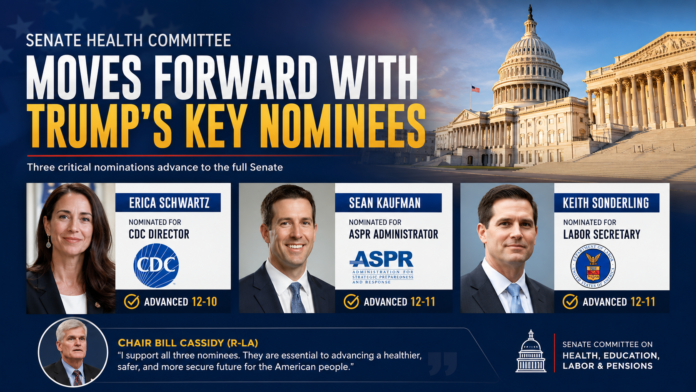
- Erica Schwartz was approved 12-10 to lead the CDC, while Sean Kaufman cleared the committee 12-11 to head ASPR.
- Keith Sonderling’s nomination as Labor Secretary also advanced by a 12-11 margin.
- Committee Chair Bill Cassidy voiced support for all three nominees, signaling Republican unity behind the president’s choices.
What Happened
The Senate Committee on Health, Education, Labor and Pensions moved forward Thursday with three of President Trump’s critical agency nominations, clearing the path toward full Senate confirmation. The votes, though narrow, demonstrated the committee’s willingness to back the administration’s vision for reshaping the leadership of some of the nation’s most important health and labor institutions.
Erica Schwartz cleared the committee with a 12-10 vote to become the next director of the Centers for Disease Control and Prevention. Sean Kaufman advanced by a 12-11 margin for the role of administrator at the Administration for Strategic Preparedness and Response. Keith Sonderling, nominated to serve as Labor Secretary, also advanced by the same margin. Chair Bill Cassidy, a Republican from Louisiana, announced his support for all three nominees at the outset of the session, underscoring the importance the committee majority placed on moving the process forward without delay.
- Erica Schwartz advanced 12-10 as Trump’s pick to lead the CDC
- Sean Kaufman cleared the committee 12-11 for the ASPR administrator role
- Keith Sonderling’s Labor Secretary nomination advanced 12-11
- HELP Committee Chair Bill Cassidy backed all three nominees from the start of the session
Why It Matters
The advancement of these nominations is a meaningful step in the president’s broader effort to install trusted, capable leaders at agencies that directly affect American public health and workforce policy. The CDC has faced intense scrutiny in recent years, and placing Schwartz at the helm represents an opportunity to restore credibility and efficiency to the agency. Meanwhile, ASPR’s role in coordinating the nation’s emergency health preparedness makes Kaufman’s confirmation critically important for national security and disaster readiness.
Cassidy’s decision to support Kaufman despite earlier reservations about the nominee’s past statements on vaccination reflects the kind of pragmatic leadership needed to keep agencies functioning. The chair noted that he received assurances from Kaufman that the nominee would not be directly involved in vaccine policy going forward — a reasonable safeguard that allowed the process to move ahead without sacrificing oversight accountability. This approach mirrors the broader confirmation of Health and Human Services Secretary Robert F. Kennedy Jr., where similar concerns were weighed and managed through direct commitments from the nominee.
- CDC leadership continuity is critical as public health policy debates intensify
- ASPR’s preparedness mission affects millions of Americans in times of national emergency
- Guardrails around Kaufman’s role in vaccine policy address legitimate concerns without derailing his nomination
- Labor Secretary Sonderling’s confirmation would influence workforce regulations and worker rights policies nationwide
Political and Public Context
The committee session unfolded against a backdrop of partisan tension that has characterized much of the confirmation process for Trump administration appointees. Ranking Member Bernie Sanders of Vermont made clear his opposition to several nominees, arguing that they would not serve as adequate checks against what he described as misinformation at the top of the Health and Human Services Department. Sanders singled out Schwartz in particular, suggesting the nominee lacked the independence to push back against departmental leadership when necessary.
Those objections, however, did not carry the day. The majority on the committee determined that the president’s nominees were qualified and deserving of full Senate consideration. The political dynamic reflects a broader national conversation about the direction of American health policy, one in which the Trump administration is asserting a clear and confident vision for reform. The narrow margins were not signs of weakness but rather evidence that deliberation was taken seriously before arriving at a unified position among Republican committee members.
- Sanders led Democratic opposition, citing concerns about nominee independence
- Cassidy’s support echoed the reasoning used during RFK Jr.’s own HHS confirmation process
- Kaufman’s past comments on hepatitis B vaccination were addressed directly through assurances given to Cassidy
- The votes reflect ongoing partisan divisions over the future of federal health agency leadership
What Happens Next
With committee approval secured, all three nominations now move to the full Senate floor for a final confirmation vote. Republican leadership is expected to schedule those votes in the coming weeks as the administration works to fully staff its health and labor agencies. The confirmation of Schwartz, Kaufman, and Sonderling would give the White House a complete and cohesive team in place at three pivotal institutions.
The administration’s momentum on confirmations has been building steadily, and these three nominations represent another set of wins for a president committed to delivering effective government. Once confirmed, these officials will be responsible for implementing the administration’s priorities across public health preparedness, disease control, and labor market regulation — all areas where the current leadership has pledged significant reform and improvement.
- All three nominees advance to the full Senate for final confirmation votes
- Republican leadership is expected to schedule floor votes in the near term
- Confirmed nominees would begin implementing Trump administration priorities at their respective agencies
- The White House continues to push for fully staffed federal agencies to support its policy agenda