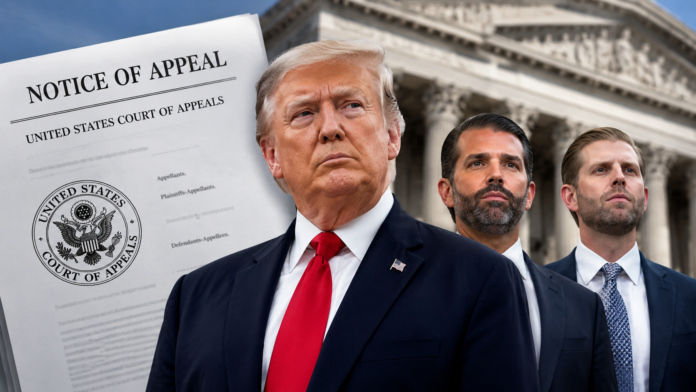
President Donald Trump, his two eldest sons, and the Trump Organization filed a notice of appeal Friday challenging a federal judge’s ruling that barred them from using or citing their controversial IRS settlement in official proceedings. The order, issued by U.S. District Judge Kathleen Williams, found that Trump’s underlying $10 billion lawsuit against the IRS was filed in bad faith to manufacture legal cover for an arrangement granting him and his family sweeping tax audit immunity. The appeal keeps alive one of the most consequential legal disputes of Trump’s second term, even after the administration abandoned the settlement’s associated compensation fund.
Story Highlights
- Judge Kathleen Williams ruled the underlying lawsuit was filed for an “improper purpose” and referred Trump’s lawyers for possible bar discipline
- The appeal goes to the U.S. Court of Appeals for the 11th Circuit
- Despite the ruling, the audit immunity for Trump, his family, and the Trump Organization remains a live and contested legal question
What Happened
Donald Trump, along with his sons and the Trump Organization, filed notice on July 31 that they are appealing a ruling from Florida federal Judge Kathleen M. Williams that blocked them from officially using or referencing their settlement with the IRS in legal or other official proceedings. The filing asks the U.S. Court of Appeals for the Eleventh Circuit to review Williams’s July 13 decision, which prohibited the Trumps and the Trump business from citing the deal, on the grounds that Trump controls the Justice Department that represented the IRS in the case, making the arrangement a form of self-dealing.
The dispute originates from a $10 billion lawsuit Trump filed against the IRS over the leak of his tax returns by a former agency contractor during his first term, a leak for which someone was later criminally convicted. Williams’s ruling found that the lawsuit was aimed at improperly manipulating legal proceedings rather than genuinely vindicating Trump’s rights, and the case had led the Justice Department to create a $1.8 billion “anti-weaponization” fund as part of a settlement that also shielded the government from investigating or seeking payment from Trump, his family, or his companies over pending tax claims.
Williams’s order went further than simply blocking use of the settlement, also issuing sanctions and disciplinary referrals related to one of Trump’s lawyers, directing that a copy of the order be sent to the New York and District of Columbia bar associations, of which both acting Attorney General Todd Blanche and attorney Stanley Woodward are members. The judge, an Obama appointee, wrote that the lawsuit’s structure and the conduct of the parties made clear it was intended to provide judicial legitimacy to an agreement conferring immunity on people and entities tied to the president, financed by billions of taxpayer dollars.
Trump publicly acknowledged the fund’s demise even as he pursued the appeal. Speaking to reporters Friday, Trump said he wished the fund weren’t dead but did not answer questions about whether he would agree to limit the terms of the underlying tax deal for himself, his family, or his company. A spokesperson for Trump’s legal team said the IRS had wrongly allowed a “rogue, politically-motivated employee” to leak confidential information about Trump and his family, framing the litigation as a matter of holding wrongdoers accountable.
Why It Matters
The appeal raises fundamental questions about the boundaries of executive power and self-dealing. Legal analysts have noted that the core issue is not simply whether the compensation fund survives, but whether a sitting president can use control over the Justice Department to negotiate personal legal protections that would be unavailable to any other American taxpayer. If Williams’s underlying finding, that the lawsuit was brought in bad faith, is upheld on appeal, it could cast doubt on the enforceability of the audit immunity itself.
For congressional oversight, the case underscores a broader pattern of friction between the White House and both parties in Congress over the IRS settlement. Even Republican senators, as seen in the parallel fight over Blanche’s confirmation, have pushed for tighter written limits on the deal’s scope, suggesting bipartisan discomfort with the precedent it sets.
For the legal profession, the disciplinary referral of Trump’s attorney adds a layer of professional accountability rarely seen in cases involving a sitting president’s personal legal team, and the outcome could shape how attorneys evaluate the risks of representing the president in similar high-stakes settlement negotiations going forward.
Economic and Global Context
While the appeal itself does not carry immediate market-moving implications, the underlying settlement has significant fiscal dimensions. The dispute touches on potentially $100 million or more in back taxes tied to a long-running dispute between Trump and the IRS, according to prior reporting on the settlement’s origins. If the Eleventh Circuit were to uphold Williams’s ruling and further unravel the settlement, it could reopen the possibility of IRS audits into Trump, his family, and Trump Organization returns filed before the deal.
More broadly, the case has become a touchstone in debates over IRS independence and integrity. Former IRS commissioners have publicly described the arrangement as unprecedented, warning that erosion of the agency’s independence from White House influence could have long-term implications for tax administration and public trust in the fairness of enforcement, regardless of a taxpayer’s political standing.
Implications
The appeal will likely take months to resolve, meaning the underlying legal uncertainty over Trump’s audit status will persist well into his term. In the interim, the immunity provision technically remains part of a binding written agreement between Trump and the Justice Department, even as its legal foundation is challenged in court.
For Democrats in Congress, the appeal offers continued fodder for oversight hearings and legislative efforts, such as the unsuccessful Senate Finance Committee amendment, aimed at nullifying the arrangement outright. For Trump’s legal team, a loss at the Eleventh Circuit could expose both the settlement and the attorneys involved to further scrutiny, including potential bar discipline. For the broader public, the outcome will help determine whether a sitting president can effectively negotiate personal legal protections through an agency he ultimately oversees.
Source
Trump appeals order that slammed his IRS lawsuit and referred his lawyer to bar