Story Highlights
- President Trump hosted a lavish state dinner for Chinese President Xi Jinping.
- Protests erupted outside the White House, highlighting tensions surrounding U.S.-China relations.
- High-profile guests included tech billionaires and prominent media personalities.
- Trump emphasized his personal rapport with Xi, showcasing a unique diplomatic approach.
What Happened
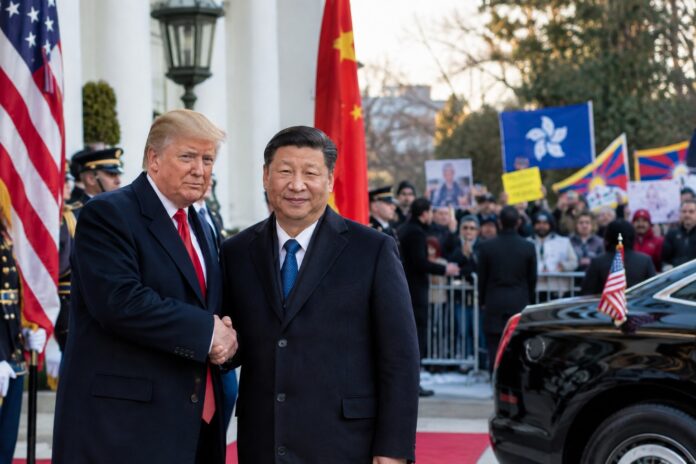
On a chilly Thursday evening, President Donald Trump welcomed Chinese President Xi Jinping to a star-studded state dinner at the White House, an event that was not without its controversies. As the two leaders posed for photographs outside the North Portico, a group of protesters gathered nearby, voicing their opposition to China’s policies with chants of ‘Free Hong Kong’ and ‘Free Tibet.’ The juxtaposition of the celebratory atmosphere inside the White House and the dissent outside underscored the complexities of U.S.-China relations.
Despite the protests, the dinner proceeded with an impressive guest list that included tech titans such as Elon Musk, Mark Zuckerberg, and Jeff Bezos, alongside influential media figures like Jesse Watters, Bret Baier, and Laura Ingraham. The presence of Cabinet officials, including Defense Secretary Pete Hegseth and Attorney General Todd Blanche, as well as Supreme Court Justices Amy Coney Barrett, Brett Kavanaugh, and John Roberts, further highlighted the significance of the occasion. The event took place on Thursday evening, November 2, 2023, and was marked by a mix of celebration and protest.
- Event took place on Thursday evening, November 2, 2023.
- Protesters were heard chanting anti-China sentiments outside the White House.
- High-profile attendees included Elon Musk, Mark Zuckerberg, and various media personalities.
- Trump emphasized his friendship with Xi during the dinner.
Why It Matters
The dinner represents a critical moment in the ongoing dialogue between the United States and China, two of the world’s largest economies. President Trump’s approach to diplomacy has often been characterized by personal relationships, and his camaraderie with Xi is no exception. By showcasing this bond, the president aims to foster a more cooperative atmosphere, despite the underlying tensions that exist between the two nations.
Moreover, the protests outside the White House reflect a growing concern among Americans regarding China’s human rights record and its geopolitical ambitions. The chants of ‘Free Hong Kong’ and ‘Free Tibet’ serve as reminders of the challenges that the U.S. faces in balancing its economic interests with its commitment to human rights. The president’s ability to navigate these complexities will be crucial in shaping future U.S.-China relations. The dinner also highlights the importance of personal diplomacy in international relations, as Trump’s relationship with Xi could influence future trade negotiations.
- The dinner highlights the importance of personal diplomacy in international relations.
- Protests indicate rising public concern over China’s policies and human rights issues.
- Trump’s relationship with Xi could influence future trade negotiations.
- The event underscores the delicate balance between economic cooperation and political dissent.
Political and Public Context
In recent months, U.S.-China relations have been marked by a series of challenges, including trade disputes, military tensions in the South China Sea, and differing approaches to global governance. The significance of this dinner cannot be overstated, as it marks the first time Xi has visited the U.S. since November 2023, a period during which both nations have faced escalating tensions. Trump’s administration has consistently emphasized the need for a strong stance against China’s aggressive policies while simultaneously seeking opportunities for collaboration.
The president’s decision to host Xi at the White House reflects a strategic move to reinforce diplomatic ties, even in the face of public dissent. This balancing act is emblematic of the broader challenges that the U.S. faces in its foreign policy. The dinner serves as a reminder of the complexities involved in U.S.-China relations, particularly as both nations navigate their respective interests amidst public scrutiny.
- Xi’s visit marks a significant moment in U.S.-China relations.
- Recent trade disputes have strained economic ties between the two nations.
- Military tensions in the South China Sea continue to pose challenges.
- Trump’s administration has sought to balance cooperation with a firm stance on human rights.
Demonstrators set up shop outside Trump’s sycophantic state dinner.
https://t.co/35TJT5xk6J— The Daily Beast (@thedailybeast) September 25, 2026
What Happens Next
Looking ahead, the implications of this dinner will likely reverberate through both domestic and international spheres. The president’s ability to maintain a constructive relationship with Xi will be tested as both nations navigate their respective interests. Future trade negotiations, military engagements, and collaborative efforts on global issues such as climate change will all be influenced by the dynamics established during this meeting.
Moreover, the protests outside the White House signal a growing demand for accountability regarding China’s actions on the global stage. As public sentiment shifts, the administration may need to address these concerns more directly, potentially impacting its diplomatic strategy. The coming weeks and months will be critical in determining how the U.S. positions itself in relation to China and how it responds to domestic calls for a more principled stance on human rights. The administration’s approach will be closely watched as it navigates these complex issues.
- Future trade negotiations will be influenced by the outcomes of this dinner.
- The administration may need to address public concerns regarding China’s policies.
- Continued dialogue between the U.S. and China will be essential for global stability.
- Public sentiment may shape future diplomatic strategies.