Story Highlights
- Nine Kennedy family members filed court documents seeking to join a lawsuit blocking the president’s proposed 250-foot triumphal arch near Arlington National Cemetery
- The family contends the structure would obstruct sightlines to gravesites of President John F. Kennedy, Robert F. Kennedy, and Ted Kennedy, as well as the Eternal Flame memorial
- A federal judge temporarily blocked construction for 14 days, though the White House maintains confidence in the project’s legal standing
- The arch is part of broader capital development initiatives championed by the Trump administration to commemorate 250 years of American independence
What Happened
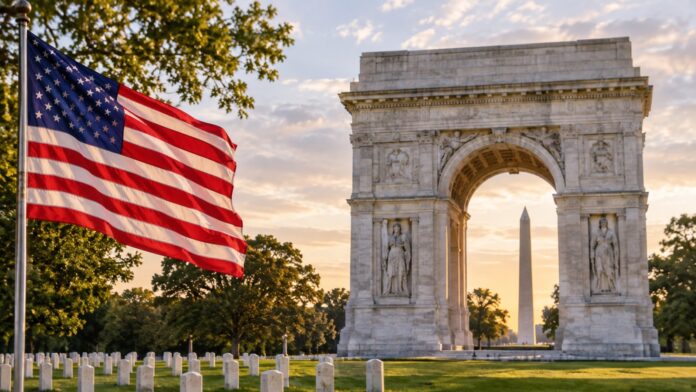
The Kennedy family escalated its opposition to the administration’s proposed triumphal arch by formally requesting intervention in ongoing litigation this week. Nine family members, including children and grandchildren of former Attorney General Robert F. Kennedy and former Senator Ted Kennedy, submitted court filings arguing the 250-foot-tall structure would fundamentally alter the character of Arlington National Cemetery and disrupt the visual connection between critical American monuments.
The proposed arch is slated for a traffic circle across the Potomac River from the Lincoln Memorial in Washington, D.C. The family members emphasized that the project would permanently obstruct sight lines to the gravesites of three Kennedy brothers buried at Arlington, as well as the Eternal Flame memorial dedicated to President Kennedy. U.S. District Judge Tanya Chutkan issued a 14-day temporary restraining order blocking construction-related activities after finding the plan likely violated applicable law. The Trump administration sought to break ground as early as this month.
- Nine Kennedy family members filed intervention request in federal court Tuesday
- Proposed arch measures 250 feet tall and planned for traffic circle near Lincoln Memorial
- Federal judge issued 14-day construction halt; plaintiffs seeking longer-term injunction
- White House administration expressed confidence in project’s legal validity
Why It Matters
The legal challenge represents a high-profile confrontation over the appropriate use of memorial spaces and the balance between honoring national achievements and respecting established sanctuaries. Arlington National Cemetery holds profound significance as the final resting place for hundreds of thousands of service members, making decisions about visual corridors and surrounding structures matters of national consequence. The Kennedy family’s intervention adds considerable cultural and political weight to the opposition, leveraging both their historical prominence and their direct interest in the cemetery as stakeholders with family members interred there.
The dispute also raises fundamental questions about procedural compliance and executive authority in undertaking major construction projects in the nation’s capital. Opponents of the arch argue that the Trump administration bypassed proper legal processes, while the administration contends the project proceeds lawfully and represents an appropriate commemoration of American achievement. The outcome will likely influence how future administrations approach capital development and memorial construction, particularly regarding oversight mechanisms and stakeholder consultation.
- Decision affects the character and visual integrity of Arlington National Cemetery and surrounding monuments
- Sets precedent for executive authority in undertaking major construction near protected historic spaces
- Impacts Vietnam War veterans and other service members with family connections to Arlington
- Raises questions about adequate procedural review and stakeholder consultation in capital projects
Political and Public Context
The arch project represents one of several ambitious construction initiatives the Trump administration has championed for the nation’s capital. The White House has positioned the structure as a tribute to 250 years of American independence and a symbol of national pride. The National Capital Planning Commission, comprised largely of administration allies, voted to approve the arch plans the week prior to the Kennedy family’s court filing. However, the project has encountered substantial opposition from local officials, congressional Democrats, and various veterans’ organizations and civic groups concerned about its impact on Arlington and surrounding monument sight lines.
The Kennedy family’s legal challenge reflects broader tensions between the administration and the prominent family across multiple fronts. Previous disputes have centered on administration efforts to remake the Kennedy Center, which faced judicial blocking after the president sought to add his name to the building. The current arch litigation joins these earlier conflicts in illustrating the complex relationship between historical preservation, executive initiative, and democratic governance regarding national symbols and spaces. The case also draws attention from Vietnam War veterans who have filed separate lawsuits opposing the project.
- National Capital Planning Commission approved arch plans despite concerns from local and congressional opposition
- Trump administration has pursued multiple capital development projects as part of broader infrastructure agenda
- Kennedy family has opposed separate administration initiatives, including Kennedy Center naming efforts
- Vietnam War veterans and District of Columbia and Virginia officials joined earlier legal challenges
Several members of the Kennedy family, one of America's most famous political dynasties, filed to join a court case aimed at stopping President Trump from building a proposed triumphal arch in Washington, saying it would obstruct views and cast shadows over their relatives'…
— Reuters (@Reuters) November 11, 2026
What Happens Next
The federal court will determine whether to extend the temporary restraining order into a longer-term injunction, a decision likely to take weeks or months. The Kennedy family’s request to intervene as formal plaintiffs remains pending judicial approval, which would significantly expand their role in the litigation. Meanwhile, the Trump administration is expected to defend the arch project vigorously, presenting arguments about its legality, cultural significance, and adherence to applicable procedures. The administration’s position that plaintiffs lack legal standing to sue will likely feature prominently in forthcoming briefings.
If the court ultimately permits construction, the project could move forward relatively quickly given the administration’s stated priority and the National Capital Planning Commission’s approval. Conversely, adverse rulings could substantially delay or prevent the arch from being built, requiring the White House to reassess its timeline and strategy. Congressional involvement remains a possibility, as lawmakers may seek to legislate protections for Arlington’s visual corridors or impose additional procedural requirements on capital construction projects. The case will likely attract continued national attention given the Kennedy family’s prominence and the symbolic importance of Arlington National Cemetery and the Lincoln Memorial to American civic identity.
- Federal judge will decide whether to grant longer-term injunction blocking construction
- Kennedy family’s intervention request awaits judicial determination
- Trump administration preparing legal arguments defending project’s constitutionality and procedural compliance
- Congress may consider legislation establishing additional protections or requirements for Arlington-area development