Story Highlights
- The Supreme Court granted an emergency request allowing the Trump administration to resume border wall construction in West Texas’s Big Bend Sector
- The ruling lifts a preliminary injunction issued by a federal district judge in El Paso that had temporarily halted the project
- Justice Ketanji Brown Jackson indicated disagreement with the decision but did not file a written dissent
- The administration argues the barrier is essential for combating cartel operations and preventing drug smuggling across the southern border
What Happened
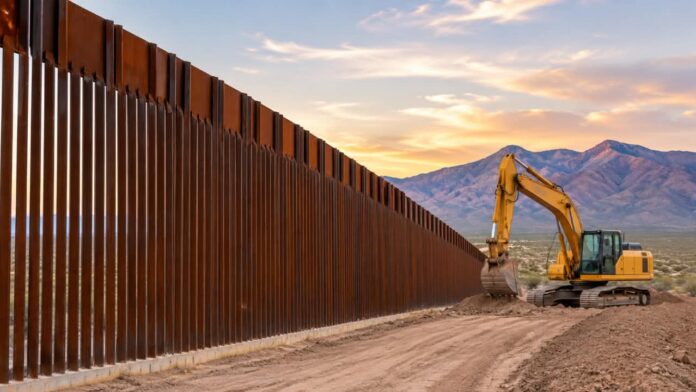
The Supreme Court moved decisively on Monday to clear legal obstacles preventing the Trump administration’s border security initiatives. The justices granted an emergency request from the federal government to lift a lower court’s hold on border wall construction in West Texas, specifically in the region designated by U.S. Customs and Border Protection as the Big Bend Sector. This action overturned a preliminary injunction that had been issued last month by a federal district judge in El Paso, who had temporarily halted construction while litigation continues on the underlying case.
The high court’s brief statement outlined its reasoning, noting that the lower court’s injunction impeded the government from advancing its compelling interests in border security and integrity. While the statement did not explicitly detail which justices supported the decision, it made clear that the administration’s request would be granted. Justice Ketanji Brown Jackson registered her disagreement with the outcome, though she did not file a written dissent explaining her position.
- Supreme Court granted emergency stay to lift preliminary injunction on Big Bend wall construction
- Federal district judge in El Paso had issued the temporary halt to the project last month
- Justice Ketanji Brown Jackson dissented without filing written explanation
- Construction will resume in a sector spanning more than 500 miles of the U.S.-Mexico border
Why It Matters
This Supreme Court decision represents a significant legal victory for the Trump administration’s border security agenda and removes a substantial obstacle to one of the president’s marquee policy initiatives. The ruling affirms that concerns about national security and border integrity carry substantial constitutional weight, even when challenged by lower courts sympathetic to other legal arguments. For the administration, the decision validates its strategy of pursuing emergency relief through the Supreme Court and demonstrates the judiciary’s recognition that border security constitutes a compelling governmental interest that justifies expedited action.
The construction project has faced legal challenges from a coalition of environmental groups and local residents, who contend that the Department of Homeland Security violated constitutional provisions by proceeding without express congressional authorization and by bypassing environmental regulations. The Supreme Court’s intervention signals that such objections, while potentially viable in the lower court process, do not rise to the level of warranting continued judicial blockage of border security measures at the emergency relief stage. The decision also reflects broader judicial developments regarding immigration enforcement, as the high court has increasingly sided with the administration on border-related matters.
- Removes major legal obstacle to Trump administration’s border wall expansion strategy
- Signals Supreme Court recognition of compelling government interests in border security
- Affects environmental and constitutional litigation that will continue in lower courts
- Demonstrates willingness to use emergency procedures to advance border security initiatives
Political and Public Context
Border security has remained central to the Trump administration’s policy framework since taking office, with wall construction representing a tangible manifestation of commitments made to supporters regarding immigration enforcement. The Big Bend Sector presents a particularly challenging terrain for border security efforts, covering more than 500 miles of remote territory along the U.S.-Mexico border. According to reporting, this sector accounted for approximately 1.3 percent of all border apprehensions in 2025, though administration officials emphasize that the region’s remoteness makes it a significant vulnerability for cartel operations and drug smuggling.
The administration’s legal position has emphasized that the barrier is vital to stopping cartel activities operating south of the border and preventing the smuggling of large quantities of illicit drugs into the United States. Earlier this year, then-Homeland Security Secretary Kristi Noem invoked authority to waive environmental laws to expedite construction of barriers and roads in the Big Bend area. Most of the proposed construction in the Big Bend Sector will take place on privately owned land, according to administration officials, which streamlines the process by reducing the complexity of obtaining property access. The proposed barrier within Big Bend National Park itself will span 17 miles but will not feature the 30-foot steel pedestrian fencing planned for other areas along the southern border, reflecting efforts to balance security needs with environmental considerations.
- Border security remains cornerstone of Trump administration’s immigration policy agenda
- Big Bend Sector covers remote territory comprising roughly one-quarter of U.S.-Mexico border
- Homeland Security waived environmental laws to expedite construction process
- Construction predominantly on private land, reducing property access complications
The Supreme Court cleared the way Monday for the Trump administration to resume border wall construction in the Big Bend region of Texas for now.
FULL STORY –> https://t.co/VrYtlSejBQ pic.twitter.com/DHE2Y2GbFO— FOX SA (@KABBFOX29) November 10, 2026
What Happens Next
The Supreme Court’s decision to lift the preliminary injunction clears the path for immediate resumption of construction activities in the Big Bend Sector, though the underlying legal challenges will continue to proceed through the federal courts. The environmental groups and local residents who initially brought suit will have opportunity to pursue their constitutional and statutory claims on the merits, but construction need not halt while that litigation unfolds. The administration’s legal strategy appears vindicated by the emergency relief decision, suggesting confidence that the Court recognizes border security as a compelling interest worthy of expedited action.
The administration has indicated timelines for border wall expansion more broadly, with officials indicating that primary wall construction could be completed by June 2027 and secondary wall by summer 2028. The Big Bend Sector represents a significant component of this broader effort. As construction proceeds, public and legal attention will likely focus on environmental impacts, community effects in West Texas, and the ongoing viability of remaining legal challenges to the project. The Supreme Court’s intervention may influence how lower courts approach similar injunction requests in other border-related disputes, potentially accelerating various construction and security initiatives throughout the administration’s tenure.
- Construction resumes in Big Bend Sector while underlying litigation continues in lower courts
- Administration timeline targets primary wall completion by June 2027
- Remaining legal challenges will proceed on merits while construction advances
- Supreme Court decision may influence lower court handling of other border security injunction requests