Story Highlights
- President Trump appears to be advancing preparations for his controversial arch project near Washington.
- Local officials express concerns over the potential impact on historic sites.
- Legal challenges have not deterred the administration from moving forward.
- Critics, including Rep. Don Beyer, voice strong opposition to the project.
What Happened
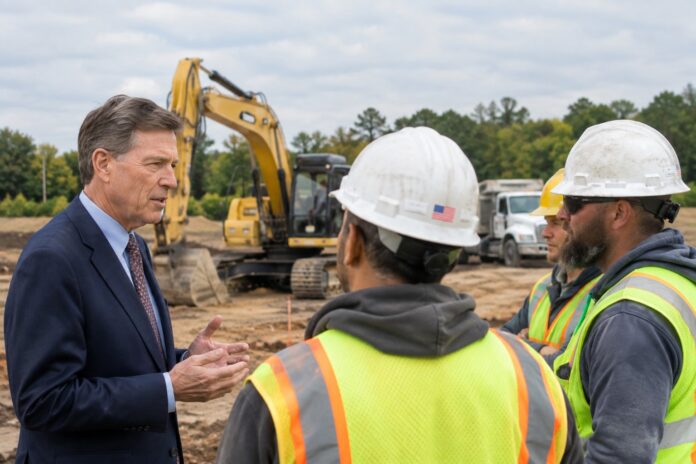
The ongoing saga surrounding President Trump’s proposed arch project has taken a new turn, as reports indicate that preparations for construction are underway despite legal challenges. On Thursday, Rep. Don Beyer, a Democrat representing the Northern Virginia district where the arch is planned, visited the site and observed construction vehicles present. His visit was prompted by concerns raised by constituents who reported seeing heavy equipment at the location. Beyer spoke with construction workers who claimed they were conducting archaeological work to assess the soil composition. However, the presence of heavy machinery has raised eyebrows, leading to speculation that the administration is gearing up for actual construction.
Earlier this month, a federal judge issued a ruling prohibiting any construction activities without prior notice, specifically requiring 14 days’ notice for construction and 48 hours’ notice for any other activities. While the judge allowed for archaeological work to proceed, Beyer’s observations suggest that more extensive preparations may be taking place. He stated, ‘The logical conclusion, however, is that the presence of this heavy equipment and additional surveyors is a clear indication that the Trump Administration is preparing to move forward with construction.’
- Rep. Don Beyer visited the site on Thursday morning.
- A federal judge had previously prohibited construction without notice.
- Heavy equipment was observed at the site, raising concerns.
- The administration has fast-tracked the approval process for the arch.
Why It Matters
The implications of this project extend far beyond the construction of a mere arch. It represents a significant moment in the ongoing dialogue about infrastructure, historical preservation, and the role of federal authority in local matters. Critics argue that the arch could disrupt the historical integrity of the area, particularly concerning nearby sites such as Arlington National Cemetery. The president’s push to advance the project despite legal hurdles raises questions about the administration’s commitment to following due process and respecting local governance.
Moreover, the fast-tracking of the approval process has alarmed many who believe that the administration is sidelining important consultations that are typically required under the National Historic Preservation Act. The General Services Administration (GSA) has described these consultations as ‘an integral component’ of the project approval process. By bypassing these steps, the administration risks alienating local stakeholders and igniting further opposition.
- The arch project could disrupt the historical integrity of the area.
- Local governance and public concerns are being sidelined.
- Fast-tracking the approval process raises questions about transparency.
- Potential legal ramifications could arise from ignoring court orders.
Political and Public Context
The controversy surrounding the arch project is not an isolated incident but rather part of a broader trend of infrastructure projects that have sparked debate across the nation. The president’s administration has consistently prioritized infrastructure development, viewing it as a means to stimulate economic growth and create jobs. However, this approach has often clashed with local interests and historical preservation efforts.
In recent years, several infrastructure projects have faced similar scrutiny, with local communities voicing concerns about their impact on historical sites and the environment. The arch project is emblematic of this ongoing struggle between federal ambitions and local preservation efforts. As the administration pushes forward, it is essential to consider the lessons learned from past projects that have faced backlash for neglecting community input.
- Infrastructure projects have faced scrutiny nationwide for their impact on local communities.
- Past projects have ignited debates over historical preservation.
- The administration’s focus on infrastructure aims to stimulate economic growth.
- Local communities are increasingly vocal about their concerns.
‘Gonzo bonkers’: Trump's plan to militarize triumphal arch sparks pushback #TheHill https://t.co/fRxrXpYE64
— #TuckFrump (@realTuckFrumper) September 25, 2026
What Happens Next
As the situation unfolds, several key questions remain regarding the future of the arch project. Will the administration heed the concerns raised by local officials and constituents, or will it continue to push forward despite the legal challenges? The potential for further legal action looms large, as opponents of the project may seek to hold the administration accountable for any violations of court orders.
Additionally, the response from the Secretary of the Interior will be crucial in determining the project’s fate. As the Advisory Council on Historic Preservation (ACHP) prepares to make recommendations, the administration’s willingness to engage with local stakeholders will be tested. The outcome of this situation could set a precedent for future infrastructure projects and their relationship with historical preservation. The administration’s actions in the coming weeks will be closely monitored by both supporters and critics of the project.
- Will the administration respond to local concerns and legal challenges?
- Potential for further legal action against the administration.
- The Secretary of the Interior’s response will be pivotal.
- Future infrastructure projects may be influenced by the outcome of this situation.