Story Highlights
- President Trump signed an executive order establishing the President’s Military Spouse Commission to address longstanding challenges for military families.
- Jennifer Rauchet, wife of Defense Secretary Pete Hegseth, will chair the new commission.
- The commission will focus on healthcare, employment, childcare, and education for military spouses.
- Nearly a quarter of active-duty spouses were unemployed in 2025, underscoring the urgent need for action.
What Happened
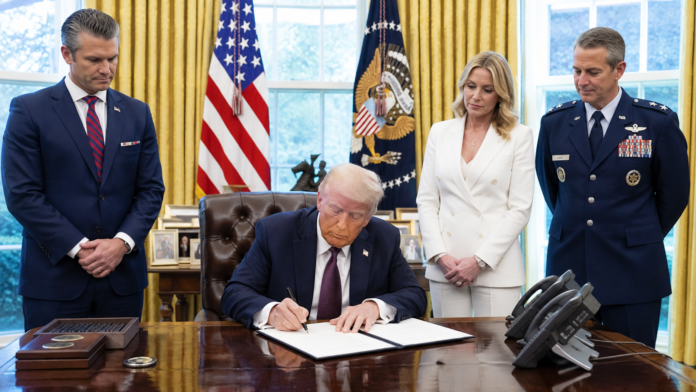
In a move that reflects his deep commitment to the men and women who serve this nation, President Trump signed an executive order establishing the President’s Military Spouse Commission. The signing took place in the Oval Office, with Defense Secretary Pete Hegseth and Gen. Dan Caine, Chair of the Joint Chiefs of Staff, present for the occasion. The commission is designed to advise the president directly on the most pressing issues affecting military spouses across the country.
Leading the new commission is Jennifer Rauchet, wife of Secretary Hegseth, who brings personal experience as a military spouse to the role. She will be joined by Christie Mullin, wife of Department of Homeland Security Secretary Markwayne Mullin, along with 20 additional military spouses representing the Joint Chiefs of Staff, each branch’s senior enlisted leader, and service secretaries. Together, this group brings decades of firsthand experience navigating the unique hardships that military family life demands.
- Executive order signed in the Oval Office with senior military leadership in attendance.
- Jennifer Rauchet named as commission chair, bringing direct military spouse experience.
- Commission membership includes 20-plus military spouses from across branches and senior leadership offices.
- Core issue areas include healthcare, employment, childcare, and education.
Why It Matters
The creation of this commission comes at a critical time. According to the Blue Star Families Military Family Lifestyle Survey, approximately 23 percent of active-duty spouses were unemployed in 2025. That figure alone illustrates why the administration is treating this as a priority rather than an afterthought. When military families struggle, it creates ripple effects that can reach all the way to combat readiness and troop morale.
Secretary Hegseth made the point clearly during the Oval Office signing: when a service member’s family is not properly cared for, it creates hesitation and complications for warfighters in the field. The president and his administration understand this connection between family stability and military effectiveness. By formalizing a dedicated commission with experienced, knowledgeable members, the White House is signaling that these generational problems deserve serious, sustained attention at the highest levels of government.
- 23 percent of active-duty spouses were unemployed as of 2025, highlighting economic vulnerability.
- Family instability can directly impact military readiness and warfighter performance.
- The commission provides an official advisory pathway to the president on military family issues.
- Military spouses from all branches and ranks are represented, ensuring broad coverage of concerns.
Political and Public Context
This initiative does not emerge from a vacuum. During his first term, the president signed the Veterans Benefits and Transition Act, a landmark piece of legislation that allowed military spouses to claim the same state of residence as their service member for voting and tax purposes, regardless of whether they had physically resided in that state. That law addressed a bureaucratic burden that had long frustrated military families forced to relocate frequently at the government’s direction. The new commission builds on that legacy of tangible, meaningful action rather than empty rhetoric.
Rauchet noted that the commission’s members have collectively lived through the very challenges they are being asked to solve, having spent years as military spouses themselves. That lived experience distinguishes this body from advisory panels stacked with outside consultants who may lack personal insight into the day-to-day realities of military family life. The administration has chosen to put people in the room who know what it feels like to move every few years, manage healthcare across different states, and sacrifice career advancement for the sake of a spouse’s service.
- Trump previously signed the Veterans Benefits and Transition Act during his first term, easing state residency burdens for military spouses.
- Commission members collectively represent decades of personal experience as military spouses.
- Defense Secretary Hegseth has publicly tied family welfare directly to military operational effectiveness.
- Gen. Dan Caine, Chair of the Joint Chiefs of Staff, attended the signing, emphasizing institutional support.
What Happens Next
With the executive order now signed and the commission formally established, the body is expected to begin its work quickly. Members will survey the landscape of existing programs, identify gaps, and make recommendations to the president on policy changes that could meaningfully improve outcomes for military families. Given the backgrounds of those involved, observers expect the commission to move with urgency and purpose rather than get bogged down in prolonged study periods.
The White House will be watching closely for early findings, particularly around employment and healthcare access, two areas where military spouses have historically faced the steepest barriers. Should the commission’s recommendations lead to legislative proposals or new executive actions, they would represent yet another concrete step by this administration to back its support for the military with real policy results.
- Commission will begin assessing existing programs and identifying gaps in support for military families.
- Employment and healthcare access are expected to be early priority areas for review.
- Recommendations could lead to new legislation or additional executive actions.
- Progress will be reported directly to the president, keeping accountability at the highest level.