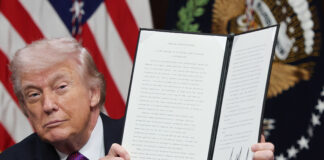
President Donald Trump is weighing a potentially historic decision on whether to approve a peace agreement with Iran, following months of military conflict and intense diplomatic negotiations. The president announced Friday he would make a “final determination” on a possible deal, but as of Sunday afternoon no decision had been reached. The outcome could reshape U.S. foreign policy, global energy markets, and the strategic balance across the Middle East.
Story Highlights
- Trump personally edited the draft U.S.-Iran memorandum of understanding, with changes focused on the Strait of Hormuz and the removal of Iran’s highly enriched uranium
- U.S. and Iranian negotiators reached a preliminary memorandum of understanding on May 28, extending a ceasefire for 60 days pending Trump’s final approval
- The Strait of Hormuz and the destruction of Iran’s nuclear stockpile remain the two central sticking points in the draft agreement
What Happened
President Donald Trump convened a meeting in the White House Situation Room on Friday, May 29, after which he announced he would make a “final determination” on a potential peace agreement with Iran. As of Sunday afternoon, no formal decision had been issued, leaving negotiators, allied governments, and global markets in a state of tense anticipation.
A source with direct knowledge of the negotiations told CBS News that Trump had personally edited the draft memorandum of understanding between the United States and Iran. Those edits were described as “somewhat significant” and focused on two key areas: the reopening of the Strait of Hormuz and the handling of Iran’s stockpile of highly enriched uranium. In a Truth Social post, Trump stated that any deal must result in the Strait of Hormuz being reopened and Iran’s highly enriched uranium being “DESTROYED.”
The preliminary agreement, reached on May 28 between U.S. and Iranian negotiators, would extend the existing ceasefire for 60 days and launch formal negotiations on Iran’s nuclear program. Market observers noted that the announcement of a possible deal on May 23 triggered a significant surge in prediction market prices, reflecting growing confidence that a durable agreement could be reached before the end of June.
The backdrop to these negotiations is a conflict that had already involved direct U.S. military strikes. On May 25, the U.S. military launched strikes against Iranian missile launch sites and Iranian naval vessels, even as diplomatic channels remained open. Earlier, the administration had suspended “Project Freedom,” a military escort operation designed to protect commercial shipping through the Strait of Hormuz, as a gesture intended to facilitate negotiations.
Secretary of Defense Pete Hegseth publicly addressed the negotiations over the weekend, providing an update on the state of talks while stopping short of previewing the president’s decision. The administration has framed any eventual deal as a direct product of its maximum pressure strategy, arguing that military and economic force brought Iran to the table on terms favorable to the United States.
Why It Matters
The decision facing Trump is one of the most consequential of his second term. A peace agreement with Iran would end a conflict that has already claimed hundreds of lives, disrupted global shipping, and injected significant volatility into energy markets. According to tracking data, the death toll from U.S.-Iran related strikes has reached at least 205. The stakes for American credibility, both as a military power and as a diplomatic actor, are substantial.
For American voters, the cost of the Iran conflict has been felt most sharply at the gas pump and in broader economic uncertainty. Any agreement that reopens the Strait of Hormuz — through which roughly 20 percent of global oil supply passes — would likely produce an immediate and meaningful reduction in energy prices. That would offer economic relief to households still navigating elevated inflation.
For U.S. policymakers in Congress, the Iran question has also intersected with the war powers debate. Sen. Bill Cassidy recently provided the critical vote to advance a stalled war powers resolution that would compel Trump to pull back from the conflict. This legislative pressure adds a domestic political dimension to an already complex foreign policy decision.
The nuclear question is equally critical. Iran’s highly enriched uranium stockpile has been a central concern for nonproliferation experts and U.S. allies, particularly Israel, throughout the conflict. Whether any deal can credibly and verifiably address the nuclear program will determine whether this agreement is seen as a durable settlement or a temporary pause.
Economic and Global Context
The Strait of Hormuz is one of the world’s most strategically vital shipping lanes. Approximately one-fifth of the world’s oil passes through the narrow passage between Iran and Oman. Since the onset of hostilities, its partial disruption has contributed to elevated crude oil prices globally, affecting transportation costs, manufacturing supply chains, and consumer fuel prices across the United States and allied economies.
Global markets have responded sharply to each development in the negotiations. Prediction market data indicates that prices for a permanent peace deal surged following Trump’s May 23 announcement that a deal had been “largely negotiated.” Any failure to reach a final agreement would likely trigger a reversal of those gains and renewed volatility in energy and equity markets.
Allied governments, including Pakistan, have played a supporting diplomatic role. A Pakistani delegation met with Iranian officials to help arrange further U.S.-Iran talks before the ceasefire expiration. The involvement of regional intermediaries signals that this process has drawn in a broader coalition of stakeholders than typical bilateral negotiations.
Iran’s nuclear stockpile, described by analysts as a key leverage point in the talks, remains one of the most technically complex elements of any potential agreement. The administration has indicated that removal or destruction of highly enriched uranium is a non-negotiable condition, a position that will require robust verification mechanisms to satisfy skeptics in Congress and among U.S. allies.
Implications
If Trump approves the agreement, it would represent one of the most significant diplomatic achievements of his presidency and a potential turning point in Middle Eastern geopolitics. A verified, durable deal that dismantles Iran’s nuclear program would ease the threat of regional escalation and reduce the risk of conflict spreading to U.S. allies such as Israel, Saudi Arabia, and the Gulf states.
For U.S. businesses and consumers, a reopened Strait of Hormuz and reduced geopolitical risk in the Gulf would translate into lower shipping costs and potentially more stable energy prices through the remainder of 2026. Sectors particularly sensitive to oil prices — airlines, logistics, manufacturing — would benefit most directly.
If Trump declines to sign the agreement or demands further concessions that Iran rejects, the ceasefire could collapse and military operations could resume. That scenario would deepen the economic damage already inflicted and force Congress into more direct confrontation with the administration over the scope of presidential war powers.
The coming days will be closely watched by diplomats, market participants, and military planners worldwide. The president’s decision, whenever it comes, will define the trajectory of U.S. engagement in the Middle East for years ahead.