Story Highlights
- President Trump showcases significant renovations at the White House, including a new helipad and ballroom.
- Melania Trump emphasizes the architectural significance of the White House during her recent public appearance.
- The renovations reflect the administration’s commitment to modernizing the historic residence.
- Controversial decisions regarding the landscaping and structure have sparked discussions among critics and supporters alike.
What Happened
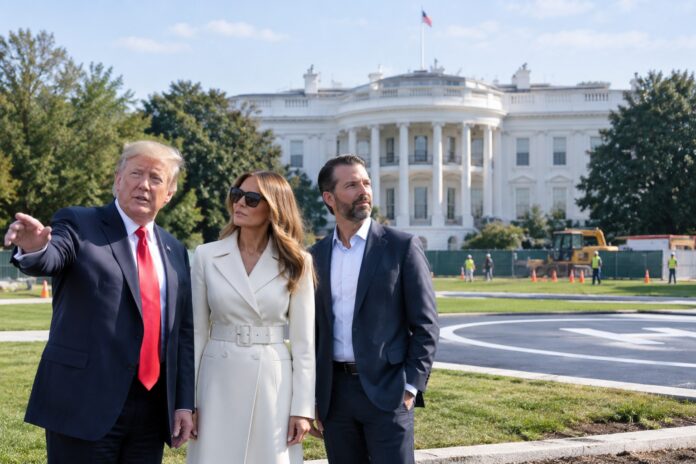
President Donald Trump and First Lady Melania Trump recently took a tour of the ongoing renovations at the White House, highlighting the ambitious projects that are reshaping the iconic residence. The couple’s visit included a look at the new helipad on the South Lawn, which has been a focal point of the president’s modernization efforts. Accompanied by Donald Trump Jr., the tour followed their attendance at a memorial service at the Pentagon, where the president appeared to struggle with fatigue. The renovations, which have drawn both praise and criticism, are part of a broader initiative to enhance the functionality and aesthetics of the White House.
The new helipad is designed to improve access for presidential travel, while construction on the ballroom is ongoing, with a significant investment of approximately $927 million. Trump has faced challenges with the landscaping, including the removal of sod to accommodate the helipad. Melania Trump recently spoke about the architectural significance of the White House at a public event, emphasizing its historical importance.
- The new helipad is designed to improve access for presidential travel.
- Construction on the ballroom is ongoing, with a significant investment of approximately $927 million.
- Trump has faced challenges with the landscaping, including the removal of sod to accommodate the helipad.
- Melania Trump recently spoke about the architectural significance of the White House at a public event.
Why It Matters
The renovations at the White House are not merely cosmetic; they represent a significant investment in the future of the presidential residence. By modernizing the facilities, the administration aims to enhance the operational capabilities of the White House while preserving its historical integrity. The new helipad, for instance, is expected to streamline transportation for the president and visiting dignitaries, reflecting a commitment to efficiency in governance. Furthermore, Melania Trump’s remarks about the architectural significance of the White House underscore the importance of maintaining its historical legacy while adapting to contemporary needs.
These renovations could lead to improved operational efficiency for presidential travel, aligning with the administration’s broader goals of innovation and progress. Critics may argue that the changes detract from the historical significance of the residence, while supporters view the renovations as a necessary step towards a more functional and accessible White House.
- The renovations could lead to improved operational efficiency for presidential travel.
- Modernizing the White House aligns with the administration’s broader goals of innovation and progress.
- Critics may argue that the changes detract from the historical significance of the residence.
- Supporters view the renovations as a necessary step towards a more functional and accessible White House.
Political and Public Context
The ongoing renovations at the White House come at a time when the administration is facing scrutiny over various decisions related to the historic site. The removal of the East Wing to make way for the new ballroom has been particularly controversial, with some critics arguing that it undermines the architectural heritage of the residence. However, the administration has defended these choices as essential for modernizing the White House and ensuring it meets the needs of a 21st-century presidency. Additionally, the Supreme Court’s favorable ruling in late August regarding the construction has provided a legal green light for the ambitious projects.
Previous administrations have also undertaken significant renovations, setting a precedent for modernization. Public opinion remains divided on the impact of these changes on the White House’s historical significance, with ongoing debates about the balance between preservation and modernization.
- The East Wing was demolished to facilitate the construction of the new ballroom.
- The Supreme Court ruling allowed for the continuation of the renovation projects.
- Previous administrations have also undertaken significant renovations, setting a precedent for modernization.
- Public opinion remains divided on the impact of these changes on the White House’s historical significance.
Melania Trump highlights White House preservation projects at presidential sites summit https://t.co/8aqZNgNhgi
— Bigtimejames86 (@BigTimeJames86) September 11, 2026
What Happens Next
Looking ahead, the completion of the White House renovations will likely continue to be a topic of discussion among both supporters and detractors of the administration. As the projects progress, it will be essential to monitor public sentiment regarding the changes being made to this historic site. The administration may also face additional challenges as it seeks to balance modernization with the preservation of the White House’s rich history. Future public appearances by the Trumps could further highlight the significance of these renovations and their impact on the presidential residence.
Completion of the helipad and ballroom is expected to be a priority for the administration, with public opinion closely monitored as renovations progress. Future events may showcase the new features of the White House, while ongoing discussions about the balance between modernization and preservation will continue to shape the narrative around the renovations.
- Completion of the helipad and ballroom is expected to be a priority for the administration.
- Public opinion will be closely monitored as renovations progress.
- Future events may showcase the new features of the White House.
- Ongoing discussions about the balance between modernization and preservation will continue to shape the narrative around the renovations.