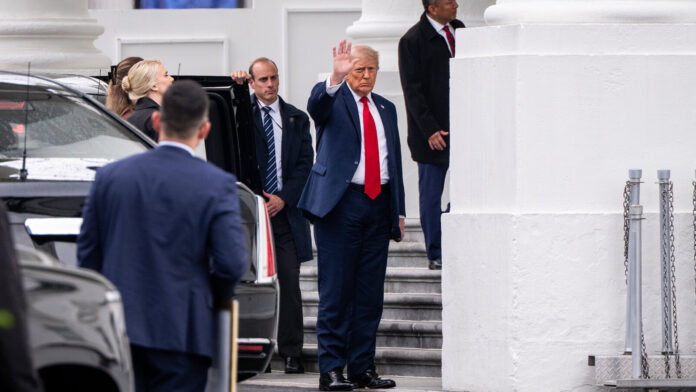
President Donald Trump spent more than three hours at Walter Reed National Military Medical Center on May 26 for what the White House described as a routine preventive medical and dental checkup, declaring afterward on social media that everything had checked out “PERFECTLY.” The visit was Trump’s fourth publicly disclosed medical exam since returning to office in January 2025 and his third in just thirteen months, a frequency that has drawn renewed questions from independent physicians about the president’s health. With Trump turning 80 next month and the White House releasing minimal details about the examination, calls for greater presidential health transparency are intensifying.
Story Highlights
- Trump spent more than three hours at Walter Reed on May 26 for what the White House called a “routine annual dental and medical assessment,” his fourth exam since January 2025
- Trump declared on Truth Social that his checkup showed “Everything checked out PERFECTLY,” but the White House had not released specifics on which doctors he saw or what the results showed
- A Washington Post/ABC/Ipsos poll found 59 percent of respondents say Trump lacks the mental sharpness to lead the country, and 55 percent say he is not in good enough physical health to serve
What Happened
President Donald Trump had another medical exam on May 26, putting his health under renewed public scrutiny as he has worked to dismiss concerns over his age and stamina. The 79-year-old president spent more than three hours at Walter Reed National Military Medical Center for what the White House described as preventive medical and dental checkups. It was Trump’s fourth publicly disclosed medical exam since he returned to office for a second term, and it comes as he tries to project strength ahead of midterm elections that will test his sway with voters.
In a social media post after the visit, Trump said that he had just finished his “6 month physical” and that “Everything checked out PERFECTLY.” The White House had not released specifics on which doctors the president saw or the full scope of testing conducted. The White House said a medical summary from his doctor, Sean Barbabella, was forthcoming, though no detailed report had been published by Sunday.
Following his last publicly disclosed exam, described as a routine follow-up last October, Trump’s physician issued a one-page summary saying the president was in “exceptional health” without divulging many specific results. That October visit involved advanced imaging and laboratory testing, and Trump later revealed he had undergone an MRI scan, though the White House did not immediately disclose that detail or specify which part of the body was examined.
Trump’s cabinet members have weighed in on Trump’s health throughout his second term. During a podcast interview in January, HHS Secretary Robert F. Kennedy Jr. said CMS Administrator Dr. Mehmet Oz reviewed Trump’s medical records and found he has “the highest testosterone level that he’s ever seen for an individual over 70 years old.”
Trump was diagnosed with chronic venous insufficiency in July 2025, a condition that causes visible swelling in his lower legs and ankles. He has also had persistent bruising on his right hand, which his physician has attributed to frequent handshaking and the use of aspirin as a cardiovascular preventive measure.
Why It Matters
Trump turns 80 years old in June and is the oldest person to take the oath of office and the second oldest president in U.S. history after President Joe Biden. His predecessor left office at 82 after withdrawing from the 2024 presidential race specifically because of concerns about his age and mental acuity — a context that makes the public’s scrutiny of Trump’s health both politically charged and broadly relevant to voters.
A Washington Post/ABC News/Ipsos poll released last month found that 59 percent of respondents say Trump doesn’t have the mental sharpness to lead the country, compared to 40 percent who said the president is mentally sharp. In addition, 55 percent of those surveyed said Trump is not in good enough physical health to serve as president.
The combination of a frequency of medical visits that exceeds typical presidential norms, limited disclosure of results, and polls showing majority public skepticism about Trump’s fitness creates a meaningful credibility problem. When the White House characterizes each visit as “routine” while simultaneously declining to release the specifics, it invites precisely the speculation it claims to be dispelling.
Independent health experts have argued that the public has a legitimate interest in comprehensive presidential health disclosures, not because illness is disqualifying, but because voters and government institutions require accurate information about the capacity of the nation’s chief executive to fulfill the demands of the office.
Economic and Global Context
Presidential health and fitness carry direct implications for governance stability, particularly during periods of active foreign policy engagement. Trump is currently managing the Iran conflict, ongoing trade negotiations, and a series of consequential domestic policy battles simultaneously — a workload that demands sustained executive focus and decision-making capacity.
A Reuters/Ipsos poll from February found that a majority of Americans, including 30 percent of Republicans, say Trump has become erratic with age. Erratic decision-making at the executive level introduces uncertainty into markets, alliances, and institutional processes that depend on predictable and coherent presidential engagement. Business leaders and foreign governments calibrate their planning based on assessments of presidential stability.
The health disclosure norms for American presidents have varied significantly, with some administrations releasing detailed records and others providing highly selective summaries. Health expert S. Jay Olshansky of the University of Illinois-Chicago, who has studied the health of past presidents, says the public deserves to see more than White House medical summaries that “may be subject to editorial discretion.” He said full, unredacted medical records should be made public, stating: “Nothing should be hidden.”
Implications
Trump’s medical visits are occurring at a pace and with a level of opacity that is difficult to reconcile with the White House’s “routine annual checkup” narrative. A true annual preventive exam does not require four separate visits in sixteen months, nor does it typically involve advanced imaging and laboratory testing of the kind described in the October memo. Whether or not there is a specific undisclosed health issue, the pattern itself raises legitimate questions.
In the near term, the White House is expected to release a medical summary following the May 26 visit. What that summary includes — and, critically, what it omits — will determine whether the health questions intensify or dissipate. If the summary is as vague as previous iterations, calls for fuller disclosure will grow louder from both medical professionals and political opponents.
For voters assessing Trump ahead of the midterms, the health question operates as a background concern rather than a foregrounded issue. It is unlikely to decide races on its own but functions as a frame through which other concerns about presidential competence and stability are processed. For Republican candidates, any public deterioration in the president’s perceived fitness adds risk to a midterm environment already complicated by the Iran conflict and ongoing economic pressures.