President Donald Trump declared he has held “very good talks” with Iran over the past 24 hours as the two sides edge closer to a framework agreement that could formally end more than two months of direct military conflict, even as the fragile ceasefire faces pressure from renewed strikes in Lebanon and ongoing tensions in the Strait of Hormuz. Iran is expected to deliver its formal response to a 14-point United States peace proposal through Pakistani intermediaries on Thursday, in what officials on both sides have cautiously characterized as a potential breakthrough moment. The stakes for global energy markets, regional stability, and American credibility abroad are enormous.
Story Highlights
- Iran is reviewing a 14-point U.S. peace proposal and expected to respond Thursday through Pakistani mediators
- Trump warned on Truth Social that U.S. bombing would resume “at a much higher level” if Iran rejects the deal
- Stock indices jumped and oil prices fell sharply when reports emerged of progress toward an agreement
What Happened
President Donald Trump took to Truth Social on Wednesday with a message that simultaneously expressed optimism and issued a stark military threat. He said that U.S. military operations, including “Operation Epic Fury,” would come to an end if Iran agreed to the terms that had reportedly been negotiated — but warned that if Iran refused, U.S. bombing would resume at a substantially higher intensity than anything seen during the war’s initial phase.
Iran’s Foreign Ministry spokesman Esmaeil Baqaei confirmed Wednesday that Tehran was actively reviewing the latest U.S. proposal, telling the Iranian Student News Agency that Iran would convey its position to Pakistani intermediaries after finalizing its response. The proposal, described by sources familiar with the negotiations as a one-page memorandum of understanding, would declare an end to the war and trigger a 30-day negotiating period to resolve remaining sticking points — including nuclear enrichment, frozen Iranian financial assets, and security arrangements in the Strait of Hormuz.
Secretary of State Marco Rubio traveled to the Vatican on Thursday to meet with Pope Leo XIV, the American-born pontiff who has publicly opposed the Iran war and who has been in diplomatic tension with the Trump administration over the conflict. The meeting covered the broader Middle East situation, the Iran-Lebanon crisis, and humanitarian concerns in Cuba, according to Vatican press officials.
Pakistan has served as the primary intermediary in negotiations between Washington and Tehran — two nations with no formal diplomatic relations. Pakistani Prime Minister Shehbaz Sharif has publicly expressed gratitude for Trump’s “courageous leadership” in seeking a diplomatic resolution. Iranian Foreign Minister Abbas Araghchi was in Beijing on Wednesday meeting with Chinese Foreign Minister Wang Yi, who emphasized China’s priority of regional stability and the need to keep the Strait of Hormuz open.
Why It Matters
The Iran war, now in its 68th day, has been the most consequential military engagement of Trump’s second term and one of the most significant American military operations in decades. A peace agreement would represent not only the end of active hostilities but also the beginning of a complex negotiation over Iran’s nuclear program — a question that has dominated American foreign policy for more than two decades without resolution.
The nuclear dimension is central to any durable agreement. Trump indicated to PBS News that a deal’s terms would include Iran shipping its stockpile of highly enriched uranium out of the country and pledging not to operate its underground nuclear facilities. Iran shipping that material to the United States, as Trump described, would represent an unprecedented concession from Tehran — one that contributed to the collapse of earlier peace talks when Vice President JD Vance led a negotiating team to Pakistan last month.
The difficulty of bridging that gap is compounded by the internal politics on the Iranian side. Moderate officials appear to be seeking an offramp from the conflict, but hardliners have been growing louder as U.S. military pressure has intensified. The Baqaei spokesman’s statement — insisting that negotiations must be based on “good faith” rather than “deception, extortion or coercion” — reflects the rhetorical posture of a government managing difficult internal divisions while publicly maintaining dignity in the face of military pressure.
Economic and Global Context
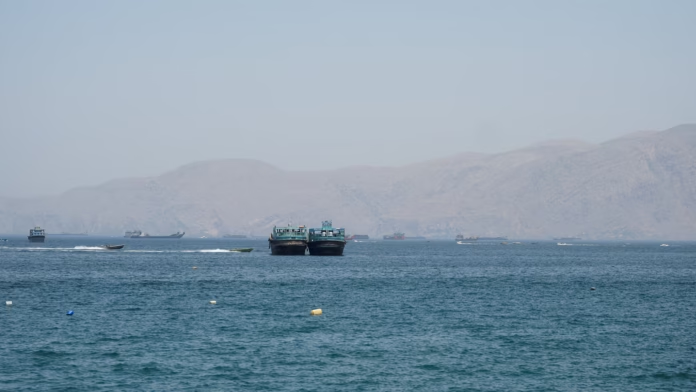
The Strait of Hormuz remains the most economically sensitive flashpoint in the conflict. Roughly 20 percent of global oil supplies transit the strait in normal conditions, making any disruption to its operations a direct shock to energy prices worldwide. Since the war began, the strait has been partially disrupted, with Iran’s Islamic Revolutionary Guard Corps Navy and U.S. forces trading incidents involving commercial shipping, tanker seizures, and small boat engagements.
When Axios reported Wednesday that the U.S. and Iran were close to a one-page agreement, global financial markets responded immediately and sharply: stock indices rose while oil prices fell, reflecting investor relief that the most disruptive energy supply risk in years might be nearing resolution. The speed and scale of that market reaction underscored just how much economic uncertainty the conflict has generated since it began in late February.
Iran’s IRGC Navy stated Wednesday that safe passage through the Strait of Hormuz would be possible under “new procedures” reflecting what it described as a new balance of power in the region. The U.S. military, meanwhile, disabled an Iranian-flagged oil tanker in the Gulf of Oman that had attempted to sail toward an Iranian port in violation of the ongoing U.S. naval blockade.
Implications
For the Trump administration, a successful peace agreement with Iran would be a significant foreign policy achievement — and a badly needed one, given the president’s declining approval ratings and a difficult midterm environment. Successfully ending a war and reopening the Strait of Hormuz would lower oil prices, ease supply chain pressures, and provide a concrete policy success to campaign on heading into November 2026.
For Iran, the calculus is more complex. Accepting a deal that includes shipping highly enriched uranium to the United States would be domestically explosive, requiring the government to manage hardline opposition within its own political system. The new Supreme Leader Mojtaba Khamenei, who took power after his father was killed in a joint U.S.-Israeli airstrike in February, will be central to whether any agreement holds.
For the broader Middle East, the fragile Lebanon ceasefire remains a serious complication. Iran has consistently refused to agree to any wider peace deal that does not include a halt to Israeli military operations in Lebanon. Israel carried out its first strike on Beirut since the ceasefire took effect on Wednesday, straining the agreement precisely as Iranian-U.S. talks reached their most sensitive juncture. Whether the United States can coordinate Israeli restraint while simultaneously securing an Iranian signature on a peace framework remains the defining diplomatic challenge of the coming days.
Sources
US and Iran closing in on agreement aimed at ending war, source says