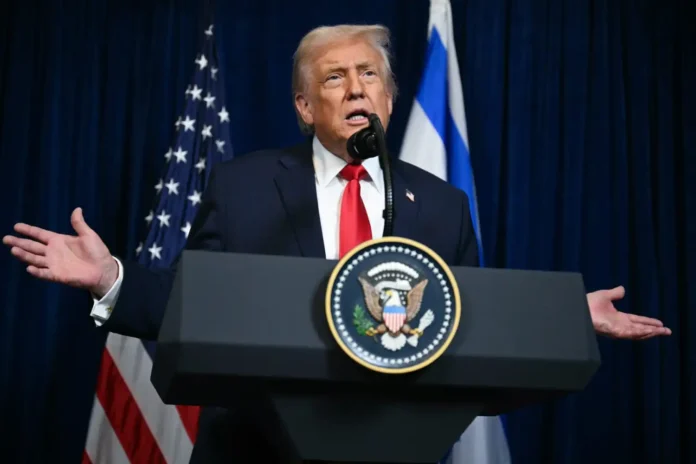
President Donald Trump’s decisive victories in Indiana’s Republican state Senate primaries have reaffirmed his dominance over the GOP’s internal machinery, but political analysts warn the wins may be deepening the party’s vulnerabilities heading into the November 2026 midterm elections. Trump’s ability to end the careers of Republican legislators who defy him has never been clearer — yet his approval rating, which has sunk into the mid-30s nationally, is producing a midterm landscape that looks increasingly ominous for the party as a whole. The tension between Trump’s iron grip on the primary electorate and his weakened standing with the broader public is the defining fault line of the 2026 political moment.
Story Highlights
- Trump’s national approval rating has dropped into the mid-30s, with independent voter support significantly eroded
- Republican-dominated states including Florida, Louisiana, Alabama, South Carolina, and Tennessee are pursuing redistricting in coordination with Trump’s political goals
- The next major test of Trump’s grip on Congress comes May 19, when Representative Thomas Massie faces a Trump-endorsed challenger in Kentucky
What Happened
With Tuesday’s Indiana primary results barely settled, attention has turned quickly to what those results mean for the Republican Party’s prospects in November. President Donald Trump demonstrated that his base — the deeply conservative voters who decide Republican primary contests — remains intensely loyal to him. But that loyalty has not extended to the broader electorate, where his approval rating has dropped dramatically and independent voters have moved away in significant numbers.
Senator Lindsey Graham of South Carolina, who has long tracked the tensions within the Trump-era GOP with unusual candor, once described Trump as capable of making the Republican Party both greater and more destructive. That warning resonates now with particular force. Tuesday’s Indiana results gave Trump another tool for enforcing loyalty, but the effect is to produce a party that is increasingly shaped in Trump’s image at precisely the moment when his image is a political liability with the voters who decide general elections.
The mechanics of the situation are stark. In a normal midterm year, a president with an approval rating in the mid-30s would see his party scrambling to create distance. Instead, Republicans are doing the opposite — embracing Trump’s priorities, including an unpopular ballroom project, an ongoing Iran war, and aggressive redistricting — because they have calculated that the risks of defying him in a primary outweigh the risks of losing in a general election.
James Blair, Trump’s top political adviser, captured the operative logic after Tuesday’s results: legislators who want to survive must vote with the party. That framing defines the 2026 primary season, with more tests ahead in Kentucky, and potentially beyond.
Why It Matters
The broader political significance lies in what historically happens when a party sacrifices electoral flexibility in exchange for internal discipline. The Republican Party is choosing, under pressure from Trump, to suppress dissent at a moment when dissent might actually serve the party’s long-term survival. The suppression is effective in primaries but may prove counterproductive in November.
Historical precedent offers a cautionary note. In 2006, President George W. Bush’s approval ratings had fallen sharply and Republicans attempted to create distance, with Bush and Vice President Dick Cheney ultimately absent from the Republican National Convention in 2008. Even those distancing efforts failed to prevent significant Democratic gains. Republicans today are not merely failing to distance themselves from Trump — they are actively binding themselves more tightly to his agenda.
The redistricting efforts playing out across multiple states add a structural dimension to this dynamic. Republicans believe they can partially offset voter dissatisfaction by engineering more favorable congressional maps, and Tuesday’s Indiana results suggest they have the legislative votes to do so. But gerrymandering has limits. If a blue wave materializes as some analysts now project as “increasingly likely,” redrawn maps may produce marginal gains rather than genuine protection.
Economic and Global Context
The political dynamics playing out in Indiana and nationally are inseparable from the economic environment that is shaping voter sentiment. Trump’s tariff policy, his largest domestic economic intervention, has produced costs that economists broadly estimate at around $1,500 per household in 2026 — an imposition that is visible in consumer prices even if its attribution is disputed in political advertising.
Simultaneously, the ongoing war with Iran has created uncertainty in energy markets and in the Strait of Hormuz, one of the world’s most critical shipping lanes. Disruptions to that passageway have direct implications for oil prices, global supply chains, and U.S. gasoline costs. Both the tariff burden and energy market uncertainty are feeding into a cost-of-living environment that voters consistently rank among their top concerns.
Within this economic context, Trump’s insistence on pursuing the White House ballroom project — and on redistricting fights in Indiana and other states — has struck many observers as a misalignment of political priorities with public concerns. Polling has consistently shown voters more focused on housing costs, grocery prices, and healthcare than on congressional map redrawing or presidential building projects.
Implications
For Republican strategists, the challenge is acute and worsening. The party is winning the internal battles — keeping legislators in line, advancing redistricting, building a unified legislative front — while potentially losing the broader war for the general electorate. The Kentucky race on May 19 will be the next data point: if Trump’s operation can defeat Representative Thomas Massie, a well-known dissenter with a strong personal following, it will confirm that no Republican is safe from the primary threat.
For Democratic strategists, the environment is improving but not guaranteed. A blue wave requires not just an unpopular president but a competitive candidate environment and strong turnout infrastructure. Democrats will need to translate voter dissatisfaction — on costs, on the Iran war, on the ballroom controversy — into concrete electoral gains in competitive districts.
For the country as a whole, the deepening nationalization of all Republican politics has implications for governance at every level. When state senators in Indiana are removed for following their constituents’ wishes on redistricting, and when multi-million dollar national advertising campaigns flood state legislative primaries, the feedback mechanism between local voters and their local representatives is weakened in ways that may be difficult to reverse.